CIH Exam Journal — My CIH Exam Journey
A real CIH exam journal documenting my CIH exam preparation for the Certified Industrial Hygienist (CIH) designation — from first read-through to exam day and beyond. I'll record what I learned, what surprised me, and eventually, the practice questions I build from it.
I don't recommend covering everything or over-studying. The SPEP exam bank and prep strategy were built after I sat the CRSP and CRST exams — I looked back at what I experienced, mapped the exam profile, and turned that into a guide so followers can study what actually matters instead of trying to cover it all. The whole premise is that I've already been in the room.
For CIH, that's not the case yet. I haven't sat this exam, so there's no post-exam profile to summarize from — and I couldn't find a third-party practice bank I trusted either. Considering work, family, and social life, I don't want to spend more time than necessary trying to cover everything blind. So my plan is the Scouting Strategy ↓
Once I've taken the exam, I'll do exactly what I did for CRSP and CRST — build a CIH exam bank and study guide based on what I observed, so future candidates have the same edge: a clear picture of the exam profile, what to focus on, and what they can safely skip.

As an Amazon Associate, SPEP earns from qualifying purchases.
The Scouting Strategy
The standard approach to certification is to over-prepare everything and hope it's enough. I know that method works — I used it for CRSP and CRST. But it's not the only way, and it's not always realistic. Between work, family, and everything else, most candidates can't afford six months of deep-reading every chapter of every reference. The scouting strategy is designed for people who have limited time and want to spend it on what actually matters.
The approach runs in four phases:
- Phase 1 — Read & Map. Do a structured read-through of the core materials — not to memorize, but to build a mental map of what's covered. You're learning the shape of the subject: the major knowledge units, the key formulas, the concepts that keep coming up. No deep drilling yet. The goal is familiarity, not mastery.
- Phase 2 — Scouting Attempt. Sit the exam. Not expecting to pass — expecting to observe. Which knowledge units actually showed up? How were questions framed — straight recall, formula-based, or scenario judgment? How many were genuinely hard vs. just unfamiliar? The real exam is the best study guide you'll ever have, and you only get this intelligence by sitting in the room.
- Phase 3 — Targeted Study. Now you know exactly where to invest. Go back and drill only the knowledge units that were heavily tested. Build practice questions around the specific question styles you encountered. No more guessing which chapters matter — you have real data. This phase is shorter, sharper, and far more effective than the first round.
- Phase 4 — Pass. Sit the exam a second time, now armed with both a solid foundation and precise intelligence about what gets tested. The expectation is to pass comfortably — not squeak through. Two attempts, but the total study time is probably less than one brute-force attempt would have taken.
This journal documents every phase in real time. If the strategy works as expected, I'll eventually turn the scouting notes and targeted study materials into a full CIH question bank — the same way CRSP and CRST were built here.
As an Amazon Associate, SPEP earns from qualifying purchases.
Study Journal
Weekly entries — most recent at the top. I update this as I go.
Starting the CIH Journey — Eligibility & Application
The CIH (Certified Industrial Hygienist) credential is administered by BGC (Board for Global EHS Credentialing) — previously known as ABIH. The main landing page is gobgc.org/cih. This is the gold standard designation for industrial hygiene practice in North America, and it's the natural next step after CRSP given how much the two credentials overlap on the technical side.
Before anything else, I had to confirm I actually met the eligibility requirements. BGC is fairly detailed about what counts, so here's how my profile lined up (I've since written up the full checklist — every requirement, in detail — as its own CIH Exam Eligibility reference):
Education. I hold a Bachelor's degree in Occupational Health and Safety, and my university is on BGC's list of recognized programs. That covered both the academic foundation and the IH coursework requirements in one shot. If your post-secondary background isn't health- or hygiene-related, you'll need to complete additional coursework and submit your transcripts directly to the Board. The specific academic thresholds BGC checks against are:
- Total IH Hours: 180 academic contact hours (or 240 continuing education hours) in industrial hygiene subjects
- Broad-Scope IH: At least 90 of those hours must cover the four core areas — Fundamentals of IH/OEHS, Toxicology, Measurements, and Controls
- Total STEM: 60 semester hours in science, math, engineering, or science-based technology from an accredited degree program
- Upper STEM: At least 15 of those 60 hours at junior, senior, or graduate level
- Ethics: Minimum 2 contact hours of ethics coursework (separate from IH hours)
Work experience. BGC requires 48 months (4 years) of professional-level industrial hygiene experience. This is important phrasing — it's not asking for hands-on technical sampling work specifically. My 4 years of IH experience is at a high level: project management, professional program development, and occupational health strategy. BGC recognizes that IH practice includes professional judgment, program oversight, and organizational work — not only laboratory or field measurement. I also have 10 years of broader OHS experience, which provided the professional context. The key is that your experience must be documented and current — at least one of your references needs to be a current CIH.
Reference letters. BGC requires a minimum of two professional references. At least one must attest to the dates and quality of your IH practice, and at least one must come from a current CIH. I had my direct manager — who holds the CIH — write my reference letter. That covered both requirements at once.
Application process. Once you've confirmed eligibility, you submit your application and pay the $160 non-refundable application fee. BGC typically takes 2–4 weeks to verify eligibility. If approved, you're granted a 2-year eligibility window covering 4 consecutive exam windows — Spring (April 1–May 31) and Fall (October 1–November 30). Application deadlines are February 1 for Spring and August 1 for Fall. That's enough room for 3–4 attempts if you need them, though the plan is not to need all of them.
With eligibility confirmed and the window open, the next step is the actual preparation — which is where this journal begins.
Ch.1–2 Map: IH History, Ethics & Exposure Limits
Started mapping Industrial Hygiene Reference & Study Guide, 4th Edition — chapters 1 and 2. Covers IH history, professional ethics, hierarchy of controls, and how exposure limits are set across OSHA, ACGIH, and NIOSH. A lot of overlap with CRSP content but goes deeper on the regulatory framework and the science behind how limits are derived. Good orientation chapter — not memorization yet, just getting the lay of the land.
Also did a quick skin-read of the table of contents for the other two books — just a high-level comparison, not deep reading. All three are structured completely differently so it's hard to compare directly. From what I can see: the CIH Exam Study Guide Ch.4 covers chemical exposure assessment — sampling strategy, OELs, gas laws, and calculation-heavy content like TWA and unit conversions. The CIH Exam Essentials community exposure chapter is more environmental science — air pollution control, environmental regulations, population-level toxicology. Will compare more closely as I get deeper into each.
Ch.3: Airborne Contaminants — Particulates, Gases & Vapors
Industrial Hygiene Reference & Study Guide, 4th Edition — Chapter 3 is where the content starts feeling more specific to IH. This chapter is all about airborne contaminants — particulates, gases, and vapors — and how they behave once they're in the air. What I found interesting is how much aerodynamic diameter matters: it's not just about particle size, it's about where in the lung a particle actually lands, which determines the health risk — whether that's pneumoconiosis, cancer, or something else. That connection between physics and health outcome isn't something I thought about much on the CRSP side.
The measurement side covers the tools — filters, cyclones, direct-reading instruments like nephelometers — and I can already see this chapter is going to require some calculation practice. Gas laws come back here again for concentration and vapor pressure calculations, and the TWA formula shows up alongside dilution ventilation modelling. The math isn't complicated in isolation, but under exam conditions with unit conversions on top, it needs to be automatic.
Ch.4: Toxicology — Back from Holiday, Into the Deep End
Took three weeks off from July 2–21 — first real break in a while, and I mostly stayed away from the books on purpose. Came back to it after and, honestly, it showed. Chapters 1 through 3 felt half-erased, especially the gas law and unit conversion pieces from Ch.3 that I'd said needed to be "automatic." So before touching anything new, I did a fast refresher pass — ethics and exposure limits from Ch.1-2, then the airborne contaminants and aerodynamic diameter concepts from Ch.3 — just enough to reload the mental map before moving forward.
Then into Chapter 4 — Toxicology, and this one is a different animal. Ch.3 was mostly physics logic you could reason through; Ch.4 is dense, factual, and long. It opens clean enough — Paracelsus's "dose makes the poison," the dose-response curve, LD50/ED50, NOEL/LOAEL — and the routes of entry section (inhalation, dermal, GI) connects nicely back to the lung anatomy from Ch.3. The combined-exposure concepts were the most interesting part: additive vs. synergistic vs. potentiating effects, with smoking + asbestos as the textbook synergistic example. That's a real "aha" connection to occupational cancer risk that CRSP never went into this deep.
Past that point, though, it turns into a long catalog — lead, mercury, cadmium, arsenic, nickel, chromium, beryllium, solvents, organophosphates, asphyxiants (CO, HCN, H2S), sensitizers, BEI one-liners for each substance. There's no way to reason your way through this part — it's memorization, chemical by chemical, exposure route by exposure route. This is easily the heaviest chapter so far, and I expect it'll take more than one pass to stick.
I summarized the common industrial substances from this chapter — the associated disease and the main industry for each — into a quick reference table. Posted it here: Industrial Toxicology Reference.
Companion article: Toxicology Basics: How Exposure Becomes Harm — the theory behind these terms (routes, ADME, dose-response, mechanisms, sensitization, interactions, limit labels), written to be read before the table.
Separately — got word from the Board that the Oct–Nov exam window is now open. Registration deadline is in November, so technically you can still register after the window has already started, which is a bit of breathing room I wasn't expecting. The exam fee is $370 USD, which is steep — that's on top of the $160 application fee from earlier. Worth keeping in mind as I think about timing the scouting attempt.
Exam Officially Scheduled — Plus Ch.5: Radiation
This week's big news: the exam is officially scheduled. Got the Authorization to Test (ATT) email from Pearson VUE — the official notice confirming BGC has cleared me to schedule, along with my Candidate ID, Client Authorization ID, and the exam window dates. The email includes a scheduling link that takes you to Pearson's test-taker portal, where you pick your certifying body from the list of organizations Pearson coordinates for — Board For Global EHS Credentialing® (BGC®) in this case.
From there you create a scheduling account using the Candidate ID from the ATT email. Since BGC has already sent your authorization over, the system recognizes it immediately and takes you straight to exam registration. Registration itself is just two decisions: test center location and appointment time. I picked the same test center I used for CRSP — no reason to introduce a new variable when the current one worked fine. Once you submit, Pearson sends a "Confirmation of Your Scheduled Exam" email with the date, time, and location locked in. That's it — nothing left to do administratively until exam day itself.
Also this week — worked through the Radiation chapter, which splits cleanly into nonionizing and ionizing radiation, and the split matters because the hazards, the physics, and the controls are genuinely different between the two.
Nonionizing radiation (UV, visible light, infrared, microwave, RF, and lasers) doesn't carry enough energy to strip electrons from atoms — instead of ionizing tissue, it mostly heats it. That distinction is the whole reason UV and laser hazards get evaluated so differently from gamma or X-ray exposure. Lasers got their own sub-section — classifications and the reflection/eyewear-selection logic, since laser hazard assessment is basically its own specialty within this chapter.
Ionizing radiation splits further into electromagnetic (gamma rays, X-rays) and particulate (alpha, beta, neutrons) — and this is where the actual dosimetry math lives: activity in curies/becquerels, exposure in roentgens, dose in rad/gray, dose equivalent in rem/sievert. The control hierarchy is the same core logic as every other IH exposure — time, distance (inverse square law), shielding — but the shielding material choice (lead, concrete, or paper depending on radiation type) and the detection instruments (Geiger-Müller, scintillation, TLDs) are specific to this chapter. Mapped the whole structure out below — these are the main areas I focused on, same approach as the toxicology summary.
One more thing from this week — realized BGC actually publishes an equation sheet listing every formula expected on the CIH exam. That sounds like a gift, but the sheet only gives you the equations themselves — it doesn't explain what each one is actually used for or what every letter in it stands for. You're expected to already know that going in. So I went through the whole list category by category and built out what each equation means: what it's for, and a plain definition for every variable. Posted the complete breakdown here: CIH Exam Equations reference.
Radiation Units — Why They Felt So Confusing
Spent more time this week sitting with the radiation chapter's units, and I'll be honest — on first pass they felt like a wall of near-random abbreviations. Curie, Becquerel, Roentgen, rad, Gray, rem, Sievert. After a deeper look, two things clicked. First, the units are mixed between imperial (Curie, rad, rem) and SI/metric (Becquerel, Gray, Sievert), which is exactly why it feels like there are twice as many units as there should be. Second, and more useful, they're not four unrelated facts — they form a chain conversion process, each unit describing radiation at a different stage as it moves from the source, through the air, into a material, and finally to its biological effect on a person. Once I mapped it that way, it stopped being memorization and started being logic.
Wrote the whole thing up as its own reference page, with the imperial-to-SI conversion table and the "why" behind each conversion: CIH Radiation Units reference.
Ch.6: Ventilation — Airflow, Pressure & a Complicated, Calculation-Heavy Chapter
Worked through the ventilation chapter this stretch, and it splits into a few clean layers. First is the fundamentals — why ventilation exists in the first place (temperature/humidity comfort, odor control, and the one that actually matters for IH: contaminant control), the three system types (general/dilution for lower-toxicity comfort control, local exhaust for capturing highly toxic substances right at the source, and make-up air to replace what's exhausted), and the baseline air properties — standard density, gas composition, standard conditions — that every calculation in this chapter builds from.
From there it moves into the physics: static, velocity, and total pressure and how they trade off in a duct; the core airflow relationships between velocity, volume, and area; and the gas-law corrections needed when you're not at standard temperature or pressure. Then system design — hood types and capture velocity, duct losses and transport velocity, and fan categories with the fan laws relating RPM to flow, pressure, and power. It closes with particle settling behavior, a couple of standard rules of thumb (the six-and-three duct rule, relevant ASHRAE standards), and Reynolds number for laminar vs. turbulent flow.
This is the most complicated, calculation-heavy chapter in the whole exam. In the equation bank, I've already split this chapter into two sections: Ventilation — pressure & velocity relationships (static, velocity, total pressure, duct losses), the concentration/dilution formulas (air changes per hour, buildup, steady state), and the fan laws — and Hood Airflow — the hood/duct-shape equations relating capture velocity to distance from the source (slot, flanged, booth, canopy, and the rest of Table 6-2). Full formulas, notation, and plain-language explanations for each: CIH Exam Equations — Ventilation. Reading the formula is the easy part — the real test is having the notation memorized cold and knowing which equation applies to which hood/duct situation on sight, which is exactly what I built the CIH Equation Master to drill.
One thing that clicked while pulling apart a few real professional IAQ assessment reports this week: two ASHRAE standards keep showing up side by side, and they're doing two different jobs. ASHRAE 62.1 (Ventilation for Acceptable Indoor Air Quality) is the actual ventilation-rate standard — it sets minimum outdoor-air requirements and is the reference behind the dilution/ACH calculations this chapter is built on. ASHRAE 55 (Thermal Environmental Conditions for Human Occupancy) is a separate standard entirely — it governs workplace thermal comfort, defining acceptable operative-temperature and relative-humidity ranges (via the PMV/PPD comfort model) rather than contaminant dilution. Every real IAQ report I looked at cited both together, and once you see why it makes sense: 62.1 tells you how much outdoor air a space needs for air quality, 55 tells you what temperature and RH that air needs to land at for occupant comfort. Same ventilation system, two different design targets.
The other piece that ties directly back to this chapter's ventilation/capture design is particle size — because the size of a particle decides how far into the respiratory tract it actually gets, which is exactly what the exposure limit for that substance is built around. The three size-selective fractions, biggest cut point to smallest: Inhalable (IPM) — particles up to roughly 100 µm, the fraction that can enter the nose and mouth at all. These deposit anywhere in the head airways — nose, mouth, throat — and matter most for substances that act right there (irritants, nuisance dusts) or that are toxic once swallowed via mucociliary clearance. Thoracic (TPM) — roughly a 10 µm cut point, small enough to get past the larynx into the lung's conducting airways (trachea, bronchi, bronchioles). This is the fraction that matters for substances that act on the airways themselves, e.g. asthma- and bronchitis-type responses. Respirable (RPM) — roughly a 4 µm cut point (4.25 µm in the ACGIH/ISO/CEN convention), small enough to reach all the way into the alveoli, the deep gas-exchange region of the lung. This is the fraction behind the classic pneumoconiosis-causing dusts — silica, asbestos, coal — where the damage is permanent scarring deep in lung tissue, not just an airway irritation. Bigger particle, shallower deposit, more localized effect; smaller particle, deeper deposit, harder to clear and more serious long-term effect — that ordering is the whole logic of the fractions.
Last thing from this chapter — before the equations and the ASHRAE standards made sense, I had to actually understand how an HVAC system moves air in the first place: outdoor air in, mixed with return air, heated or cooled, pushed out through supply ducts to the room, collected back through return grilles, with some of it exhausted and replaced by make-up air. That whole loop, plus the full OA/RA/MA/SA/EA/MUA/AHU terminology, is written up here: HVAC Air Cycle: Complete Airflow Reference.
Ch.7: Noise & Vibration — From Sound Pressure to Hearing Loss
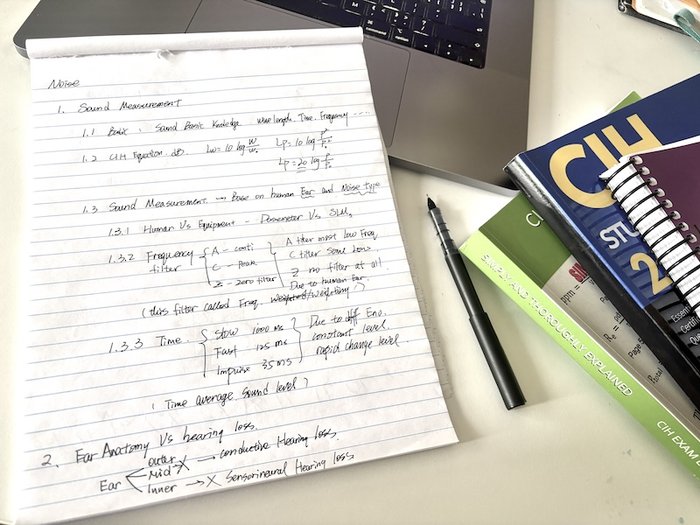
Sound is pressure oscillations in a medium — a neutral physical phenomenon. Noise is specifically unwanted sound: it causes hearing loss, interferes with communication, and causes annoyance.
- Wave types: Transverse (molecules move perpendicular to travel direction) vs. Longitudinal (molecules move parallel — how sound actually propagates through air).
- Core relationship: c = λf, with period t = 1/f.
- Speed by medium (denser = faster): air 332 m/s < water 1,433 m/s < wood 3,962 m/s.
- Acoustic range: 0.00002 Pa (0 dB, threshold of hearing) up to 194 dB — the ceiling set by atmospheric pressure itself (100,000 Pa), the point a sound wave becomes a shock wave.
Correction to my own notes: I'd written the threshold of pain as 300 Pa at 140 dB — that pairing doesn't check out (300 Pa is actually ≈143.5 dB). The pressure consistent with 140 dB is 200 Pa.
Two decibel formulas that look different but aren't inconsistent:
- Sound Power: Lw = 10log(W/W₀)
- Sound Pressure: Lp = 20log(p/p₀) — the 20 (not 10) is because intensity is proportional to pressure squared, and squaring inside a log pulls out as ×2.
Instruments: a dosimeter is worn and integrates a full shift's exposure; a sound level meter (SLM) takes a point-in-time reading.
Ear anatomy maps directly onto hearing loss type — the exam tests this as one connected idea:
- Outer + Middle ear (pinna, canal, eardrum, ossicles — which amplify pressure ≈25× via impedance matching) → Conductive loss: the mechanical path is blocked or damaged.
- Inner ear (cochlea, Organ of Corti, hair cells) → Sensorineural loss: the path works fine, sensory transduction doesn't. (Mixed, CNS, and psychogenic categories exist too.)
How permanent the damage is:
- TTS (temporary) — hair cells fatigued, reversible within ≈16 hours.
- PTS (permanent) — hair cells have died.
- STS — OSHA's regulatory trigger: an average 10 dB+ shift at 2000/3000/4000 Hz in either ear.
NIHL peaks in the 3,000–6,000 Hz range — the same band human hearing is most sensitive to (peak ≈4,000 Hz), which isn't a coincidence. Ototoxicants (certain solvents, nitriles, metals) are this chapter's version of Ch.4's combined-exposure logic: they damage hearing on their own, or make noise exposure worse than the dB level alone predicts.
The inverse square law shows up again — same logic as radiation and ventilation: doubling distance from a point source drops SPL by 6 dB. Directivity (Q) accounts for reflective surfaces, from Q=1 (free space) to Q=8 (room corner). SLM grades: Type 0 (lab standard) through Type 2 (general purpose).
Weighting networks:
- A-weighting — attenuates low frequencies to mimic the ear's response curve; the standard TTS-risk predictor.
- C-weighting — close to flat; used for peak/impact noise.
- Z-weighting — genuinely unweighted, flat 10 Hz–20 kHz; for detailed frequency analysis, not exposure assessment. (Flagged in my own notes, not in the typed outline.)
Time response: Slow (1,000 ms), Fast (125 ms), Impulse (35 ms rise) — verified against IEC 61672. Dosimeter settings, OSHA vs. ACGIH: Criterion Level 90 vs. 85 dBA; Exchange Rate 5 vs. 3 dB — the same "which body says what" pattern that keeps showing up. This isn't just theory, either — I wrote up a real dosimeter setup (the 3M/Quest Edge 5 I actually use) with these exact settings, including a real configuration mistake sitting in the ACGIH meter: Noise Dosimeter Setup: OSHA HC, OSHA PEL & ACGIH TLV.
Hierarchy of controls, noise-specific:
- Engineering — substitute quieter equipment, add barriers/enclosures, change mounting or speed.
- Administrative — rotate workers, schedule loud work for fewer people or shorter shifts.
- PPE — earplugs, earmuffs. Last line of defense, not the first.
A case I keep turning over rather than have a clean answer for: a designated quiet room — engineering or administrative? A purpose-built, physically isolated booth reads as engineering (a structural modification). An existing quiet office just designated as a break area, with nothing physically changed, reads as administrative (a work-practice decision). Same outcome, different classification depending on what was actually done.
Materials: porous (converts high-frequency energy to heat), diaphragmatic (absorbs low frequencies), resonant — vs. hard barrier materials (concrete reflects ≈99% of sound). TL vs. NR: NR = TL − 10log(S/a); enclosing a source increases internal reverberation, so TL is never actually equal to NR. HCP's 5 pillars: exposure evaluation, engineering control, hearing protection, training, audiometric testing.
- Hand-arm vibration (power tools, grinders) → Raynaud's Phenomenon / Hand-Arm Vibration Syndrome.
- Whole-body vibration (vehicles, heavy equipment) → motion sickness, fatigue, lower-back pain, lumbar disc herniation.
Resonance: motion amplifies when forcing frequency matches natural frequency. Whole-body resonates around 4–5 Hz; hand-arm at 150–300 Hz. Isolation requires the transmissibility ratio <1, which needs f/fn > 2 — below that, isolation can actually amplify vibration instead of damping it.
Accelerometers (usually piezoelectric): must be rigidly mounted along the actual vibration axis, and their own mass shouldn't exceed ≈1/10 of the equipment's mass, or they start measurably altering what they're measuring.
Sound Pressure Level, Lp = 20log₁₀(P/P₀), is the one that shows up constantly.
Example: An industrial hygienist measures a high-pressure air leak. RMS sound pressure (P) reads 0.632 Pa; P₀ = 0.00002 Pa. Lp = 20log₁₀(0.632/0.00002) ≈ 90.0 dB.
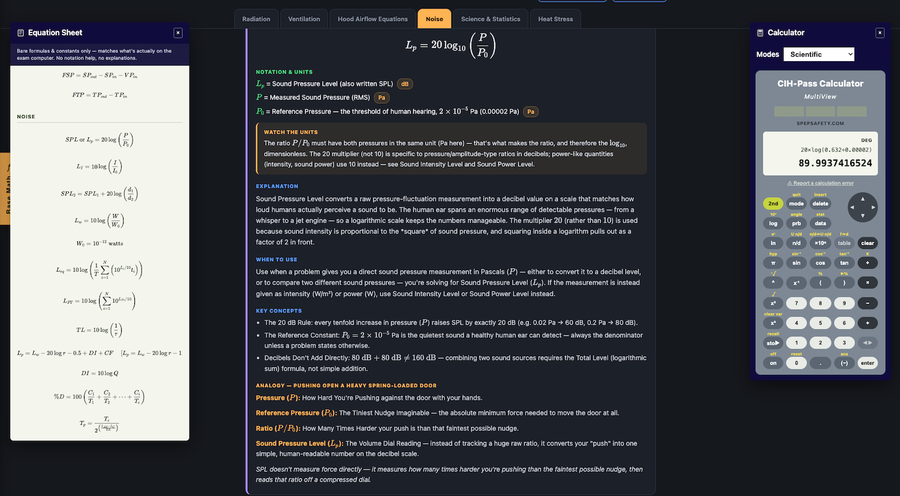
Not the only noise equation on the exam, either — Dose Percentage (%D = 100×(C₁/T₁ + C₂/T₂ + …)) is the other high-yield one, the basis for every OSHA/ACGIH dose and TWA calculation once a worker moves through more than one noise level in a shift. Full formulas: CIH Exam Equations — Noise. As always, the CIH Equation Master is where it actually gets memorized.
Ch.7.1: Frequency Weighting — Why It Always Confused Me
A/C/Z frequency weighting is one of those things I could recite the definitions of — A mimics the ear, C is nearly flat, Z is unweighted — but the first time I actually had to apply one to a real noise measurement, I froze. Which one do you even use, and does it matter which order you weight versus combine multiple sources? So I took a weekend and actually worked through it properly, rather than just re-reading the definitions again.
The thing that made it click wasn't more reading — it was building a real scenario and forcing myself to solve it end to end. I designed a case with three machines around one operator, each at a different frequency and distance, and made myself run the full chain: correct each reading for distance first, then weight it (A and C, side by side, so the difference between filters is actually visible instead of assumed), combine everything with Total Level, and only then turn it into an actual OSHA-vs-ACGIH dose comparison. That last part surprised me too — the combined level came out above 85 dBA, but the real time-weighted dose was still under 100% for both standards. Worth sitting with why that isn't a contradiction.
Wrote the whole thing up, table, chart, and all: How to Apply A-Weighting: Octave-Band Table & Real Dose Examples. It also pulls in Sound Pressure and Distance, Total Level, Permissible Time, and Dose Percentage along the way, so it doubles as practice for those too. See if you can solve it before you check the steps.
Ch.7.2: Ear Anatomy — The Physical Half of Every Noise Formula
Every formula in the Noise chapter assumes you already know why they're shaped the way they are — why Sound Pressure Level uses 20log but Sound Intensity Level and Sound Power Level use 10log, why the exchange rate matters, why a "criterion level" exists at all. None of that actually clicks until you go back one step further, to the anatomy the formulas are describing in the first place.
So before going further into the calculation side, I stopped and mapped the anatomy properly — outer ear, middle ear, inner ear — and forced myself to connect each region to the specific IH concept it drives, instead of memorizing them as separate facts. Ototoxicants only cause sensorineural loss because they act on inner-ear hair cells directly, never the outer/middle ear. The acoustic reflex can't protect against impulse noise because of a real anatomical latency, not just a rule to memorize. Acoustic trauma and occupational NIHL produce genuinely different injuries because they damage different regions on a different timescale. Once the anatomy is the anchor, the IH rules stop being arbitrary.
Wrote it up as a full reference: Ear Anatomy & Industrial Hygiene: A Field Reference — the labeled anatomy diagram, a region-by-region table, and five anatomy-to-IH connections (ototoxicants, the acoustic reflex, audiometric testing frequencies, acoustic trauma vs. NIHL, and conductive hearing loss).
The rest of Ch.7 — the hearing conservation program, noise control and NRR math, and vibration — is collected in one place: CIH Noise Control and Vibration.
Particulate Size & Sampling — From the Chart to the Filter
Started this one from two separate reference tables — particulate categories by generation mechanism, and the inhalable/thoracic/respirable size-selective fractions — and kept trying to hold both in my head at once. They're really the same axis (particle size) described from two different directions, so I put them on one log-scale chart instead of two disconnected tables. Fumes and smokes sit almost entirely under the respirable line; dusts and bioaerosols straddle all three fractions, which is exactly why the same dust cloud can be a minor nuisance or a fatal exposure depending on which slice of its mass you're actually measuring.
Before writing any of the sampling-media detail up, I checked every device and flow rate against primary sources rather than trusting the first thing I'd written down — and caught a real error doing it: I had the Button Aerosol Sampler running at the same 2.0 L/min as the IOM sampler. It's actually 4 L/min, a different design flow for the same inhalable convention. Small thing, but exactly the kind of number that's easy to memorize wrong and never notice.
Closed it out with three sample trains — asbestos (fiber, counted by shape under NIOSH 7400, not by aerodynamic size at all), respirable crystalline silica (cyclone-selected, gravimetric + XRD), and VOCs as the deliberate contrast case, since a gas has no particle size and needs a completely different train (sorbent tube, no filter, no size-selective inlet at all). Then generalized those three into the actual equations behind them — deriving a flow rate from a velocity pressure or a hood static pressure reading when a rotameter isn't available, and the Fick's-Law uptake rate that governs passive diffusive sampling instead.
Full writeup: Particulate Size & Sampling: A Field Reference — the chart, both media tables, all three sample trains, and the three equation groups behind them.
Ch.8: Community Exposure — Why the Order Matters
Every chapter so far has been workplace-side industrial hygiene — Ch.7's equations were all about a worker breathing contaminated air on shift. Ch.8 is a real pivot: Community Exposure, stepping outside the fenceline into ambient environmental science. The first assumption that stops carrying over is duration and population. A TLV assumes a working adult, 8 hours a day, 5 days a week. Ambient air standards assume the general public — kids, the elderly, people with existing conditions — breathing continuously, all 168 hours a week. That's the whole reason ambient limits read so much stricter than occupational ones for the exact same chemical. It isn't a "stricter" standard so much as a completely different question being asked.
What actually made this chapter click wasn't the individual topics — it's that they aren't six separate things, they're one causal chain. You start with environmental science as the foundation: what's actually in clean air (mostly N2 and O2, with argon and trace gases filling the rest), where pollutants come from, and how the atmosphere moves them once they're released. Sources split into natural vs. anthropogenic (human activity dominates in industrialized settings, though the exact split is pollutant-specific — global sulfur emissions run roughly 75% anthropogenic, nitrogen oxides closer to an even split, so I stopped trying to memorize one blanket percentage for "pollution" as a whole) and primary vs. secondary (a primary pollutant comes straight out of a tailpipe or stack; a secondary pollutant like photochemical smog or acid rain doesn't exist at the source at all — it forms afterward in the atmosphere, which is exactly why you can't scrub a reaction happening ten miles downwind). Mobile sources turned out to be a genuinely outsized piece of this — EPA attributes more than half of US air pollution overall to transportation, and over 90% of carbon monoxide specifically, since incomplete combustion in an engine is close to the textbook definition of how CO forms. Then meteorology — lapse rates, stability, inversions, and the five plume shapes (looping, coning, fanning, fumigating, lofting) — explains how the exact same source can disperse harmlessly or get trapped at ground level depending only on what the atmosphere is doing that day.
None of that is useful on its own until you see what it unlocks: knowing the pollutant's source and behavior is what lets you pick the right dispersion model to predict or explain a concentration, and knowing its physical and chemical properties is what lets you design the right sampling method to actually measure it — isokinetic sampling only matters because a mismatched probe velocity literally biases which particle sizes a stack sample collects. Model and sample together are how you find out what you're actually dealing with.
Only once you know that can the last two pieces make sense. Engineering control selection is really particle-size selection in disguise — cyclones for coarse particulate, baghouses and electrostatic precipitators for fine, adsorption vs. absorption depending on whether the contaminant sticks to a solid or dissolves into a liquid — and none of that can be chosen correctly without the sampling data that came before it. Emergency response is the parallel branch for when routine control isn't the situation anymore: TLVs and PELs only ever covered predictable, repeated exposure, so an actual community-facing release needs ERPGs or AEGLs instead, built for a single acute event and run through the Incident Command System rather than whatever gets improvised on the spot.
Full reference for this chapter, reorganized in that same order: CIH Community Exposure Reference — primary and secondary pollutants, the five plume types, dilution and ppm calculations, ambient monitoring methods, isokinetic sampling, air-cleaning devices, ERG and ICS, and a self-test.
Ch.9: Biological Hazards — The Chain, the Agents & the Containment Ladder
Biological hazards are agents of living origin — organisms, their toxins, or the allergens they produce — that can harm people. The list is broader than “germs”: bacteria, viruses, fungi and parasites, but also bloodborne pathogens, cell cultures and recombinant material in research settings. They enter the body by inhalation, ingestion, contact with skin or mucous membranes, or a needlestick or sharps injury, and the industries that meet them range from healthcare and agriculture to wastewater, food production and biotechnology.
Infection needs every link of a six-part chain, so breaking any one link stops transmission — which is exactly how controls are chosen:
- Agent — an organism able to cause disease.
- Reservoir — where it lives and multiplies.
- Portal of exit — how it leaves the reservoir.
- Transmission route — how it travels through the environment.
- Portal of entry — how it gets into a new host.
- Susceptible host — a person who can be infected.
- Viruses: hepatitis B and C, HIV, rabies, hantavirus — healthcare and emergency workers, laboratory staff, wildlife and agricultural workers.
- Bacteria: anthrax, brucellosis, leptospirosis, tuberculosis, Q fever, psittacosis, tularemia, Legionnaires’ disease — farmers, veterinarians, sewer and maintenance workers.
- Fungi: aspergillosis, coccidioidomycosis, histoplasmosis — agricultural, construction and excavation work.
- Parasites: giardiasis, cryptosporidiosis — water treatment, food handling, farm and healthcare work.
Biosafety starts with a risk assessment, which then drives four things together: safe work practices, safety equipment, personal protective equipment and facility design. The cabinet types are a useful ladder to remember: Class I protects the worker and the room, Class II also protects the work itself (HEPA-filtered laminar airflow), and Class III is a sealed glove box for the highest-risk material.
| Level | Idea | Control emphasis |
|---|---|---|
| BSL-1 | Minimal hazard to healthy adults | Standard microbiological practice, handwashing, cleanable surfaces |
| BSL-2 | Moderate hazard, usually treatable | Restricted access, signage, autoclave, PPE, cabinets for aerosol-generating work |
| BSL-3 | Serious disease spread by aerosol | Directional negative-pressure airflow, ducted exhaust, double doors, medical surveillance |
| BSL-4 | Life-threatening exotic agents | Isolated facility, airlock and shower, positive-pressure suits or Class III cabinets |
Biosafety level describes laboratory containment. It is not the same as a worker’s exposure risk in the field, which depends on the task and the controls in place.
Full reference table for the workplace side of this chapter: CIH Biological Hazards Reference — 27 hazards with exposure route, tasks, onset and controls, plus sampling, mold remediation and OSHA rules. To practise it on your phone, try the free CIH biohazard flashcards. Sources are on the CIH references page.
PPE Standards and How to Pick the Right One
PPE kept showing up as a supporting fact everywhere else — the last line of the hierarchy of controls in the ventilation logic, the cabinets and containment ladder in the biosafety levels, hearing protectors and NRR derating in the noise material — so this pass puts it all in one place instead of half-relearning it each time it comes up as a side note. The real goal isn’t memorizing standard numbers in isolation; it’s being able to look at a job and actually pick the right combination.
PPE only belongs once elimination, substitution, engineering and administrative controls are exhausted or insufficient. The paperwork side matters too: the employer’s written hazard assessment, and the specific training content (when, what, how to don/doff, limitations, care and disposal) that has to happen before anyone gets handed a respirator or a glove.
This material is mostly recognition of standard numbers and letter codes — ANSI Z87.1 markings for eyewear (Z87 vs Z87+, the D-ratings for splash and dust), Z89.1 head protection classes by voltage, ASTM F2413 footwear ratings, and the chemical-resistant glove properties (breakthrough time, degradation, permeation rate). The welding shade table is the one genuinely calculation-adjacent piece — not a formula, but a lookup exams like to test directly by process and amperage.
The four levels of chemical protective clothing read like a spectrum until you look closer: A and B actually share the same top-tier respiratory protection (SCBA) — the real difference between them is the suit, gas-tight and encapsulating for A, a splash suit for B. Level C only works when the contaminant identity and concentration are already known, since it depends on picking the right air-purifying cartridge. D is close to ordinary work clothes.
The standards only matter once you can put six categories — head, eye/face, hearing, body/skin, respiratory, footwear — together for one actual hazard profile. A confined-space entry and a welding job both need head and respiratory protection, but the specific gear, and even which standard applies, is completely different. Built a practical selection matrix for six common hazard profiles (electrical maintenance, chemical processing, toxic dust, welding, confined space/HazMat, and petroleum/warehousing) to make that concrete, plus the real cartridge colour code for respirators, since getting that one wrong on a real job is the kind of mistake that actually hurts someone.
Full reference: CIH PPE Reference — the real-workplace selection matrix, the hierarchy position, eye/face and head/foot/hand standards, chemical glove selection, Levels A–D, eyewash and shower rules, respirator classes, cartridge colour codes and fit testing, and the NRR derating worked example, with a self-test. Sources are on the CIH references page.
Ergonomics — From Risk Factors to Controls
Ergonomics only looks soft until you notice how much of the exam it touches: it comes up when recognizing hazards, when measuring risk factors in a survey, and again when picking controls. This pass puts it in one chain — risk factors, the disorders, the tools that measure them, the fixes — instead of a pile of disease names.
Force, awkward posture, repetition, vibration, too little rest and an extreme environment explain nearly every disorder on the list. Risk comes from the combination, not any one alone — and OSHA has no ergonomics standard of its own, so it gets enforced through the General Duty Clause.
The nerve disorders are the ones that get tested: the median nerve at the wrist is carpal tunnel, the ulnar nerve has two doorways (the elbow and the wrist), and tennis versus golfer’s elbow is just lateral-extensor versus medial-flexor. Built one table sorted by what is damaged, with the work factor beside each.
Three tools, three regions. The ACGIH Hand Activity Level covers the hands (TLV = 0.56 × (10 − HAL), with the action limit two below that); the lifting TLV and the NIOSH equation cover the back; and a one-third-of-aerobic-capacity rule covers whole-body work. The NIOSH equation is a best-case 23 kg load cut down for distance, height, travel, twist, frequency and grip — and horizontal distance is usually the easiest one to fix.
A symptom-to-fix table for the exam’s favourite pairings (a held static posture points to jigs, the wrist to a neutral tray, whole-body vibration to an air-ride seat), the six program elements, a short office-desk checklist, and the light levels from 20 to 10,000 lux with the inverse-square law for the lighting math.
Full reference: CIH Ergonomics Reference — the six risk factors, anthropometry and biomechanics, the disorder tables, the HAL and NIOSH lifting worked examples, work physiology, the symptom-to-control matrix, program elements, workstation and office setup, illumination levels, and a self-test. Sources are on the CIH references page.
Industrial Hygiene Chemistry
Chemistry reaches the exam as calculation and as recognition. This is the short list of what to know, in the order it builds.
- Atoms and the mole: moles = mass ÷ molar mass. A balanced equation gives mole ratios, not gram ratios; the reactant that runs out first is the limiting reactant.
- Gas laws: Boyle P1V1 = P2V2; Charles V1/T1 = V2/T2; combined P1V1/T1 = P2V2/T2; ideal PV = nRT; Dalton adds partial pressures. Always kelvin and absolute pressure. Molar volume is 22.4 L at 0°C and about 24.45 L at 25°C.
- Solutions and concentration: % w/w, % v/v, molarity and ppm. 1% = 10,000 ppm. For gases and vapors, mg/m³ = ppm × MW ÷ 24.45. Dilution: C1V1 = C2V2.
- Acids and bases: pH = −log[H⁺]; pH + pOH = 14; Ka × Kb = Kw = 10−14; buffer pH = pKa + log([A⁻]/[HA]); at a 1:1 titration endpoint, moles acid = moles base.
- Collection chemistry: absorption goes into the bulk (impinger liquid); adsorption sticks to a surface (charcoal).
- Alkanes: flammable; n-hexane is the exception that causes nerve damage (peripheral neuropathy), made worse by ketones such as MEK.
- Aromatics (benzene, toluene, xylene): benzene causes leukemia; toluene and xylene depress the CNS.
- Halogenated solvents: liver and kidney toxicity; methylene chloride is metabolized to carbon monoxide.
- Ketone, ester, alcohol: volatile solvents; ketones also dry the skin, esters irritate.
- Ether: extremely flammable and forms explosive peroxides on standing.
- Aldehyde (formaldehyde): sensitizer and carcinogen. Isocyanate (TDI, MDI): respiratory sensitizer. Amine (aniline): corrosive; aromatic amines cause methemoglobinemia.
- Flammability: flash point, LEL – UEL and autoignition are three different questions; vapor density = MW ÷ 29; 10% of the LEL is already far above the toxic limit for most solvents.
- Reactivity: oxidizers, pyrophorics, water-reactives and peroxide formers; never mix bleach with ammonia or an acid.
Three families. Chromatography separates the mixture, spectroscopy reads a characteristic signal, X-ray methods identify elements or crystal structure.
- Chromatography: GC-FID (BTX, hexane, ethanol); GC-TCD (O₂, N₂, CO, CO₂); GC-MS (complex VOC mixtures); GC-ECD (PCBs, chlorinated pesticides); HPLC (isocyanate and aldehyde derivatives, PAHs); ion chromatography (chloride, sulfate, Cr(VI)).
- Spectroscopy and elemental analysis: AAS (lead in dust); ICP-OES (many metals in welding fume); ICP-MS (trace Pb, Cd, Be, As); UV/visible colorimetry (Cr(VI), formaldehyde); IR/FTIR (CO, CO₂, silica).
- X-ray methods: XRF identifies elements (lead in paint); XRD identifies crystal structure (quartz and cristobalite in respirable dust).
- Also on the list: PCM, TEM and PLM for asbestos; gravimetry for dust mass; LAL for endotoxin.
- LOD and LOQ: detection is not quantitation. Below the LOD does not mean absent; between LOD and LOQ the value is only an estimate.
- Bias and precision: a result can agree closely and still be consistently off.
- Recovery and blanks: desorption efficiency shows how much the lab got back; a field blank is handled like a sample but no air is drawn. Apply blank and recovery corrections once, never twice.
- Sampling checks: a charcoal tube back section above about 25% of the front means breakthrough; a bump test proves the sensors respond, a calibration check proves accuracy.
- Worked example: a 0.002 mg lab LOQ and a target of 10% of a 0.05 mg/m³ limit needs 0.002 ÷ 0.005 = 0.40 m³ (400 L) of air.
Full reference: CIH Chemistry Reference — the formulas, tables, chart and a self-test. Ten matching scenario cards are in the free flashcards. Sources are on the CIH references page.
Industrial Processes and Occupational Hazards
Hazard recognition is the skill behind many CIH questions: a stem describes a task, and you have to name what to investigate. This is the short list, in the order I use it on any workplace: process, how exposure is generated, agent, route, assessment and control.
- Heated metal becomes fume: review base metal, filler, coating, process and ventilation. Total welding fume can miss a critical constituent.
- Grinding, blasting, cutting, shakeout release respirable dust. Assess what is in the dust (silica, lead), not only how much. A silica-free abrasive does not make blasting hazard-free: abrasive, coating and substrate each contribute.
- Spraying a low-volatility liquid (isocyanates, coatings) still creates droplets in the breathing zone. Sample vapor and aerosol.
- Open, heated or agitated baths release vapor, mist or splashes; bubbles bursting at the surface eject droplets (electroplating).
- Plating and anodizing: in conventional plating the workpiece is the cathode; in anodizing it is the anode. Acid plus cyanide can release hydrogen cyanide.
- Foundries: assess sand, binder and curing together. A metal casting task can still be a major silica task.
- Kraft pulping: cooking liquor is sodium hydroxide plus sodium sulfide; sodium sulfate belongs to makeup and recovery.
- Tanning: common chrome tanning uses Cr(III), not Cr(VI); acid plus sulfide releases H2S.
- Maintenance and vessel entry: routine measurements do not represent entry conditions; residues, trapped gas and oxygen deficiency change the task.
- Manure pits: odor is not a reliable H2S warning, and agitation can sharply raise exposure.
- Hazardous drugs: low air concentrations do not rule out contact with contaminated surfaces.
- Batteries and 3D printing: intact cells, powders, damaged cells and thermal runaway are different exposure situations; printing, washing, curing and sanding are separate tasks.
- Polycarbonate is a thermoplastic, not a thermoset.
- Mass is not identity: total dust cannot stand in for silica, lead or another specific target.
- Symptoms despite low air results can mean skin absorption, ingestion, missed peaks or a sampling mismatch. An air sample answers an air question only.
- A substitute product changes the hazard profile: evaluate it in its actual use conditions.
- No single silica percentage describes every ceramic, glass, stone or construction product.
Full reference: Industrial Processes and Occupational Hazards — five industry tables, the recognition patterns and the corrections, with sources under each table.
Indoor Air Quality and Indoor Environmental Quality
An IAQ investigation asks three things: what is being released, how does it reach people, and what building conditions allow exposure. This is the short list of what to know.
- IAQ vs IEQ: IEQ is wider: thermal comfort, lighting, noise and ergonomics as well as air.
- Sick building syndrome means symptoms tied to time in a building with no established cause. Unexplained symptoms are not proof of a psychological cause. Building-related illness is a diagnosable illness linked to a building exposure.
- Odor strength is not a toxicity meter. A suspected CO exposure or large release means emergency response before the survey.
- Interview questions: who, where, when, what changed, better away, others affected?
- CO2 is evidence about ventilation relative to occupancy, not a pass/fail test. ASHRAE does not set 1,000 ppm as a requirement, and low CO2 does not rule out mold, formaldehyde, CO, radon or particles.
- Moving air is not fresh air. Recirculation moves air; outdoor-air ventilation replaces it. Particle filters do not normally remove gases.
- Mold: find and fix the moisture; there is no health-based indoor spore threshold and short air samples cannot certify a building safe.
- Legionella: water reservoir to aerosol or aspiration, managed with a water-management program, not by cleaning air ducts.
- Dew point: condensation can form on a surface at or below the dew point (12°C air, 8°C pipe: it condenses).
- Radon: Canada's reference level is 200 Bq/m3 as a long-term average; the U.S. EPA action level is 4 pCi/L (148 Bq/m3). Do not compare a brief peak with an annual average.
- ACH = Q ÷ V. Supply air changes are not outdoor-air changes: 900 m3/h in a 300 m3 room is 3 ACH, but with 20% outdoor air only 0.6 ACH is outdoor air.
- CO2 estimate of outdoor airflow: Q = G ÷ (Cin − Cout), using fractions, not raw ppm. With 0.30 L/min generation, 1,000 ppm inside and 400 ppm outside, Q = 500 L/min.
- Dilution after the source stops: (Ct − Cout) ÷ (C0 − Cout) = e−Qt/V. At 6 air changes per hour, a 99% reduction takes about 46 minutes in an ideal, well-mixed room.
Full reference: Indoor Air Quality and Indoor Environmental Quality — nine sections with the tables, worked examples and sources.
Heat and Cold Stress
Thermal stress is an energy balance: can the worker lose enough heat, or keep enough heat, during the actual task? This is the short list of what to know, in the order it builds.
- Storage = (M − W) − C − R − K − E, with every term in the same rate unit (watts). Rate × time = energy: never mix watts with joules.
- Evaporation: sweat must evaporate to cool. Dripping sweat loses fluid without the same cooling. Compare vapor pressures, not relative humidity alone.
- Radiation: a hot source heats you without touching you, and a fan does not remove it. Do not use 95°F as a universal fan on/off threshold.
- Temperature differences: Δ°F = 1.8 × Δ°C with no +32, so a 3°C difference is 5.4°F.
- Without direct solar load: WBGT = 0.7Tnwb + 0.3Tg. With direct sun: 0.7Tnwb + 0.2Tg + 0.1Tdb. An indoor furnace still has strong radiation, so the globe stays in the equation.
- clo measures insulation; CAF adjusts WBGT. A zero CAF means the baseline ensemble, not zero insulation. Cloth coveralls 0, SMS 0.5, polyolefin 1, double-layer cloth 3, limited-use vapor-barrier 11 (°C added to WBGT).
- Example: measured WBGT 27°C with CAF 3°C gives an effective WBGT of 30°C: an assessment adjustment, not a change in air temperature.
- Formula trap: NIOSH's SI convection equation is C = 7.0 V0.6(ta − tsk); its English-unit version uses 0.65, air speed in ft/min and Btu/h. Relabeling Btu/h as kcal/h gives a seriously wrong answer.
- Heat stroke: neurological change in the heat means emergency help and immediate cooling. Sweating does not rule it out.
- Acclimatization (NIOSH example): new workers start at no more than 20% of usual exposure and add no more than 20% a day; experienced workers 50%, 60%, 80%, 100% on days 1–4. Hydration: about one cup every 15–20 minutes, not more than six cups an hour.
- Hypothermia is core cooling, generally below 35°C; frostbite is local freezing; trench foot is cold and wet without freezing. Hypothermia can occur above freezing when someone is wet.
- Wind chill is a cooling equivalent, not the air temperature. NWS equation in °F and mph, valid at or below 50°F with wind above 3 mph: 10°F at 15 mph is about −7°F.
Full reference: Heat and Cold Stress — fourteen sections with the equations, worked examples, tables and sources.
Exposure Assessment
Exposure assessment asks more than whether one sample is under a limit: who is exposed, to what, under which conditions, how much it varies, and whether the evidence supports a decision. This is the short list of what to know, in the order it builds.
- Sequence: characterize the workplace, define exposure groups, choose the question, sample or model, validate the data, interpret variability and uncertainty, then control and reassess.
- A similar exposure group (SEG) shares exposure determinants. A common job title is not enough: tasks, materials and controls may differ.
- Match the benchmark to the question: an 8-hour TWA, a STEL and a ceiling answer different questions, so check the form, units, averaging period and jurisdiction of the OEL.
- Sampling labels are separate dimensions: one sample can be personal, active and integrated. Area samples are not automatically personal exposure.
- Direct-reading instruments measure different things: a PID does not identify a solvent, and every instrument has a cross-sensitivity or response limit.
- There is no universal number of samples. It depends on variability, representativeness and how close results are to the OEL. More samples from an unrepresentative condition do not repair the design.
- Validate before you calculate: calibration, duration, media and blanks, backup section, interruptions and detection limits. Accuracy is closeness to a reference value; precision is agreement among repeats.
- GM = eȳ and GSD = esy from the logs. GSD is dimensionless and corresponds to about X84.13/X50. X95 = GM × GSD1.645.
- Example: GM 0.20 mg/m³, GSD 2.0 gives X95 ≈ 0.63 mg/m³, about 63% of a 1.0 mg/m³ OEL. That is a point estimate, not the confidence of the decision.
- The 95th percentile is not a 95/95 upper tolerance limit. The percentile describes the population; the tolerance limit adds confidence.
- AIHA categories 0 to 4 place X95 against the OEL (below 1%, 1–10%, 10–50%, 50–100%, above 100%). They are not legal thresholds. Control banding (HSE COSHH A to E) is a different system for when there is no OEL.
Full reference: Exposure Assessment — fourteen sections with the formulas, a worked example, tables, an FAQ and sources.
Occupational Epidemiology
Epidemiology answers a workplace question with a comparison: is the number unusual, are exposed workers affected more often, and could something else explain it? This is the short list of what to know, in the order it builds.
- Start with people, exposure, outcome and time. A case definition is applied the same way to every group.
- Three counts, three questions: prevalence is existing cases ÷ the population now; risk is new cases ÷ the people initially at risk; the incidence rate is new cases ÷ person-time. Example: 4 first cases in 196 person-years is 20.4 per 1,000 person-years, while 4 of 100 workers is a 4% two-year risk.
- Design follows how people enter the study: cohort follows a defined group, case-control starts from cases and controls, cross-sectional takes one snapshot.
- From one 2 × 2 table: RR = exposed risk ÷ comparison risk; risk difference = the extra absolute risk; attributable fraction among the exposed = (RR − 1) ÷ RR. Example: 10% versus 5% gives RR 2, a 5-point difference and a 50% attributable fraction, under causal assumptions.
- Case-control studies report the odds ratio (ad ÷ bc), because the investigator chose how many cases and controls to enroll. It approximates the RR when the disease is uncommon.
- SMR = observed ÷ expected deaths (15 observed, 10 expected is 1.5, which is 50% above expected). PMR compares shares of deaths, so it is not a risk among living workers.
- Ask what could distort the comparison: selection bias, information bias, confounding and random error. The healthy-worker effect means low overall mortality does not prove a workplace is harmless.
- Read the interval, not just the p-value. RR 2.0 with a 95% CI of 0.6 to 6.7 is imprecise, not proof of no effect. SD is the spread of observations; SE is the uncertainty of an estimate.
- Cause needs more than association: exposure must precede disease, and the Bradford Hill viewpoints organize the rest. Sensitivity and specificity start with the condition; PPV and NPV start with the test result.
Full reference: Occupational Epidemiology — twelve sections with the formulas, worked examples, tables, check questions, an FAQ and sources.
Next entry coming next week
I'll add a new entry each week as I work through Phase 1 — what I read, what stood out, and anything that connects back to what I already know from CRSP and CRST.
As an Amazon Associate, SPEP earns from qualifying purchases.
Master Every CIH Equation
All 98 equations from the CIH exam — Radiation, Ventilation, Noise, Science & Statistics, Hood Airflow, and Heat Stress — with worked practice problems, dimensional-analysis breakdowns, and a built-in scientific calculator.
Try the CIH Equation Master →Radiation equations are free to try — no sign-up required
Frequently asked questions
What is the CIH exam?
The CIH (Certified Industrial Hygienist) exam is the certification exam for the CIH designation, administered by BGC (Board for Global EHS Credentialing), formerly known as ABIH. It's considered the gold-standard credential for industrial hygiene practice in North America, covering topics like toxicology, airborne contaminants, radiation, and exposure controls.
Who administers the CIH designation?
The CIH designation is administered by BGC (Board for Global EHS Credentialing), previously known as ABIH (American Board of Industrial Hygiene). The exam itself is delivered through Pearson VUE test centres.
What are the eligibility requirements for the CIH exam?
BGC requires a bachelor's degree with recognized industrial hygiene coursework (180 academic contact hours in IH subjects, including at least 90 hours across the four core areas of Fundamentals of IH/OEHS, Toxicology, Measurements, and Controls), 60 semester hours of STEM coursework, 2 hours of ethics coursework, and 48 months of professional-level industrial hygiene experience.
Is SPEP building a CIH practice question bank?
Not yet. SPEP already has full CRSP and CRST practice question banks. For CIH, SPEP is documenting a real, first-person CIH exam journal as the founder studies and sits the exam himself — once he completes the exam, SPEP plans to build a CIH question bank based on real observed exam patterns, the same way the CRSP and CRST banks were built.
What is the CIH Exam Journal?
The CIH Exam Journal is a live, weekly-updated study journal published by SPEP documenting real CIH exam preparation — chapter-by-chapter knowledge summaries, the Authorization to Test (ATT) and Pearson VUE scheduling process, and the four-phase Scouting Strategy the author is using to prepare for and eventually pass the CIH exam.