The Economic Value of the CRSP & CRST Designation

Who holds these credentials, what they earn, and how the profession has grown. Data compiled from BCRSP Annual Reports and the biennial BCRSP Salary Survey — the most comprehensive picture of the Canadian safety profession available.
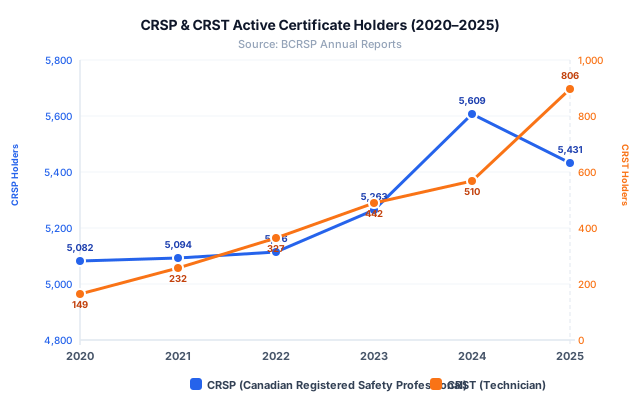
Verified Year-End Active Certificate Holders (2020–2025)
Line chart showing CRSP and CRST active certificate holder growth from 2020 to 2025. CRSP grew from 5,082 to 5,431 holders (blue line). CRST grew from 149 to 806 holders (orange line), a 441% increase. Source: BCRSP Annual Reports.
Left axis (blue): CRSP holders  |  Right axis (orange): CRST holders  |  Source: BCRSP Annual Reports 2020–2025
The CRST story: The CRST launched in 2020 with 149 holders. By 2025 it had grown to 806 — a 441% increase in five years. CRSP growth has been steadier (+7% over the same period), reflecting a mature, established professional community. The total active safety professional cohort grew from 5,231 to 6,237.
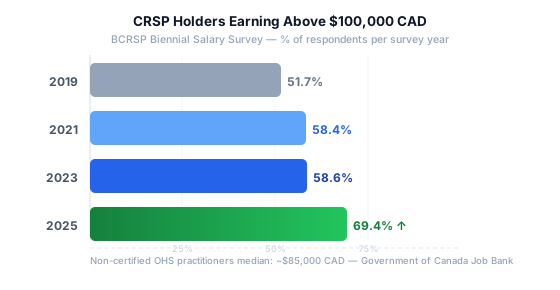
The $100K Salary Threshold — CRSP Holders Over Time
Horizontal bar chart showing percentage of CRSP holders earning above 100000 CAD annually from 2019 to 2025. 2019: 51.7%, 2021: 58.4%, 2023: 58.6%, 2025: 69.4%. Non-certified OHS practitioners median is approximately 85000 CAD. Source: BCRSP Biennial Salary Survey.
% of credentialed CRSP holders reporting annual base salary above $100,000 CAD  |  Source: BCRSP Biennial Salary Survey
The credential premium: In 2025, nearly 7 in 10 CRSP holders earn above $100K — versus a non-certified OHS median of ~$85K. The jump from 58.6% (2023) to 69.4% (2025) is the largest single-survey gain on record, a 10.8 percentage point increase in just two years.

Who Holds the CRSP

The BCRSP Salary Survey paints a consistent picture of a highly experienced, stable professional community — not early-career candidates, but seasoned safety leaders.

🏅
86.2%
of active CRSP holders have 10+ years of dedicated safety leadership experience
📋
97%
have at least 5 years of professional OHS experience
😊
89.4%
report being satisfied or more than satisfied with their OHS career
🏢
74.3%
have changed employers 3 times or fewer over a 10-year period — an exceptionally stable sector
What this means for candidates

The CRSP is not a credential people chase early in their career and drop — it anchors long-term professional identity. The experience profile also explains why salaries skew so high: the bulk of the cohort occupies senior manager, director, and executive safety roles. Earning the designation signals readiness for those positions.

Regional Earning Patterns

Geographic location shapes salary outcomes consistently across every BCRSP Salary Survey cycle. Western and Central Canada dominate the top end; Atlantic Canada sits lower, partly driven by fewer urban job clusters.

Relative Earning Strength by Region
Source: BCRSP Salary Survey (multi-year)
Alberta
Highest
British Columbia
High
Ontario
High
Saskatchewan / Manitoba
Mid
Québec
Mid
Atlantic Canada
Lower

Bar lengths represent relative median salary positioning — not absolute values. Oil & gas concentration in Alberta and financial/tech density in Ontario and BC drive the top-end premiums. Atlantic Canada has 74% urban job concentration vs. 88.5% in Central Canada.

Ready to earn the designation?

The data makes the case. Start with a free 20-question CRSP or CRST practice exam — blueprint-aligned, with a radar chart showing your weakest domains.

Try a Free Mini-Exam

No sign-up required. Results include domain breakdown.

Data sourced from: BCRSP Annual Reports (2020–2025) and BCRSP Biennial Salary Surveys (2019, 2021, 2023, 2025). Non-certified OHS median salary from the Government of Canada Job Bank. SPEP is not affiliated with BCRSP.