How to Take the CRSP Exam: Reading Strategy, Time Management, and the Cognitive Priming Method
I passed the CRSP in February 2026 and the CRST in March 2025 — both on the first attempt. I can’t legally recall specific questions (BCRSP test security rules), but I can share what worked for me on the day, the reading techniques I trained ahead of time, and the time-management decisions that made the difference. This is the post-exam strategy I wish I’d had before I sat down.
Four things matter on CRSP exam day: (1) treat it as a judgment exam, not a memorization exam — most-relevant beats most-correct; (2) use cognitive priming on case-based scenarios — skim question stems and answer keywords first, then read the scenario with your brain already searching for answers; (3) use the flag-and-return framework for uncertain questions, splitting them into true blind spots and stuck-between-two; (4) if your reading speed isn’t at least 250 words per minute, you will run out of time on CRSP. There’s a built-in reading-speed self-test below to check.
It’s a judgment exam, not a memorization exam
The single biggest mindset shift between candidates who pass and candidates who fail: stop looking for "the right answer" and start looking for the most relevant answer.
The questions on the CRSP are not necessarily difficult — they’re hard to judge. Most of the four answer choices are technically correct OHS practices. You would do every one of them in a real workplace, eventually. The question is asking which one fits this specific scenario, this specific role, this specific moment.
Most-relevant beats most-correct
If I had to summarize the entire CRSP exam in one phrase: most-relevant beats most-correct. The four answer options are usually all defensible. Your job is to find the one that fits the question stem the best.
This is the meta-skill I covered in detail in The 5 CRSP Scenario Archetypes — the recurring patterns BCRSP uses to construct judgment questions. If you haven’t read that one, do it before the exam. The DHSTW filter (Domain → Hierarchy → Stakeholder → Time → Wording) from Archetype 5 is the tool you’ll reach for again and again on exam day.
The Cognitive Priming Method
Here’s a technique I trained during practice and used heavily on exam day. I call it cognitive priming, because it pre-loads your brain to search for specific information before you read the long scenario paragraph.
For a typical CRSP case-based question, the page shows a one-to-two paragraph scenario followed by 3 to 5 sub-questions that all reference the same scenario. The instinct is to read the scenario carefully first, then read each question, then look at the options. That’s the slow way.
The fast way:
Quickly read each of the 3 to 5 sub-question stems. You don’t need to understand them fully — just register the topics. This takes about 15 seconds.
Glance at the four options for each sub-question. Note distinctive keywords (specific control measures, regulations, roles). Another 15–20 seconds.
Your brain is now searching for the keywords from step 2 while you read. Your reading is in front mode; your answer-search is running in background mode. You’ll register answer-relevant details on the first pass.
Without rereading the scenario, answer each sub-question. Because you’ve effectively pre-loaded the answer search, the right options jump out faster.
How fast do you actually read? Find out now.
Cognitive priming only works if your raw reading speed is fast enough to begin with. The CRSP gives you 4 hours for 190–210 questions — roughly 72 seconds per question on average, with case-based scenarios adding extra reading load. The CRST is tighter at 3.5 hours.
Here’s a real reading-speed self-test using a CRSP-style scenario I wrote for this page. No signup. About 1 minute.
Reading-Speed Self-Test
You’ll see a realistic CRSP-style workplace scenario (177 words). Read at the speed you’d use on the actual exam — fast enough to keep moving, careful enough to catch the details.
Click START. Timer begins. Click DONE when you’ve finished reading. We’ll show you your words-per-minute and one comprehension question to verify you actually read carefully.
Time-budget reality check — my real exam-day numbers
People talk about exam timing in abstract terms ("manage your time well"). Here’s what actually happened on my two exams:
| Metric | CRST (March 2025) | CRSP (February 2026) |
|---|---|---|
| Total exam time | 3.5 hours | 4 hours |
| Total questions | ~200 | ~210 |
| Time left at end | ~1 hour | ~5 minutes |
| Uncertain (flagged) questions | ~15 | ~20–30 |
| Practical takeaway | Easy to review thoroughly | Triage your flagged review — no time for deliberation on every flag |
The CRSP is much heavier on reading and judgment than the CRST. If you go in expecting CRSP-as-CRST timing, you will run out of time. Plan for tight pacing on CRSP, plan for review on CRST.
Independent questions are mini-scenarios
One of my biggest mistakes early in CRSP practice: I treated the independent (non-case-based) questions as quick "theory" questions. They’re not. Most independent questions are mini-scenarios — a sentence or two of context, then a question that requires the same judgment muscles as a case-based question.
If anything, the independent questions ate more of my time than the case-based ones, because I couldn’t use cognitive priming as efficiently (no shared scenario across multiple sub-questions). I had to apply the full archetype-recognition process for each one independently.
The flag-and-return framework
The Pearson VUE interface lets you flag questions for review. Most candidates know this; few use it strategically. Here’s the framework I used.
During the first pass through the exam, I flagged any question I wasn’t sure about. Don’t agonize on the first pass — pick the answer that feels most right, flag it, move on. Burning 4 minutes on one question costs you the chance to catch 6 easier ones later.
During my review pass, I sorted flagged questions into two categories:
- True blind spots. Questions where I genuinely had no idea what the answer should be — the topic, the framework, the regulation. I skipped these quickly during review. Spending 5 minutes deliberating on a topic you don’t know is a waste of your last 5 minutes.
- Stuck-between-two. Questions where I had narrowed it down to two plausible answers. This is where I spent my review time. The deliberation is productive because I have specific options to compare, not the entire universe of OHS knowledge.
Elimination heuristics for stuck-between-two questions
When you’re down to two answers and need to choose, here’s what worked for me:
- Avoid options with absolute wording like "always," "never," "must always," "in every case." OHS is contextual; absolute statements are usually wrong.
- The more detailed option often (but not always) wins. Specific control measures usually beat generic ones. But this isn’t a rule — it’s a tiebreaker.
- Re-read the question stem. The signal words ("first," "most effective," "best long-term," "primary," "immediate") rewrite the answer. The right answer fits the signal word.
- Apply the DHSTW filter from Archetype 5: Domain match, Hierarchy match, Stakeholder match, Time match, Wording match.
- Trust your first instinct. If you’ve eliminated to two and your gut said one of them on the first pass, don’t talk yourself out of it without a specific reason. Second-guessing changes more right answers to wrong than the other way around.
The reverse-learning method — how I prepared (with real radar chart)
Everything above is exam-day strategy. The work happens before exam day. The single most effective study method I used — for both CRST and CRSP — was what I call reverse-learning: practice questions first, textbook reading second, only on the topics where practice exposed gaps.
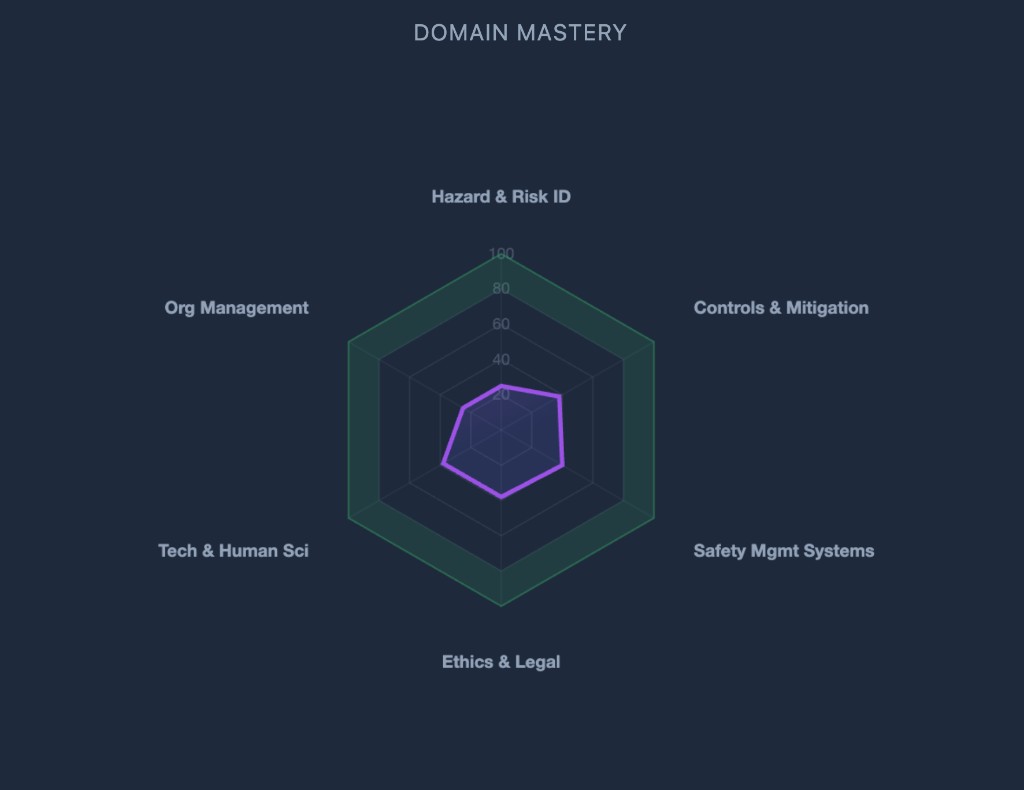
Real domain mastery output from SPEP. Purple line = current performance after one mini-exam. Green line = target (80%+ across all domains). The radar chart instantly tells you where to study next — this is the “reverse” in reverse-learning. You don’t read the textbook cover-to-cover. You read only the chapters that match your weak domains.
The flow:
- Take a domain-balanced practice mini-exam before reading the textbook
- The competency radar chart shows your accuracy by domain — weak, refining, strong
- Read only the textbook sections for your weak domains
- Take another mini-exam, watch the radar chart fill in
- Repeat until all six CRSP domains (or five CRST domains) are at ≥80%
The reason this works: there is no fixed passing score on the CRSP. You’re competing against other candidates on a modified Angoff-set cut score. You don’t need to be perfect — you just need to be better than enough other candidates. If you strengthen your weakest domain from 40% to 75%, you’ve already moved ahead of a meaningful chunk of the field. The remaining improvement comes from refining judgment and getting familiar with question styles — which is exactly what cognitive priming and the scenario archetypes are for.
Practice with the same setup I used
SPEP’s mini-exams are blueprint-weighted, case-based, and produce the radar chart you see above. The free 20-question mini-exam needs no signup and no card. After your first attempt you’ll know exactly which domains to study.
Start a Free CRSP Mini-Exam →Your radar chart reveals your weak domains in 20 minutes. The reverse-learning loop closes from there.
→ Or try a timed CRSP Mock Exam Rehearsal (14 questions, real exam pacing)How the three SPEP methods connect
Three named methods on this site — reverse-learning, scenario archetypes, and cognitive priming — solve three different problems. Together they form the complete CRSP / CRST preparation system I used.
Reverse-Learning
What: Study method.
When: Weeks before exam.
Solves: What to study.
Scenario Archetypes
What: Question pattern recognition.
When: Practice + exam day.
Solves: What template fits this question.
Cognitive Priming
What: Reading-order technique.
When: Exam day.
Solves: How to read fast without losing comprehension.
Use them in this sequence: reverse-learning during preparation to narrow what you need to study, scenario archetypes during practice and on exam day to recognize question patterns in 10 seconds, and cognitive priming on the day itself to process case-based scenarios efficiently.
Final thoughts
This exam is not about memorizing content. It’s about applying judgment in realistic situations. Practice matters more than passive reading. Understanding question patterns matters more than knowing every term. Time management is critical — especially on CRSP, where I had 5 minutes left at the end.
This approach worked for me. It may not work for everyone. But if you’ve been studying for weeks and still feel like you’re not making progress, try flipping the order: practice questions first, study to the gaps, recognize archetypes, and prime your reading. Most candidates I’ve talked to who failed and re-tried successfully made some version of this switch.
Frequently asked questions
What is the cognitive priming method for the CRSP exam?
Cognitive priming is a reading-order technique I used during my CRSP exam: instead of reading the scenario top-to-bottom and then the question, you skim the question stems first, scan the answer choices for keywords, and only then go back and read the scenario carefully. By the time you read the scenario, your brain is already searching for specific information — your reading is in front mode, your answer-search is running in background mode. This is especially powerful on case-based questions where 3 to 5 sub-questions share a single scenario, because you only need to read the scenario carefully once but answer multiple questions from it.
How fast do I need to read to finish the CRSP exam on time?
The CRSP gives you 4 hours for 190–210 questions, which works out to roughly 72 seconds per question on average. Because case-based scenarios add reading load (one paragraph for 3 to 5 sub-questions), a comfortable reading speed is around 250–300 words per minute. Below 200 wpm you will likely run out of time. The CRST is tighter at 3.5 hours so you need closer to 280–320 wpm. Use the reading-speed self-test in this guide to check where you stand.
What is the flag-and-return framework?
The flag-and-return framework is how I handled uncertain questions. The Pearson VUE interface lets you flag questions to revisit. I split flagged questions into two categories during my review pass: true blind spots (questions I didn’t understand at all — I skipped these quickly during review rather than burning my last minutes on them) and stuck-between-two (questions where I had narrowed it to two plausible answers — I spent my review time here, applying elimination heuristics like avoiding absolute wording, preferring the more detailed option, and checking signal words in the stem).
How is the CRSP different from the CRST in terms of question style?
The CRSP has very few calculation-based questions, very few direct definition questions, and even the independent (non-case-based) questions feel like mini-scenarios. The CRST is more knowledge-heavy with more numeric calculations (TWA, incident rates, fall protection values). On exam day I had about 5 minutes left at the end of the CRSP versus roughly 1 hour of review time at the end of the CRST — the CRSP is much heavier on reading and judgment, the CRST is heavier on direct technical knowledge.
How do I combine cognitive priming with reverse-learning?
These two methods solve different problems. Cognitive priming is an exam-day technique for processing scenario questions efficiently under time pressure. Reverse-learning is a study-phase method: take a domain-balanced practice mini-exam first, get a competency radar chart showing your weakest domains, then read only the textbook sections that address those gaps. Together: reverse-learning narrows your study scope, cognitive priming makes you faster on exam day. Both rely on practice questions as the primary input — not textbook reading.
Should I trust my first instinct on the CRSP exam?
Generally yes. If you’ve eliminated to two answers and your gut had one of them on the first pass, don’t talk yourself out of it without a specific reason. Statistically, second-guessing changes more right answers to wrong than the other way around. Change your answer only if you’ve found a specific reason to — for example, you re-read the stem and a signal word ("first" vs "most effective") rewrites the answer.