Common questions about BCRSP certification exams and how SPEP helps you prepare. For official certification details, visit bcrsp.ca.
What is the difference between CRSP and CRST?
CRSP (Canadian Registered Safety Professional) is a strategic, management-level certification requiring a bachelor's degree and 48 months of OHS experience. CRST (Canadian Registered Safety Technician) is a tactical, technical-level certification with lower entry requirements including a 1-year OHS certificate or 2-year diploma. Both are administered by BCRSP and require passing a certification examination.
Do I need Canadian experience to apply for BCRSP certification?
No. According to BCRSP, you do not need Canadian experience to apply for either CRSP or CRST certification. International OHS work experience is accepted as part of the application process.
Can I write the CRSP or CRST exam outside Canada?
Yes. BCRSP uses Pearson VUE for the delivery of certification examinations. You can write the CRSP or CRST exam at any approved Pearson VUE test centre worldwide. Search for available centres on the Pearson VUE website.
What does the CRSP certification exam cover?
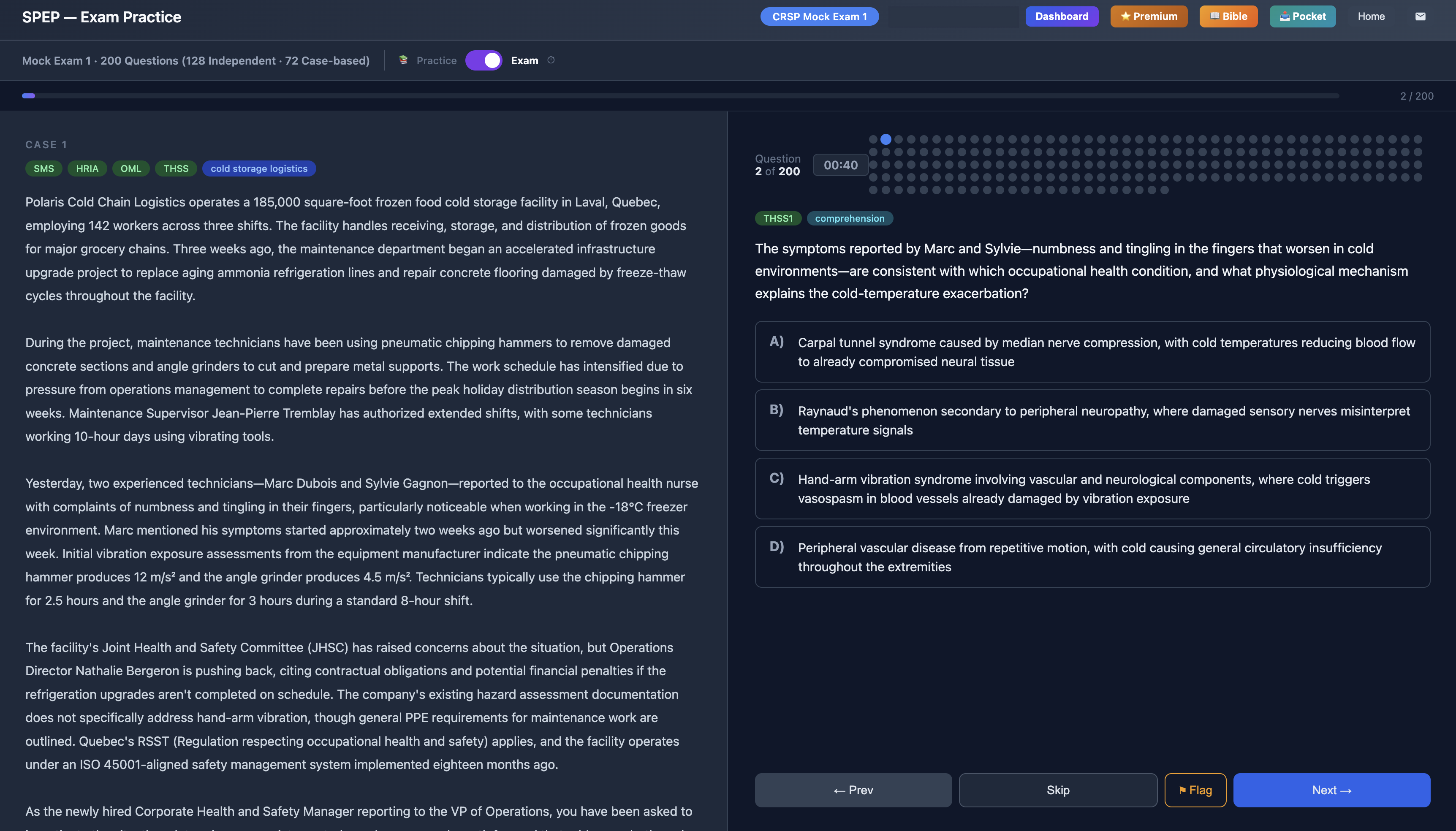
The CRSP exam covers 6 competency domains: Safety Management Systems (26%), Hazard & Risk Identification and Analysis (20%), Hazard & Risk Controls and Mitigation (20%), Organizational Management and Leadership (14%), Ethics, Legal, Professional Role and Function (10%), and Technical and Human Sciences for Safety (10%). The exam includes 190–210 questions with both independent and case-based formats, tested at knowledge, application, and critical thinking levels.
What does the CRST certification exam cover?
The CRST exam covers 5 competency domains: Hazard Identification, Risk Assessment & Control (29%), Technical Safety Fundamentals (25%), Health & Safety Systems (17%), Legal, Ethics & Professional Practice (17%), and Social & Human Sciences (12%). The exam includes 190–210 questions over 3.5 hours, primarily at the knowledge and application cognitive levels.
How does SPEP's adaptive learning work?
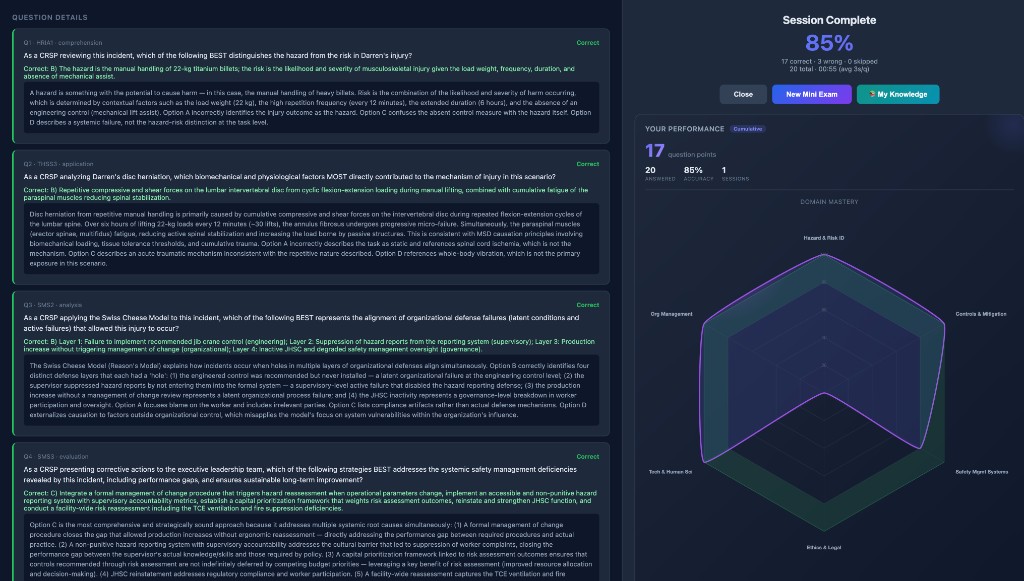
After each 20-question mini exam, SPEP analyzes your performance across every exam domain. A radar chart visualizes your accuracy per domain, and three performance tiers guide your study: Weak Areas (below 80% accuracy), Keep Refining (80–99% with any wrong or skipped questions), and Strong Areas (100% accuracy, no gaps). The Literacy Class recommends targeted knowledge units directly matched to your specific wrong answers using bidirectional keyword scoring and competency-code matching.
How many free practice exams do I get?
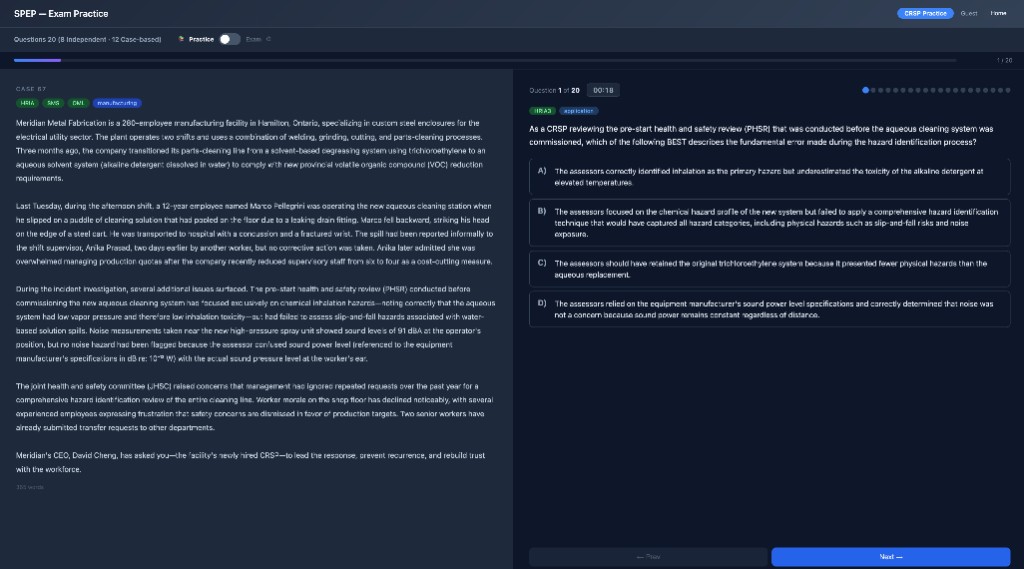
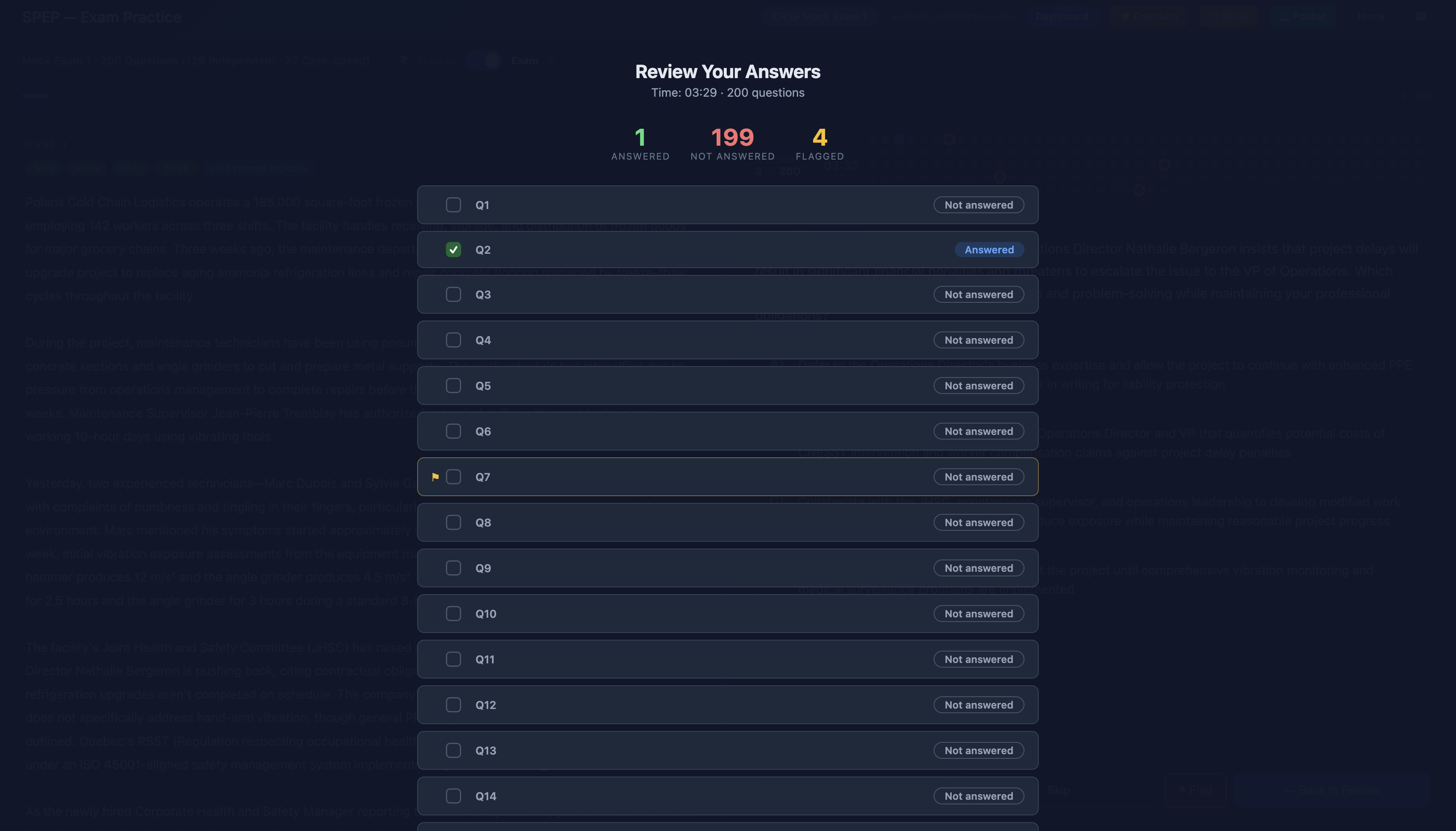
SPEP offers 1 free practice exam with no sign-up required. Just click Start and begin practicing immediately. Each mini exam contains 20 domain-balanced questions covering all CRSP or CRST exam domains, with a mix of independent and case-based question formats. After your free exam, create an account to continue.
Is SPEP affiliated with BCRSP?
No. SPEP (Safety Professional Exam Preparation) is an independent exam preparation platform and is not affiliated with, endorsed by, or connected to the Board of Canadian Registered Safety Professionals (BCRSP).
How many questions are on the CRSP exam?
The CRSP exam contains 190–210 multiple-choice questions completed within a 4-hour window. Approximately 65–75% are independent questions and 25–35% are case-based questions with 3–5 sub-questions each. Questions are tested at three cognitive levels: knowledge (15–20%), application (45–55%), and critical thinking (30–35%).
How long should I study for the CRSP or CRST exam?
BCRSP recommends 2 to 4 months of focused preparation between application approval and sitting the exam. Most candidates report 12–14 weeks of active study depending on prior OHS experience. Because 80%+ of questions test application and critical thinking rather than rote recall, practicing with blueprint-aligned questions is more effective than textbook reading alone.
How many attempts do I get to pass the CRSP or CRST exam?
You have 12 months after application approval to write your first attempt. If you do not pass, BCRSP allows up to two supplementary attempts within the following 12 months. Each attempt requires a separate exam fee. If all three attempts are unsuccessful, you must reapply for certification.
What is the CRSP or CRST passing score?
BCRSP does not publish a fixed passing percentage. The pass mark is determined through a modified Angoff standard-setting process applied to the difficulty of each exam form. Candidates receive a pass or fail result, not a numeric score.
How much does the CRSP exam cost?
Each CRSP exam attempt costs $200 CAD (the CRST exam is $175 CAD), in addition to the non-refundable $525 CAD application fee. See every CRSP and CRST fee. Always confirm current fees on bcrsp.ca as BCRSP periodically updates its fee schedule.
Can I transfer from CRST to CRSP?
There is no direct upgrade path from CRST to CRSP. To become a CRSP, you must independently meet CRSP eligibility requirements (a bachelor's degree plus 48 months of OHS experience) and pass the CRSP exam. Many safety professionals hold both designations by first earning CRST and completing CRSP separately.
Do I need a bachelor's degree for the CRSP exam?
Not always. The CRSP requires either a bachelor's degree in any field or a 2-year diploma or certificate in occupational health and safety (at least 900 hours or 60 credits), plus 48 months of professional-level OHS experience within the last 72 months. For complete eligibility rules, see bcrsp.ca.
How long does it take to get CRSP or CRST exam results?
BCRSP typically releases exam results within 6 to 8 weeks after your test date. Results are posted to your BCRSP Clarus account and emailed to the address on file. You will receive a pass or fail outcome, not a numeric score.
What is the best way to prepare for the CRSP or CRST exam?
Allocate study time proportional to blueprint domain weights, prioritize application-level and critical-thinking practice (not rote recall), and simulate real exam conditions with timed mini exams. SPEP builds this approach into every 20-question session — domain-balanced, case-based scenarios, and instant feedback on weak areas matched to your specific wrong answers.
Why are CRSP exam questions so vague?
They aren’t actually vague — they’re scenario-based. The CRSP is a competency-based exam, not a knowledge-based one, so most questions place you in a realistic workplace situation and offer four options that are all technically defensible. You aren’t choosing the “correct” answer; you’re choosing the BEST or FIRST action a senior HSE advisor would take given competing priorities (safety, law, operations, worker relations, ethics).
A systematic approach makes these questions manageable:
- Identify your role in the scenario (you as the HSE professional, the employer, the worker, a contractor)
- Identify the hazard category (physical, chemical, biological, ergonomic, psychosocial)
- Apply the hierarchy of controls: elimination → substitution → engineering → administrative → PPE
- Eliminate any option that violates OHS law or professional ethics
- Choose the option that acts on the most immediate safety risk first
Questions feel vague when candidates look for a “textbook right answer.” They feel clear once you frame them the way a senior HSE advisor would: what protects workers now, what satisfies legal duty, and what reflects professional judgment. The CRSP is a judgment exam, not a memorization exam — that’s why questions read this way.
How much math is on the CRSP or CRST exam?
Expect roughly 10–15% of the CRSP exam to involve calculations — about 20–30 of the 190–210 questions. This is not a math-heavy exam, but the calculation types are predictable and limited to a small set of formulas.
Most common CRSP calculations:
- Incident rates: Total Recordable Incident Rate (TRIR), DART rate, Lost Time Injury Frequency (LTIF), using the formula (incidents × 200,000) ÷ hours worked
- Time-Weighted Average (TWA): For chemical or noise exposure, Σ(C × T) ÷ 8 hours
- Ventilation rates: Required dilution airflow Q = G/C, and air changes per hour (ACH)
- Risk scoring: Likelihood × severity × exposure (Fine-Kinney method) or 5×5 risk matrices
- Noise dosimetry: Percent dose and equivalent continuous level with a 3-dB or 5-dB exchange rate
- Fall distance: Total fall distance including free fall, deceleration, and harness stretch
Tips:
- You get an on-screen calculator during the exam — no mental math needed
- Memorize only 2–3 core formulas (TRIR, TWA, ventilation); the rest follow logically
- Answer options typically differ by an order of magnitude, so ballpark estimates work to eliminate wrong choices
- Even if you skip every calculation question and get everything else correct, math alone will not fail you
CRST is slightly more calculation-heavy than CRSP because it leans into technical standards and specific numeric values. A one-page numeric cheat-sheet of standard limits (PELs, TLVs, common thresholds) is useful for CRST exam-day recall.
Is there a penalty for guessing on the CRSP or CRST exam?
No. BCRSP does not deduct marks for incorrect answers on the CRSP or CRST exam. Every question is scored independently, a wrong answer counts the same as a blank answer, and you should answer every question even if you have to guess.
Why this matters in your exam strategy:
- A random guess on a 4-option question has a 25% chance of being correct
- Educated elimination of one obviously wrong option raises your odds to 33%
- Eliminating two options raises your odds to 50%
- Over 20–30 guessed questions, the difference between educated guessing and leaving blank can shift your result from fail to pass
Recommended approach when time is running low:
- Read the question stem carefully
- Eliminate any answer that violates OHS law, the hierarchy of controls, or professional ethics
- Between remaining options, choose the one that prioritizes immediate worker safety and reflects senior HSE advisor judgment
- Flag the question if time permits to return later
- Never leave a question blank — BCRSP treats blanks and wrong answers the same
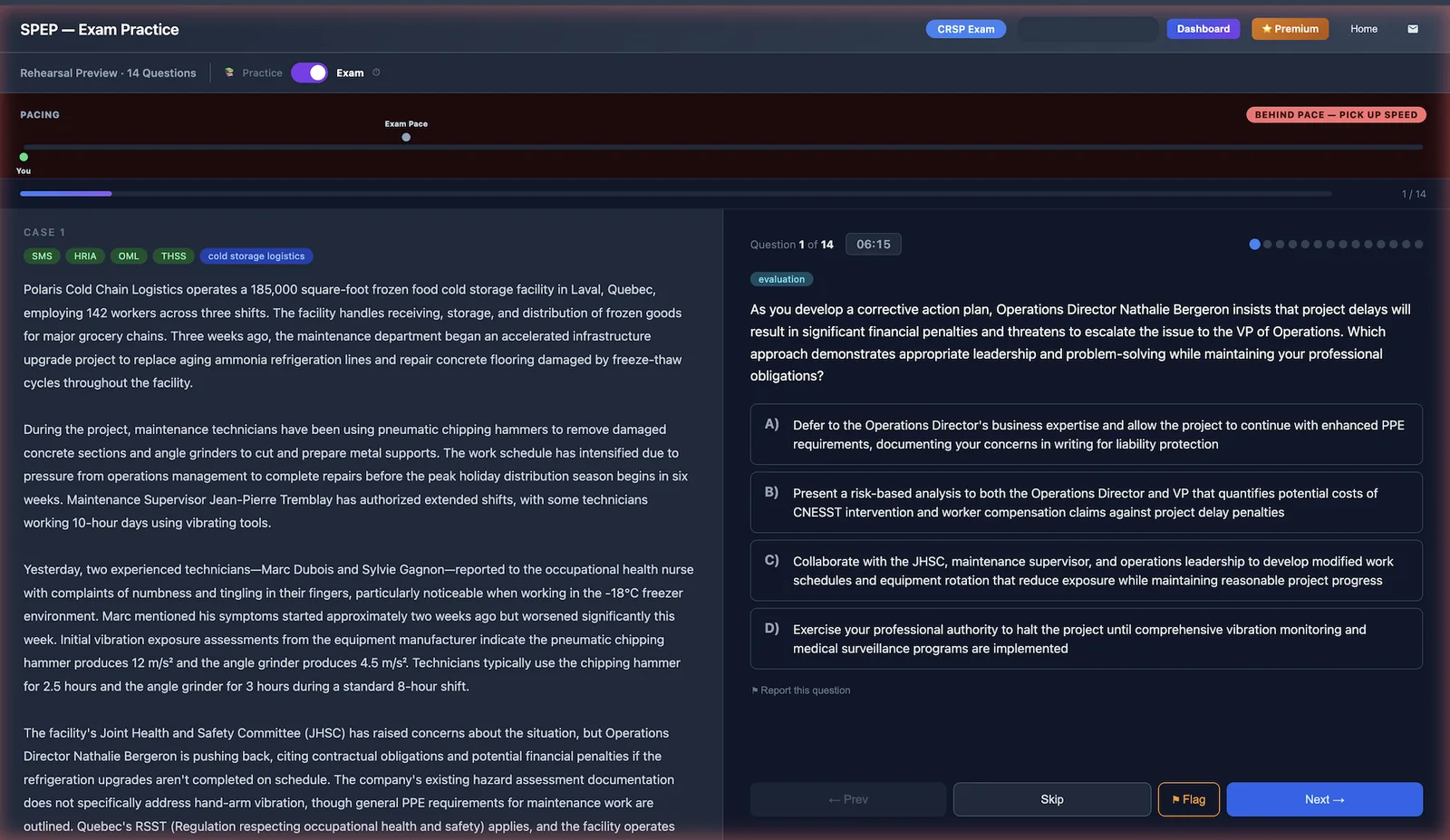
A pragmatic time-management rule: allocate roughly 60 seconds per independent question and 90 seconds per case-scenario sub-question. If a question takes more than 2 minutes, flag it, guess, and move on. You can always return during the review phase.
Is CRSP or CRST a trucking, hazmat, or DOT certification?
No. CRSP (Canadian Registered Safety Professional) and CRST (Canadian Registered Safety Technician) are occupational health and safety certifications issued by the Board of Canadian Registered Safety Professionals (BCRSP) in Canada. They are unrelated to CRST International (a US trucking company), hazmat handling certifications, or DOT commercial driver licensing.