Numeric Threshold Patterns for CRST & CRSP Candidates
Key numbers both exams test — and how they test them differently. CRST often asks you to recall the number directly. CRSP uses the same number as a trigger for judgment — what would a senior HSE advisor do given this threshold?
How to use this page
These numeric thresholds have a higher-than-average chance of appearing — but not all of them will be on your specific exam. Every exam is different.
This is not a complete list. The CRST and CRSP exams cover far more numeric values than what is here. These are commonly cited thresholds, not a guaranteed question set.
Knowing these numbers alone is not enough to pass. What matters is understanding the reasoning behind each threshold — which standard sets it, what it protects, and what action it triggers. Each card below shows how CRST and CRSP test the same number differently.
- What this page does: Gives you study anchors for numeric knowledge and shows how each exam type frames the same threshold.
- What this page does NOT do: Predict specific questions, guarantee coverage, or replace the official standards and provincial regulations.
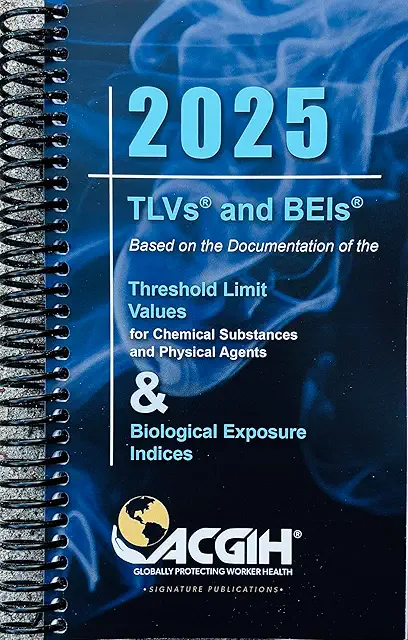
As an Amazon Associate, SPEP earns from qualifying purchases.
01 Chemical Exposure Time Limits
How long and at what concentration a worker can be exposed — three different limit types, each serving a different purpose.
TWA, STEL, and Ceiling
TWA (Time-Weighted Average) is the average airborne concentration over an 8-hour work shift. It is the primary OEL for most substances.
STEL (Short-Term Exposure Limit) is a 15-minute average that must not be exceeded more than 4 times per day, with at least 60 minutes between each excursion, and only if the TWA is not exceeded.
Ceiling is a concentration that must never be exceeded, even momentarily. Used for substances with acute toxic effects.
One of the most consistently tested industrial hygiene topics. The trap is confusing STEL (15-minute limit) with Ceiling (never-exceed). They are not the same.
“What is the measurement period for a STEL?” / “Which exposure limit type is a never-exceed value?”
A worker reports symptoms during short-duration solvent tasks despite TWA compliance. As senior HSE advisor, which limit type now applies and what actions do you take?
Reference: ACGIH TLVs & BEIs (updated annually); provincial OHS regulations vary — consult your jurisdiction’s OEL table.
02 Radiation Dose Limits
Ionizing radiation is one of the few hazards in Canadian OHS with federally legislated numeric dose limits — making these numbers directly testable.
Effective Dose Limits for Radiation Workers
Canadian federal regulations set effective dose limits for nuclear energy workers and other radiation-exposed workers under the Radiation Protection Regulations (SOR/2000-203):
• Nuclear energy workers: a dose limit averaged over a 5-year dosimetry period, with no more than a defined maximum in any single year — consult the current CNSC regulatory document for the precise value, as operational conditions may affect applicable limits.
• General public: a substantially lower annual effective dose limit applies to members of the public from licensed activities.
The governing principle in all cases is ALARA (As Low As Reasonably Achievable) — limits are not targets; they are upper boundaries.
Tests knowledge of who sets radiation dose limits in Canada (CNSC, under the Nuclear Safety and Control Act), ALARA vs limit-based thinking, and the distinction between ionizing vs non-ionizing radiation monitoring requirements.
“Which Canadian body regulates radiation dose limits for workers?” / “What monitoring device records cumulative ionizing radiation exposure?” (Answer: film badge / dosimeter)
A radiation worker is approaching their annual dose limit mid-year. As senior HSE advisor, what program controls do you recommend to maintain ALARA and prevent exceedance?
Reference: Radiation Protection Regulations, SOR/2000-203; CNSC REGDOC-2.7.1 (Radiation Protection); Nuclear Safety and Control Act, S.C. 1997, c. 9.
Ionizing vs Non-Ionizing Radiation
Ionizing radiation (X-rays, gamma rays, alpha particles, beta particles, neutrons) carries enough energy to remove electrons from atoms, causing cell damage and increasing cancer risk. Monitored with dosimeters and film badges.
Non-ionizing radiation (radio waves, microwaves, visible light, UV, infrared, laser) does not remove electrons but can cause thermal damage, eye injury, or skin burns at sufficient intensity. UV and laser have their own specific exposure limits.
A classic distinguishing concepts question. Common trap: labeling UV or microwaves as ionizing. They are non-ionizing. The distinction matters for selecting appropriate controls and monitoring instruments.
“Microwave radiation is what type?” (Non-ionizing) / “Which type of radiation is monitored with a film badge?” (Ionizing)
Workers in a communications tower maintenance role report skin and eye discomfort. As HSE advisor, how do you classify the hazard type and what engineering controls do you prioritize?
Reference: ACGIH TLVs for Physical Agents; ICNIRP guidelines for non-ionizing radiation; provincial OHS regulations (e.g., Ontario Reg. 833 — Control of Exposure to Biological or Chemical Agents).
03 Noise Exposure Limits
Noise thresholds in Canada trigger specific program requirements — knowing the action levels is as important as knowing the limits.
Noise Action Levels & OELs
Most Canadian provincial OHS regulations set a hearing conservation program trigger at or around 85 dBA as an 8-hour TWA. Above this level, employers must implement audiometric testing, hearing protection, worker training, and noise monitoring.
The permissible exposure limit (the regulatory OEL) varies by jurisdiction — commonly in the range of 85–90 dBA for an 8-hour shift. The exchange rate (how much time is halved per 3-dB or 5-dB increase) also varies by province and standard.
3-dB exchange rate (used by NIOSH and most Canadian standards): each 3-dB increase halves the permissible exposure time.
5-dB exchange rate (used by OSHA in the US): each 5-dB increase halves the time.
Tests both numeric knowledge and program knowledge. Knowing 85 dBA as the typical action level and understanding what program elements it triggers is more exam-relevant than memorizing any single OEL number.
“At what noise level is a hearing conservation program typically required in Canada?” / “Which instrument measures a worker’s personal noise dose over a full shift?” (Dosimeter)
A noise survey shows workers averaging 88 dBA over their shift. As senior HSE advisor, what elements of a hearing conservation program would you implement, and what is your priority order of controls?
Reference: CSA Z94.2-14 (R2019) — Hearing Protection Devices; provincial OHS regulations (values vary by jurisdiction — always verify the applicable regulation for your province).
04 Heat Stress Body Temperature Thresholds
Heat illness follows a progression — recognizing the physiological thresholds guides both prevention and emergency response.
Core Temperature & Heat Illness Progression
Normal core body temperature is approximately 37°C. Heat-related illness risk increases progressively with core temperature:
• ~38°C: Heat exhaustion range begins. Symptoms include heavy sweating, weakness, cold/pale/clammy skin, nausea, and fainting.
• ~40°C and above: Heat stroke territory. Symptoms include hot/red/dry skin, confusion, rapid/strong pulse, loss of consciousness. This is a medical emergency.
Environmental measurement uses WBGT (Wet Bulb Globe Temperature), which accounts for temperature, humidity, radiant heat, and air movement. WBGT action limits vary by workload and acclimatization status.
Tests the distinction between physiological thresholds (core temperature) and environmental measurement (WBGT). The exam also tests first response priority: move the worker to a cool area and call emergency services immediately at heat stroke core temperatures.
“At approximately what core temperature does heat stroke become a medical emergency?” / “What environmental index accounts for humidity and radiant heat in heat stress assessment?” (WBGT)
Workers are reporting dizziness and confusion during outdoor work on a hot day. As senior HSE advisor, what is your immediate priority action, and what program controls would you put in place going forward?
Reference: ACGIH TLVs for Heat Stress and Heat Strain (updated annually); CSA Z1004 (Workplace Ergonomics); provincial OHS heat stress guidelines vary — consult your jurisdiction.
As an Amazon Associate, SPEP earns from qualifying purchases.
05 Pressure Vessel Hydrostatic Testing
A frequently cited numeric standard — the ratio between test pressure and working pressure is a common exam anchor.
Hydrostatic Test Pressure Ratio (vs MAWP)
Pressure vessels must be hydrostatically tested at a pressure greater than their Maximum Allowable Working Pressure (MAWP) to verify structural integrity. The commonly cited test ratio in Canadian and international standards is 1.5 times (150%) the MAWP.
Water is used because it is nearly incompressible — if the vessel fails during a water-filled test, the energy release is far less catastrophic than a gas-filled test.
Note: the exact ratio can vary by standard revision, vessel type, and design code. Always verify against the applicable version of the standard in effect.
A direct numeric recall question on CRST. The ratio 1.5× MAWP appears in CSA B51 and ASME BPVC. The exam may also test why water is used (incompressibility = safer failure mode).
“A pressure vessel has a MAWP of 1,000 kPa. What is the minimum hydrostatic test pressure?” / “Why is water used instead of air for hydrostatic testing?”
A newly fabricated pressure vessel is ready for commissioning. As HSE advisor, what pre-use verification steps would you require, and which standard governs the testing requirement?
Reference: CSA B51-19 (Boiler, Pressure Vessel, and Pressure Piping Code); ASME BPVC Section VIII Division 1 (verify current edition for applicable ratio).
06 Respirator Fit Test Frequency
Respirator programs have specific numeric requirements — frequency of fit testing is a common knowledge recall target.
Fit Testing: Frequency & Types
Respirator fit testing must be conducted:
• Initially before the respirator is used in the workplace.
• Annually (at minimum) thereafter.
• Whenever a different respirator model/size is selected, or when there are changes to the worker’s facial characteristics (significant weight change, dental work, scarring).
Qualitative fit testing (QLFT): pass/fail based on the wearer’s detection of a test agent (saccharin or Bitrex). Relies on sense of taste or smell. Suitable for half-face respirators up to 10× OEL.
Quantitative fit testing (QNFT): instrument measures actual particle counts inside and outside the mask, producing a numerical fit factor. Required for higher-hazard environments and full-face respirators.
Tests respirator program knowledge. Key facts: annual minimum frequency, two types exist, and qualitative relies on the wearer’s senses while quantitative provides a numeric fit factor.
“How often must respirator fit testing be conducted at minimum?” / “What is the difference between qualitative and quantitative fit testing?”
You are reviewing a respiratory protection program. A worker has lost significant weight since their last fit test two years ago. As HSE advisor, what actions do you require before the worker re-enters the hazardous area?
Reference: CSA Z94.4-18 (Selection, Use, and Care of Respirators); provincial OHS regulations (some jurisdictions specify more frequent testing for certain hazards).
07 Ventilation Metrics (ACH)
Air changes per hour is a common ventilation benchmark — but the number that matters depends entirely on the space type.
Air Changes per Hour (ACH)
ACH measures how many times the total air volume of a space is replaced with outside or filtered air in one hour. Higher ACH means more dilution of airborne contaminants.
There is no single universal ACH value — requirements vary significantly by space type:
• General offices: typically 6–10 ACH (ASHRAE 62.1)
• Healthcare/hospital rooms: 6–15+ ACH depending on room type and infection control requirements
• Laboratories with chemical hazards: may require 10–12 or more ACH
• Cleanrooms and isolation rooms: substantially higher
The key concept is that ACH is a dilution metric, not a control metric. For toxic, carcinogenic, or high-concentration substances, Local Exhaust Ventilation (LEV) is preferred over dilution.
Tests ventilation program knowledge. The exam is more likely to test the concept and comparison (LEV vs dilution, when ACH is appropriate) than a specific number. Know the principle: ACH = dilution; LEV = source capture.
“What does ACH stand for?” / “Which ventilation method captures contaminants at the source?” (LEV) / “For which hazard level is dilution ventilation NOT appropriate?”
Workers in a paint spray booth report headaches despite general ventilation. As senior HSE advisor, you determine the current ACH is within general office guidance. What is your priority recommendation and why?
Reference: ASHRAE Standard 62.1 (Ventilation for Acceptable Indoor Air Quality); ACGIH Industrial Ventilation: A Manual of Recommended Practice; CSA Z317.2 (Special Requirements for HVAC Systems in Health Care Facilities).
08 Hot Work Clearance Distances
Hot work permits require specific exclusion zones around ignition sources — a numeric standard with direct life-safety implications.
Hot Work Combustible-Free Zone
Hot work (welding, cutting, grinding, brazing) must be conducted in a combustible-free zone. The commonly cited clearance is 10 metres (approximately 35 feet) in all directions from the point of operation. Where this cannot be achieved, the area must be protected with fire-resistant barriers and a firewatch must be posted.
The firewatch must remain in the area for at least 30 minutes after hot work stops, as smouldering ignition can occur well after the work ends.
Key controls in a hot work permit system: area inspection, combustible removal or shielding, fire suppression equipment on standby, and a trained firewatch with authority to stop work.
Tests hot work permit knowledge and the 10m clearance and 30-minute firewatch as specific numeric anchors. Common trap: assuming hot work refers to working in high-temperature environments. It refers to ignition sources, not ambient heat.
“What is the minimum combustible-free clearance distance for hot work?” / “How long must a firewatch remain after hot work is completed?”
A contractor requests permission to weld adjacent to a storage area containing cardboard packaging. The area cannot be cleared to 10m. As senior HSE advisor, what controls do you require before issuing the hot work permit?
Reference: CSA W117.2-19 (Safety in Welding, Cutting, and Allied Processes); NFPA 51B (Standard for Fire Prevention During Welding, Cutting, and Other Hot Work); verify current edition for applicable values.
For each threshold on this page, ask yourself two questions: (1) What does this number protect against? and (2) What action does crossing this threshold trigger? If you can answer both without looking, you’re ready for both the CRST recall version and the CRSP judgment version of the question. For deeper numeric practice, see Part 3 — CRST Question Style Patterns for AI prompt templates on numeric recall questions.
Remember: knowing the number is the starting point, not the finish line
On CRST, a number question has one correct answer. On CRSP, the number is the context for a judgment question — the exam wants to know what a senior HSE advisor would do when a threshold is approached or exceeded.
In both cases, the underlying logic matters more than rote memorization: What does this number protect? Who sets it? What does it require me to do?
Use this page as a recall check. If you can explain each threshold in one sentence and describe what action it triggers, you’re ready for the numeric questions on either exam.
Numbers are not absolute. Thresholds on this page reflect values commonly cited in named standards as of the publication date. Standards are revised periodically, and the applicable value in your jurisdiction may differ. Always verify against the current version of the applicable provincial regulation or standard before applying any value in practice or citing it in an exam answer.
The exam is not limited to these thresholds. Numeric questions may reference values or standards not listed here. This page covers high-frequency anchors, not the complete set of testable numbers.
Provincial variation is real. OELs, noise limits, and program trigger values are set by provincial OHS regulations, which differ across Canada. The federal Canada Occupational Health and Safety Regulations apply in federally regulated workplaces. Know which jurisdiction governs your exam context.
SPEP is not affiliated with BCRSP. This page shares general study anchors based on publicly available standards. It does not reproduce confidential exam content. For official certification requirements, visit bcrsp.ca.
Test yourself on these thresholds
The free SPEP mini-exams include questions that apply these numeric thresholds in realistic CRST and CRSP scenarios. Your competency radar chart shows which domains need more work.
Not sure which to try? See Mini vs Mock →
As an Amazon Associate, SPEP earns from qualifying purchases.