CIH Chemistry Reference
In learning order: atoms and the mole, bonding, gases, solutions, organic families, flammability and reactivity, sampling, lab methods, direct-reading instruments and the lab report, then a self-test. The fact an exam question most often leans on is in red.
How to use this page
Chemistry shows up in the CIH exam as calculation (gas laws, ppm, dilution, flammable limits) and as judgment (which medium, which instrument, can I trust this result). The sections build in that order, each one using the one before.
- Red text is the recognition cue; yellow cards are memory tricks.
- Worked examples use values computed from the formulas shown. Examples marked hypothetical use made-up numbers to show the method; real limits come from your jurisdiction.
- Original wording, not a copy of any course text, BGC material or standard. Practice questions are in the question bank.
01 Matter, Atoms and Chemical Amounts
The vocabulary and the mole, plus the constants every calculation on this page uses.
Industrial hygiene chemistry starts with counting. Atoms combine into molecules, molecules are counted in moles, and moles connect the mass you weigh to the concentration you report.
| Term | Plain meaning | Example |
|---|---|---|
| Element | Atoms that all have the same number of protons (the atomic number, Z) | Oxygen, carbon, lead |
| Atom | A nucleus of protons (+) and neutrons (0) with electrons (−) around it | Carbon: Z = 6 |
| Isotope | Same protons, different neutrons | Carbon-12 and carbon-14 |
| Ion | An atom or group with a net charge: lose electrons and it is positive (cation), gain them and it is negative (anion) | Na⁺, Cl⁻ |
| Atomic weight | The weighted average of the natural isotopes, so it is rarely a whole number | Chlorine ≈ 35.45 |
| Molecule vs compound | A molecule is bonded atoms of one or more elements; a compound has two or more elements in fixed proportions | O₂ is a molecule but not a compound; H₂O is both |
| Mixture vs solution | A mixture varies in composition; a solution is a mixture that is uniform throughout, and it need not be liquid | Air is a gaseous solution |
| Mole | 6.022 × 10²³ particles. Moles = mass ÷ molar mass | 1 mol H₂O = 18.015 g |
| Stoichiometry | A balanced equation gives mole ratios, not gram ratios. The reactant that runs out first is the limiting reactant | 2H₂ + O₂ → 2H₂O |
Constants and conversions to have memorized
| Item | Value | Why it matters |
|---|---|---|
| Celsius to kelvin | K = °C + 273.15 | Gas laws need kelvin. Use 273 only when a question says to |
| One atmosphere | 101.325 kPa = 14.696 psia = 760 mmHg = 29.92 inHg | Memorize 14.7, 760 and 29.92 |
| Absolute pressure | Pabs = Pgauge + Patm | Gas laws use absolute pressure; a gauge reading is not enough |
| Gas constant | R = 0.082057 L·atm/(mol·K) = 8.314 J/(mol·K) = 8.314 L·kPa/(mol·K) | Pick the R that matches your pressure and volume units |
| Molar volume | 22.4 L/mol at 0°C, 1 atm. About 24.45 L/mol at 25°C, 1 atm | The 24.45 is the one in ppm and mg/m³ conversions |
| Volume | 1 m³ = 1,000 L | Convert pump volume to m³ before dividing mass |
| Mass | 1 mg = 1,000 µg | A missed step is a thousand-fold error |
| Concentration | 1% = 10,000 ppm; 1 ppm = 1,000 ppb | Both sides must use the same basis (volume or mass) |
02 Bonding, Polarity and Physical Behavior
Why some chemicals stay liquid and others become airborne, and why that decides how you sample and control them.
Properties come from how atoms share electrons and how molecules attract each other. For an industrial hygienist the result is volatility: how readily a liquid becomes the vapor you breathe.
| Concept | Plain meaning | Practical link |
|---|---|---|
| Electronegativity | An atom's pull on shared electrons | Oxygen pulls harder than hydrogen, so O–H is polar |
| Covalent bond | Atoms share electrons, equally (nonpolar) or unequally (polar) | O₂ nonpolar; O–H polar |
| Ionic bond | Opposite charges attract | Na⁺ and Cl⁻ in a salt crystal |
| Polarity | Uneven charge, decided by bonds and shape | CO₂ has polar bonds but is nonpolar overall because they cancel; water is polar |
| Like dissolves like | Polar dissolves polar; nonpolar dissolves nonpolar | Water takes up salts; hexane takes up oils. A guide, not a law |
| Intermolecular forces | Attractions between molecules: dispersion, dipole, hydrogen bonding (H on N, O or F) | Stronger attraction means a higher boiling point and lower volatility |
| Vapor pressure | The pressure of vapor in equilibrium with its liquid at a stated temperature | Higher vapor pressure at the same temperature means more airborne vapor |
| Boiling point | The temperature where vapor pressure equals the surrounding pressure | Lower air pressure lowers it |
| Isomers | Same formula, different arrangement | Same formula does not mean same toxicity: n-butane and isobutane are both C₄H₁₀ |
| Aromaticity | Extra stability from electrons shared around a ring | Benzene. “Aromatic” describes structure, not smell or safety |
| Activation energy | The energy barrier a reaction must cross | A catalyst lowers it; a favorable reaction can still be slow |
| Oxidation and reduction | Oxidation loses electrons; reduction gains them | OIL RIG. Cr(VI) and Cr(III) are two oxidation states with very different toxicity |
03 Gases, Temperature and Pressure
The gas laws, the reference conditions, and how to correct a sampled volume.
Sampling, calibration and ppm conversions all rest on the gas laws. Two habits prevent most errors: use kelvin, and use absolute pressure.
| Law | Statement | Equation | Remember |
|---|---|---|---|
| Boyle | Fixed gas and temperature: squeeze it and pressure rises | P1V1 = P2V2 | Pressure up, volume down |
| Charles | Fixed gas and pressure: heat it and volume rises | V1/T1 = V2/T2 | Temperature up, volume up |
| Pressure–temperature | Fixed gas and volume: heat a sealed rigid container and pressure rises | P1/T1 = P2/T2 | A heated cylinder |
| Combined | Fixed amount of gas, conditions change | P1V1/T1 = P2V2/T2 | Same moles, new conditions |
| Ideal gas | Links amount to conditions | PV = nRT | Choose R to match units. Equation card › |
| Dalton | Partial pressures add up | Pi = yi × Ptotal | Each gas takes its share. Equation card › |
Correct a volume to reference conditions
Vref = Vfield × (Pfield ÷ Pref) × (Tref ÷ Tfield), with kelvin and absolute pressure. Example: 100 L sampled at 30°C and 700 mmHg, corrected to 25°C and 760 mmHg: 100 × (700 ÷ 760) × (298.15 ÷ 303.15) ≈ 90.6 L.
First find out whether the pump or calibrator already reports a standardized volume. Never correct a volume that has already been corrected.
| Reference condition | Molar volume | Used for |
|---|---|---|
| 0°C, 1 atm (STP, one convention) | 22.4 L/mol | Chemistry texts. “Standard” has several definitions, so read the question |
| 25°C, 760 mmHg | ≈ 24.45 L/mol | OSHA and NIOSH ppm ↔ mg/m³ conversions |
04 Solutions, Concentration, Acids and Bases
Every way a concentration is written, how to convert between them, and the acid-base and collection chemistry behind sampling.
A concentration is an amount of something in an amount of something else. Most mistakes come from not asking which two amounts.
| Unit | Definition | Remember |
|---|---|---|
| % w/w | Solute mass ÷ solution mass × 100 | The denominator is the solution, not the solvent |
| % v/v | Component volume ÷ mixture volume × 100. 1% = 10,000 ppm | State the basis every time |
| Molarity (M) | mol solute ÷ liters of solution | Final volume, not solvent volume |
| ppmv (gas or vapor) | Volume of analyte per million volumes of air | A volume fraction, not a mass concentration |
| mg/m³ | Mass of contaminant per cubic meter of air | Used for dusts, fumes, mists and also gases and vapors |
Convert gas and vapor concentrations
mg/m³ = ppm × MW ÷ 24.45, and ppm = mg/m³ × 24.45 ÷ MW, at 25°C and 1 atm. Only for gases and vapors, never for dust. Example: 50 ppm toluene (MW 92.14) is 50 × 92.14 ÷ 24.45 ≈ 188.4 mg/m³. And 1 ppm benzene (MW 78.11) is about 3.19 mg/m³.
Equation card: Concentration (ppm), the ppm and mg/m³ conversion with the 24.45 molar volume.
| Calculation | Formula | Example |
|---|---|---|
| Moles from mass | n = m ÷ MW | Grams over g/mol |
| Dilution | C1V1 = C2V2 | 100 mL of 10 mg/L from a 1,000 mg/L stock needs 1.0 mL stock, diluted to a final 100 mL |
| Air volume | V = Q × t | 2 L/min × 120 min = 240 L = 0.240 m³ |
| Air concentration | C = mnet ÷ V | 0.12 mg ÷ 0.240 m³ = 0.50 mg/m³ |
| TWA | ΣCiti ÷ Σti | Match the averaging period to the limit. An unsampled period is not automatically zero |
Acids and bases
| Item | Meaning | Formula or cue |
|---|---|---|
| Brønsted–Lowry | An acid donates H⁺; a base accepts it | Acid donates, base accepts |
| pH and pOH | Logarithmic scales; each pH unit is a tenfold change | pH = −log[H⁺]; [H⁺] = 10−pH; pH + pOH = 14 at 25°C. Equation card › |
| Ka, Kb, Kw | Strength constants, unitless | Ka × Kb = Kw = 1.0 × 10⁻¹⁴. Equation card › |
| pKa | Lower means a stronger acid | pKa = −log Ka |
| Strength vs concentration | Strength is how far it ionizes; concentration is how much is present | A weak acid can be concentrated; a strong acid can be dilute |
| Buffer | A weak acid with its conjugate base resists pH change | pH = pKa + log([A⁻]/[HA]); equal amounts give pH ≈ pKa |
| Titration | At the endpoint, moles of acid = moles of base for a 1:1 reaction | M1V1 = M2V2 for a monoprotic acid and a hydroxide |
Acids and Bases: From Ka and Kb to pH Calculated
These ideas are connected. Once you see how Ka, Kb and pH relate, many acid–base questions become short. The key difference: Ka tells you how strong an acid is. pH tells you how acidic one particular solution is.
1. What are Ka and Kb? Picture an acid or base reacting with water. The question is: how much does it react?
Ka is for acids. An acid donates H+ to water. Acetic acid is an example:
Not every acid molecule gives up its H+. Ka tells you how far it goes: a large Ka means more dissociation and a stronger acid; a small Ka means less dissociation and a weaker acid.
Kb is for bases. A base takes H+ from water, which leaves hydroxide (OH−). Ammonia is an example:
A large Kb means a stronger base; a small Kb means a weaker base.
2. Which acid is stronger? Compare the Ka values. Example: A has Ka = 1.9 × 10⁻⁵ and B has Ka = 1.0 × 10⁻³. Compare the powers of ten: 10−3 = 0.001 and 10−5 = 0.00001, so 1.0 × 10⁻³ is larger. B is the stronger acid. You do not need to calculate pH for this. Just compare Ka.
3. What is pH, and how is it different from Ka? pH depends on the hydrogen ion concentration in that solution:
If [H+] = 1.0 × 10⁻³ M, then pH = 3. If [H+] = 1.0 × 10⁻⁵ M, then pH = 5. To go back, [H+] = 10−pH.
| pH | Solution is |
|---|---|
| Below 7 | Acidic |
| Equal to 7 | Neutral (for water at about 25°C) |
| Above 7 | Basic |
Exam trap: a strong acid does not always have a lower pH than a weak acid, because concentration matters too. Compare a strong acid at 0.00001 M (pH 5) with the weak acid worked out in step 4 at 0.10 M (pH 3): the weak, concentrated solution is the more acidic one.
4. How to find pH when Ka is given. A weak acid HA is 0.10 M, with Ka = 1.0 × 10⁻⁵. It reacts as
Let x be the amount of acid that dissociates. Then [H+] = x, [A−] = x, and [HA] = 0.10 − x. Substitute:
For a sufficiently weak acid, x is small, so 0.10 − x ≈ 0.10:
Check the shortcut. Here x is 1% of 0.10 M, so the approximation holds (a common rule of thumb is under about 5%). If it does not hold, solve the full quadratic equation instead.
5. How Ka, Kb and pH link up. For a conjugate acid–base pair in water at 25°C:
Example: an acid with Ka = 1.0 × 10⁻⁵ has a conjugate base with Kb = 10−14 ÷ 10−5 = 1.0 × 10⁻⁹. The weaker the acid, the stronger its conjugate base, and the reverse. You may also see pKa = −log Ka; unlike Ka, a smaller pKa means a stronger acid.
6. Cheat sheet.
| If the question asks… | Do this |
|---|---|
| Which acid is stronger? | The larger Ka wins |
| Which base is stronger? | The larger Kb wins |
| pH from [H+] | pH = −log[H+] |
| [H+] from pH | [H+] = 10−pH |
| pOH from [OH−] | pOH = −log[OH−] |
| pH from pOH | pH = 14 − pOH (at 25°C) |
| Kb of the conjugate base | Kb = Kw ÷ Ka |
| Ka of the conjugate acid | Ka = Kw ÷ Kb |
| pH of a weak acid from Ka | [H+] ≈ √(Ka × C), then pH = −log[H+]; check x is small |
Equation cards: pH and dissociation constants. The numbers here are teaching examples, not exposure limits.
Collection chemistry
| Term | Meaning | Sampling example |
|---|---|---|
| Absorption | Enters the bulk of a material | A gas dissolving in an impinger liquid |
| Adsorption | Sticks to a surface, including pore surfaces | Organic vapor on activated charcoal |
| Henry's law | At fixed temperature, dissolved gas concentration rises with its partial pressure (C = kHP; constants come in several unit conventions) | Why a gas dissolves better into a liquid under pressure or when it is more soluble |
05 Organic Families and Their Hazards
Recognize the family from the name, and you can predict the main hazard.
Organic solvents are grouped by functional group. Learn the group's structure and name ending, and its main hazard follows.
Hydrocarbons
| Family | Structure and name ending | Examples | Main hazard |
|---|---|---|---|
| Alkane | Single bonds only; -ane | Methane, propane, butane, n-hexane | Flammable. The light gases also act as simple asphyxiants by displacing oxygen. n-Hexane is the exception to remember: it is a neurotoxin that causes peripheral neuropathy |
| Aromatic | A ring with delocalized electrons; names vary, often -ene | Benzene, toluene, xylene (BTX) | Benzene is a human carcinogen that targets bone marrow (leukemia). Toluene and xylene are CNS depressants. All absorb through skin |
| Halogenated | Hydrogens replaced by Cl, Br or F | Methylene chloride, TCE, perchloroethylene | Liver and kidney toxicity; most are known or suspected carcinogens. Methylene chloride is metabolized to carbon monoxide in the body |
Oxygen- and nitrogen-containing groups
| Group | Structure and ending | Example | Main hazard |
|---|---|---|---|
| Alcohol | –OH; -ol | Ethanol, isopropanol | Low to moderate toxicity. CNS depression and mucous membrane irritation at high levels |
| Ketone | C=O between two carbons; -one | Acetone, MEK | Very volatile; defatting dermatitis; CNS depression. MEK and similar ketones can potentiate n-hexane neuropathy |
| Ester | C=O linked through O (–COO–); -ate | Ethyl acetate | Eye and airway irritant. Fruity, low-odor-threshold smell can give false comfort |
| Ether | O between two carbons; -ether | Diethyl ether | Extremely flammable and a peroxide former: explosive peroxides build up on standing in air (Section 6) |
| Aldehyde | C=O at the end of a chain; -al | Formaldehyde | Respiratory and skin sensitizer; formaldehyde is a known human carcinogen |
| Carboxylic acid | –COOH; -oic acid | Acetic acid | Corrosive to skin, eyes and airway |
| Isocyanate | –N=C=O | TDI, MDI (polyurethane foam, spray liners, auto paint) | Potent respiratory sensitizer and a leading cause of occupational asthma. Once sensitized, trace exposure can trigger an attack |
| Amine | N-containing; derived from ammonia | Triethylamine, aniline | Corrosive. Aromatic amines such as aniline cause methemoglobinemia (blood that cannot carry oxygen) |
06 Flammability and Reactivity
What makes a vapor burn, how liquids are classified, and which chemicals must never meet.
A vapor burns only when enough of it is in the air and something ignites it. Know the three numbers, the liquid classes, and what must never meet.
| Class (NFPA 30) | Flash point | Type |
|---|---|---|
| IA, IB, IC | below 100°F (IA and IB below 73°F; IA also boils below 100°F) | FlammableNFPA OSHA |
| II, III | 100°F and above | Combustible |
At the flash point the vapor reaches about the LEL. The wider the LEL–UEL range, the worse: diethyl ether burns from 1.9 to 36%, hydrogen 4 to 75%, acetylene 2.5 to 100%CDC/NIOSH. Carbon disulfide autoignites near 90°C, so even a hot steam pipe can ignite it.
Mixture LEL (Le Chatelier): LELmix = 100 ÷ Σ(Ci ÷ LELi). A vapor of 50% acetone (2.5), 30% toluene (1.1) and 20% hexane (1.1) gives 1.53%. Vapor density = MW ÷ 29: above 1 it settles low (propane 1.52); below 1 it rises (hydrogen 0.07).
| Fact | Rule |
|---|---|
| Confined space | Hazardous above 10% of the LEL; oxygen must be 19.5–23.5%OSHA |
| Toxicity first | 10% LEL of toluene is about 1,100 ppm, far above its limit. People are overexposed to most solvents long before the air can burn |
Reactivity
| Group | What to know | Examples |
|---|---|---|
| Oxidizer | Makes fuels burn harder; keep from solvents and organics | Nitrates, chlorates, hypochlorite |
| Pyrophoric | Ignites in air | Silane, white phosphorus |
| Water-reactive | Releases heat and flammable gas; never use water | Sodium, potassium, calcium carbide |
| Peroxide former | Builds explosive peroxides on standing. Date, test, discard. Never open a container with crystals | Diethyl ether, THF, dioxane |
Never combine: bleach and ammonia (chloramine), bleach and acid (chlorine), cyanide or sulfide and acid (HCN, H₂S). NFPA 704: blue health, red flammability, yellow instability, white special (W with a bar = water-reactive).
Also: VHR = Pvapor (mmHg) × 106 ÷ (760 × OEL ppm), a screening rank, not an exposure (15.2 mmHg, 50 ppm gives 400). Chemicals with the same target organ add: ΣCi/Li ≤ 1 (toluene 80/200 + MEK 60/200 + acetone 300/1,000 = 1.00, at the limit). A skin notation means the dermal route can add as much as breathing.
Equation cards: Vapor/hazard ratio · Mixture TLV.
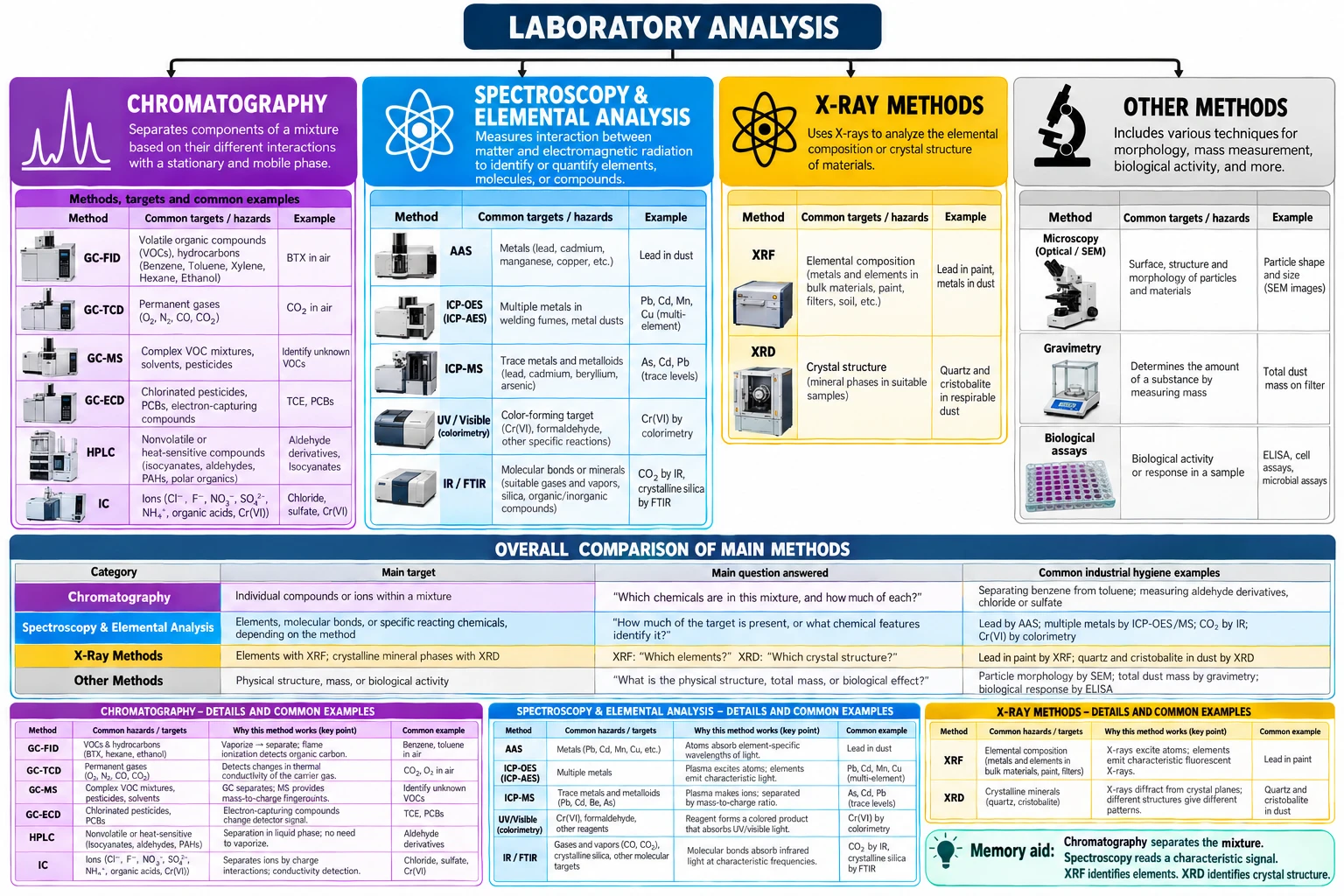
07 Laboratory Analytical Methods
Which instrument answers which question.
Pick the method by the question it answers, not by the instrument's name.
Chromatography: which compounds, and how much of each?
| Method | Best for | How it works |
|---|---|---|
| GC-FID | Volatile organics: BTX, hexane, alcohols, ketones | Vaporize, separate on a column, burn in a hydrogen flame; carbon makes ions that are counted |
| GC-TCD | Permanent gases (O₂, N₂, CO, CO₂) | Detects change in the carrier gas's heat conduction. No flame needed |
| GC-MS | Complex or unknown mixtures; pesticides | Separates, then reads the mass fingerprint of each compound |
| GC-ECD | Chlorinated pesticides, PCBs | Compounds that capture electrons change the detector signal |
| HPLC | Isocyanate and aldehyde derivatives, PAHs, other heat-sensitive or nonvolatile compounds | A liquid carries the sample through the column, so it never has to become a gas |
| Ion chromatography | Chloride, nitrate, sulfate, ammonium, organic acids, Cr(VI) | Separates ions by their charge |
Spectroscopy: which elements, which chemicals?
| Method | Best for | How it works |
|---|---|---|
| AAS | Single metals such as lead, cadmium, copper | Free atoms absorb their own wavelength; the missing light is measured |
| ICP-OES | Many metals at once (welding fume, digested filters) | A hot plasma excites atoms, which emit element-specific light |
| ICP-MS | Trace metals and metalloids (Pb, Cd, Be, As) | A plasma makes ions, which are sorted by mass-to-charge. Most sensitive of these |
| UV/visible colorimetry | Cr(VI), formaldehyde and other chemicals that form a color | A reagent makes a colored product; more absorbed light means more analyte |
| IR / FTIR | CO, CO₂, suitable vapors; silica by validated methods | Bonds absorb infrared at characteristic frequencies |
X-ray methods: which element, which crystal?
| Method | Best for | How it works |
|---|---|---|
| XRF | Lead in paint; metals in bulk material | X-rays cause atoms to emit characteristic fluorescent X-rays; identifies elements |
| XRD | Quartz and cristobalite in respirable dust | Crystal planes diffract X-rays into patterns that identify the mineral structure |
Laboratory analysis at a glance
08 Sampling, Media and Instruments
Now that you know the methods, match each hazard to its medium and instrument, check capacity, volume and calibration, and learn the field instruments that read on the spot.
A sampling medium has to hold the chemical, in the form it is in, until the lab can measure it. Decide the form first: a particle on a filter, a vapor on a sorbent or in a liquid, or a gas in a bag or canister. Filters, cyclones and size fractions are in Particulate Size and Sampling.
Know your volume: calibration standards
| Type | Device | How it works |
|---|---|---|
| Primary (measures volume directly) | Bubble meter (soap film) | Times a soap film through a tube of known volume |
| Primary | Spirometer, Mariotti bottle, piston meter (e.g. DryCal) | Gas displaced in a bell, liquid or precisely sized cylinder |
| Secondary (must be checked against a primary) | Rotameter | Float in a tapered tube; reading depends on conditions |
| Secondary | Critical orifice | Sonic flow through a hole; depends on pressure and temperature |
| Secondary | Dry gas meter, wet test meter | Bellows or drum counts volume; accuracy depends on condition and fluid level |
| Secondary | Mass flow controller | Heat-loss sensor; gas-specific calibration |
Calibrate the pump with a calibrated primary reference and representative sampling media in line, before and after sampling, following the method instructions. If air volume is overestimated, concentration is underestimated. A pitot tube with a manometer belongs to ventilation measurement, not pump calibration: it reads velocity pressure, which gives duct air velocity, and velocity times duct area gives airflow.
Sorbent tubes: the three you will meet
| Medium | Best for | Weak point |
|---|---|---|
| Charcoal | Nonpolar organic vapors: solvents, aromatics, many halogenated compounds | Water competes at high humidity; very polar or very light compounds hold poorly; reactive compounds can be lost |
| Silica gel | Polar compounds such as amines, some alcohols, and acids | Humidity cuts its capacity sharply because water takes the sites |
| XAD-2 and similar polymers | Semivolatile vapors such as PAHs and many pesticides, often behind a filter | Used with a filter when both particle and vapor are present |
Front, back and the breakthrough rule
A sorbent tube has a large front section (for example 100 mg of charcoal) and a smaller back-up section (50 mg). The back section catches what the front could not hold. The two are analyzed separately. If the back section holds more than about 25% of the front (NIOSH criterion), the chemical may have passed through, and the sample is probably low. Breakthrough comes sooner at higher temperature, higher humidity, higher concentration, a higher flow, or a longer sampling time than the method allows.
Passive (diffusive) samplers and impingers
| Sampler | How it works | Use it when |
|---|---|---|
| Passive badge | No pump. The chemical diffuses to the sorbent at a fixed rate set by Fick's law: uptake rate ∝ D × A ÷ L (diffusion coefficient, open area, path length) | Personal monitoring is easier with no pump. Concentration = mass ÷ (uptake rate × time) |
| Impinger | Air bubbled through 10–25 mL of collecting liquid, typically at about 1 L/min, so the chemical dissolves or reacts | A gas must be captured by absorption or reaction (for example formaldehyde); glass is fragile, so many methods now use treated sorbents |
Example (hypothetical numbers): a badge with a 20 mL/min uptake rate worn for 480 min samples 9.6 L = 0.0096 m³. A lab result of 12 µg gives 12 ÷ 0.0096 = 1,250 µg/m³ ≈ 1.25 mg/m³.
Direct-reading instruments: answers on the spot
A direct-reading instrument gives an answer in the field with no lab, but only about what its sensor responds to. Know the sensor, how it can be wrong, and the check that proves it works.
| Instrument | Measures | Watch for |
|---|---|---|
| PID (photoionization) | Total ionizable vapors. A UV lamp (commonly 10.6 eV) ionizes any compound whose ionization potential (IP) is lower than the lamp energy | A chemical with IP above the lamp is invisible. Humidity and dust affect it. Readings assume the calibration gas (usually isobutylene) |
| Catalytic bead (LEL sensor) | Flammable gas as % of the LEL, by heat from burning on a hot bead | Needs oxygen to work; poisoned by silicones, lead compounds and H₂S; calibrated to one gas, so other gases need a correction factor |
| Electrochemical | Specific toxic gases (CO, H₂S, O₂) | Cross-sensitivity to other gases; sensors age and dry out |
| NDIR | Infrared-absorbing gases (CO₂, CO, hydrocarbons) | The standard for CO₂ and ventilation checks; unaffected by oxygen level |
| Aerosol photometer, particle counter | Particle concentration trends | Calibrated on one test dust; gives relative values, not a mass sample |
| Colorimetric detector tubes | A specific gas, by length of stain | Short-term use; accuracy is stated by the manufacturer (typically about ±25% of the reading) under a stated temperature and humidity |
PID readings are relative to the calibration gas. For a different chemical, apply the manufacturer's correction factor (CF): true concentration = reading × CF. Hypothetically, a reading of 40 ppm with a CF of 0.5 means about 20 ppm of the target. A mixture cannot be corrected with a single factor.
Prove it works: bump test versus calibration
| Check | What it does | When |
|---|---|---|
| Bump test (function check)OSHA | A challenge gas is passed over the sensors to confirm they respond and that every alarm activates. It does not measure accuracy | Before each day's use, per the manufacturer |
| Calibration check | Test gas is applied and the reading is compared with the known value; typically within ±10–20% | Periodically and whenever in doubt |
| Full calibration | The instrument is adjusted to match certified gas traceable to NIST | Whenever a bump or calibration check fails, and on the manufacturer's schedule |
A failed bump test or calibration check means a full calibration before the instrument is used again. A meter that has not been checked is not a basis for a decision.
Hazard to medium to instrument
| Hazard | Typical medium | Typical instrument | Why |
|---|---|---|---|
| Alcohols, ketones, esters, ethers, halogenated solvents, BTX, heavy alkanes | Charcoal sorbent tube | GC-FID (GC-MS for unknown mixes) | Organic vapors adsorb well on charcoal; carbon burns well in a flame detector |
| Amines (aniline, methylamine) | Silica gel tube or acid-treated filter | GC-FID or HPLC | Acidic media captures the basic amine |
| Aldehydes (formaldehyde) | DNPH-coated sorbent or impinger | HPLC (or UV/visible) | Polar and heat-sensitive, so keep them liquid and derivatize |
| Isocyanates (TDI, MDI) | Reagent-coated filter or impinger | HPLC | Reactive and heat-labile; stabilize on the medium at collection |
| Carboxylic acids (acetic) | Silica gel tube | Ion chromatography | Water-soluble acids are separated by charge |
| Metals (lead, cadmium, beryllium, nickel) | MCE filter, 0.8 µm | ICP-MS, ICP-OES or AAS | Filter is acid-digested and the solution is measured. Form matters: organic lead (tetraethyl lead) is skin-absorbed and affects the CNS; soluble, insoluble and carbonyl nickel are judged separately |
| Hexavalent chromium | PVC filter | Ion chromatography or colorimetry | Form matters: Cr(VI) is the carcinogen (OSHA limit 5 µg/m³OSHA) and Cr(III) is not. The +6 state must be kept |
| Arsenic | MCE filter, 0.8 µm (particulate arsenic only; arsine and As₂O₃ vapor need other methods); urine for biological monitoring | AAS (NIOSH 7900), ICP-OES or ICP-MS; HPLC-ICP-MS to speciateCDC/NIOSH | Form matters: inorganic arsenic is the toxic, regulated form. Seafood arsenic (arsenobetaine) can inflate a total urine result, so speciate before calling it exposure |
| Mercury | Hopcalite sorbent tube (NIOSH 6009, elemental mercury)CDC/NIOSH | Cold-vapor AAS | Form matters: elemental vapor, inorganic salts and methylmercury act on different organs; mercury compounds can read falsely high |
| Crystalline silica | Respirable cyclone with PVC filter | XRD | Form matters: only diffraction tells quartz or cristobalite from amorphous silica with the same formula |
| Asbestos and fibers | MCE filter in open-face cassette | PCM (count); TEM (identify) | PCM counts fibers by shape (length, aspect ratio 3:1 or more); TEM identifies the mineral |
| CTPV: benzene-soluble fraction (OSHA Method 58)OSHA | Glass-fiber filter in a cassette | Benzene extraction, then gravimetry | The OSHA limit is the benzene-soluble fraction: extract the collected material, evaporate the solvent and weigh the residue. This is not the weight of the whole filter catch. (The NIOSH REL uses the cyclohexane-extractable fraction, a different target.) If the result exceeds the PEL, selected PAHs are then measured by HPLC |
| Individual PAHs (NIOSH Method 5506)CDC/NIOSH | PTFE filter plus XAD-2 sorbent tube | HPLC with fluorescence or UV detection | Collects particle and vapor-phase PAHs, then separates and measures each compound. The benzene-soluble fraction is not the sum of the measured PAHs, so the two are not interchangeable |
| Cotton dust; endotoxin | Filter after a vertical elutriator; filter extract | Gravimetry; LAL assay | Dust is weighed. Endotoxin is a biochemical assay |
| Light gases (propane, butane) | Bag or canister, or a direct-reading meter | Direct reading or GC | Too volatile to hold on solid sorbents |
| NO and NO₂ | TEA-coated sorbent or direct-reading sensor | Colorimetry; chemiluminescence in the field | Collected as a nitrite that makes a dye |
09 Reading a Laboratory Report
Can the lab see it, can you trust the number, and did anything change it on the way.
The central question: does this sampling and analysis result reliably answer the exposure question? The four data-quality goals, the ±25% accuracy target and laboratory accreditation are in the Particulate Size and Sampling guide.
| Term | Meaning | Calculation or reading |
|---|---|---|
| LOD | Smallest amount distinguishable from background | Commonly estimated as 3s ÷ b (s = low-level signal variability, b = calibration slope). Below the LOD does not mean absent |
| LOQ | Lowest amount measurable with acceptable quantitative reliability | Commonly 10s ÷ b. Between LOD and LOQ the value is an estimate only |
| Mass limit versus air limit | Labs report µg per sample; you need µg/m³ | CLOQ = mLOQ ÷ Vair. More air collected means a lower detectable concentration |
| Reporting limit | What the lab chooses to report | May be higher than the LOD or LOQ because of dilution or matrix; read the definitions |
| Accuracy | Closeness to the true value; affected by bias and precision together | Not a single percentage |
| Bias | Consistent error in one direction | % bias = 100(mean − reference) ÷ reference |
| Precision | Agreement among repeats | s, and %RSD = 100s ÷ mean |
| RPD | Disagreement between duplicates | 100|x1 − x2| ÷ mean |
| Measurement uncertainty | Spread around the reported value | Matters most near a limit; the lab states the coverage factor |
Plan a sample sensitive enough. A lab LOQ of 0.002 mg per sample and a target of 10% of a 0.05 mg/m³ limit (0.005 mg/m³) needs at least 0.002 ÷ 0.005 = 0.40 m³ (400 L). At a method-approved 2 L/min that is 200 min. If only 40 L were collected, the LOQ would be 0.05 mg/m³, the full limit, and the sample could not show exposure at 10% of it. Longer sampling must still respect sampler capacity and the averaging period.
Precise but biased. A reference of 100 µg and replicates of 89, 90 and 91 µg give a mean of 90, a bias of −10%, a standard deviation of 1 and an RSD of 1.11%. The results agree closely and are consistently low.
Recovery and blanks
| Item | What it checks | Treatment |
|---|---|---|
| Desorption efficiency | How much of the analyte the lab can get off the sorbent | % DE = 100 × recovered ÷ added |
| Matrix spike recovery | Whether the sample matrix suppresses or enhances the result | 100(spiked − unspiked) ÷ added |
| Field blank | Contamination from media and handling | Handled like a sample; no air drawn. About 10% of samples, never fewer than two |
| Media blank | Background in unused media, from the same lot | Analyzed as is |
| Trip blank | Contamination in shipping and storage | Travels with samples, no sampling |
| Reagent (method) blank | Contamination from lab preparation | Analyte-free material taken through preparation |
Where a method requires both corrections and the lab has not already applied them: 50 µg measured, 5 µg blank, DE 0.90, air volume 0.100 m³ gives (50 − 5) ÷ 0.90 = 50 µg, so 50 ÷ 0.100 = 0.50 mg/m³. Never correct twice. Blank and recovery rules differ by method, and there is no universal 90% or 75% recovery.
What can damage a sample
| Factor | Likely effect |
|---|---|
| Higher temperature | Reduced adsorption; earlier breakthrough or loss |
| High humidity | Water competes for sorbent sites; filters can gain weight |
| Flow too high | Poor capture, or the wrong size fraction on a size-selective sampler |
| Overloading | Breakthrough beyond the sampler's capacity |
| Wrong medium | Analyte passes through or reacts |
| Vapor and aerosol together | One stage may miss the other phase; low result |
| Poor storage or delay | Evaporation, degradation, a change of chemical form |
| Wrong air volume | Volume too high gives a concentration too low |
Checklist for any lab report
| Check | Ask |
|---|---|
| Target and method | Did the lab analyze the right chemical, form and sample type? |
| Sensitivity | Is the sample-specific reporting limit low enough for the decision? |
| Quality control | Are blanks, spikes, calibration checks and duplicates acceptable? |
| Integrity | Were holding times, storage and sampler capacity respected? |
| Units and corrections | Mass per sample or air concentration? Are blank, recovery and dilution already applied? |
| Accreditation | Is the test inside the lab's accredited scope? |
| Relevance | Does the sample represent the worker, task, fraction and averaging period of concern? |
10 Self-Test
Original scenarios. Cover the answer, decide, then open it.
1A liquid has a flash point of 20°F and boils at 180°F. Flammable or combustible, and which class?
Flammable: its flash point is below 100°F. Below 73°F with a boiling point at or above 100°F makes it Class IB.
2A vapor mixture is 50% acetone, 30% toluene and 20% hexane by fuel volume. What is its LEL, and why is it not 2.5%?
LELmix = 1 ÷ (0.50/2.5 + 0.30/1.1 + 0.20/1.1) ≈ 1.53%. It is pulled down by the two components with LELs near 1.1%, so the mixture ignites at far lower vapor than acetone alone.
3A confined-space meter reads 10% LEL for toluene vapor. Is the space safe to enter without respiratory protection?
No. 10% LEL is about 1,100 ppm, many times the toluene exposure limit. It is also at OSHA's 10% LEL threshold for a hazardous flammable atmosphere. Toxicity governs entry long before the air can burn.
4Propane and hydrogen both leak in a basement. Where should detectors go?
Propane (vapor density about 1.5) settles, so detectors go low. Hydrogen (about 0.07) rises, so detectors go high.
5A 3-year-old bottle of diethyl ether has crystals around the cap. What do you do?
Do not touch or open it. Ethers form shock-sensitive peroxides on standing, and crystals mean a detonation hazard. Secure the area and call the hazardous-materials or disposal contact.
6A lab holds one sample bottle labeled sodium metal and another labeled calcium carbide. What do they have in common, and what extinguisher is wrong?
Both are water-reactive (sodium releases hydrogen and heat; calcium carbide releases acetylene). Water is wrong. Use a Class D agent or dry sand per the program.
7A sorbent tube is analyzed. The front section has 80 µg, the back 30 µg. Valid?
The back is 37.5% of the front, above the 25% criterion, so breakthrough likely occurred and the result is probably low. Resample with less volume or a lower flow.
8A passive badge with a 20 mL/min uptake rate was worn 8 hours and the lab found 12 µg. What is the concentration?
Volume = 20 mL/min × 480 min = 9.6 L = 0.0096 m³. C = 12 ÷ 0.0096 ≈ 1,250 µg/m³ (1.25 mg/m³).
9A PID with a 10.6 eV lamp reads zero in a room where methylene chloride is being used. Is the room clean?
No. Methylene chloride's ionization potential (11.32 eV) is above the lamp's energy, so the PID cannot see it. Use an 11.7 eV lamp or another method.
10A gas monitor passed its bump test this morning. Is its reading accurate?
Not proven. A bump test only shows that the sensors respond and the alarms work. Accuracy needs a calibration check against a known gas, and a full calibration if it fails.
11Three solvents each read below their own PELs: toluene 80 ppm (200), MEK 60 ppm (200), acetone 300 ppm (1,000). Is the mixture acceptable?
The additive sum is 0.40 + 0.30 + 0.30 = 1.00. That is at the limit of 1, so it is not under it. Controls are needed, assuming the effects add.
12Why can a high urine arsenic after a seafood dinner be misleading?
Seafood contains organic arsenic (such as arsenobetaine) that is not the toxic form. Total arsenic can look high, so the urine needs speciation to find inorganic arsenic.
These are original practice scenarios written for this page. They are not BGC questions and do not predict exam content.