CIH Exam Prep, Documented as It Happens
SPEP built its CRSP and CRST question banks after passing both exams — mapping exactly what gets tested. CIH is being built the opposite way: the founder is studying and sitting the exam himself, sharing every reference guide and tool along the way. No finished question bank yet — but a real study journal, a growing set of reference guides, and a working Equation Master you can use today.
Everything Written So Far
Free reference guides pulled directly out of real CIH study notes — no sign-up required for any of them.

Free CIH flashcards: study topics
Swipe cards covering every CIH topic written up so far — pick one topic or study them all. Swipe left when you know it, right to see it again.
Open the flashcards →What Is CIH? The Certified Industrial Hygienist Credential
What CIH actually certifies, the 17 subject areas it covers, who administers it, and how it compares to CRSP and CRST.
Learn the basics → EXAM BLUEPRINT
CIH Exam Blueprint: 3 Domains, 9 Tasks Explained
The official BGC blueprint in plain terms — domain weights (50/35/15%), all nine tasks, the 17 technical subject areas exam questions are categorized under, exam format, and current fees.
See the blueprint → STUDY JOURNAL
My CIH Exam Journey: Study Journal & Scouting Strategy
A live study journal documenting the CIH exam prep process — knowledge unit tracking, question type patterns, and a phase-by-phase scouting strategy for ABIH candidates.
Follow along → REFERENCE
CIH Exam Eligibility: Complete BGC Requirements Checklist
Every CIH eligibility requirement explained — STEM credits, IH coursework, the Big Four pillars, ethics hours, professional experience, and reference options — sourced from BGC's official checklist.
Check eligibility → REFERENCE
CIH Calculator & Math Basics
The math skills behind every CIH equation — logs, exponents, roots, ratios — explained plainly with worked examples, exact calculator keystrokes, and a free practice calculator.
Refresh your math → REFERENCE
CIH Exam Equations: Complete Formula Reference
Every equation on the CIH exam — ventilation, noise, statistics, heat stress, and radiation — rendered with a plain-language variable key for each formula.
View equations → STUDY MATERIAL · AIR SAMPLING
Particulate Size & Sampling: A Field Reference
A log-scale chart linking fumes through fibers to the inhalable/thoracic/respirable cut-points, real NIOSH sample trains for asbestos and silica, and the equations behind flow rate and diffusive uptake.
See the chart → STUDY MATERIAL · TOXICOLOGY
Toxicology Basics: How Exposure Becomes Harm
Exposure, dose, toxicity and risk; routes of entry; ADME; dose-response and LD50; twenty mechanisms of harm; irritation versus sensitization; cancer and developmental harm; interactions; limit labels; and how to read the evidence. Read it before the chemical tables.
View reference → STUDY MATERIAL · TOXICOLOGY
Industrial Toxicology Reference
69 substances across 8 chemical families with workplace sources, routes, mechanisms, and acute and chronic effects, plus a glossary of medical prefixes and suffixes. Built for CIH, useful for CRSP and CRST too. For the theory behind the terms, start with Toxicology Basics.
View reference → STUDY MATERIAL · RADIATION
CIH Radiation Reference: Ionizing and Nonionizing
Alpha to neutrons, Curie to Sievert as one chain, time-distance-shielding, detectors, effects and NRC dose limits — then UV, IR, RF/microwave and lasers.
View reference → STUDY MATERIAL · VENTILATION
HVAC Air Cycle: Complete Airflow Reference
The full HVAC cycle with the OA/RA/MA/SA/EA/MUA terminology, plus ventilation for contaminant control — dilution vs local exhaust, SP/VP/TP, hoods, fans and the six-and-three rule.
View airflow guide → STUDY MATERIAL · NOISE
CIH Noise Control and Vibration
Sound basics, how noise damages hearing, the OSHA hearing conservation program, noise control and NRR derating, and hand-arm and whole-body vibration — with a self-test.
View reference → STUDY MATERIAL · NOISE
How to Apply A-Weighting: Octave-Band Table & Real Dose Examples
Frequency weighting explained, the real octave-band correction table, and a full worked multi-machine example — distance correction, source combination, and a real OSHA-vs-ACGIH dose comparison.
See the walkthrough → STUDY MATERIAL · NOISE
Ear Anatomy & Industrial Hygiene: A Field Reference
Outer, middle, and inner ear anatomy mapped directly to conductive vs. sensorineural hearing loss, ototoxicants, the acoustic reflex, acoustic trauma vs. NIHL, and audiometric testing frequencies.
See the anatomy → STUDY MATERIAL · NOISE
Noise Dosimeter Setup: OSHA HC, OSHA PEL & ACGIH TLV
How to configure a 3M/Quest Edge 5 dosimeter for all three profiles at once — with a real setup screenshot and a real Criterion Level configuration error, annotated.
See the setup → STUDY MATERIAL · COMMUNITY
CIH Community Exposure Reference
Chapter 8 in one logical order — sources, lapse rate and plume types, dilution and ppm, monitoring, isokinetic sampling, air cleaning, water and hazardous waste, ERPG/AEGL, ERG and ICS — with a self-test.
View reference → STUDY MATERIAL · BIOHAZARDS
CIH Biological Hazards Reference
27 occupational biological hazards plus allergens and microbial toxins, then sampling, mold remediation, Legionella, biosafety levels, disinfection, infection control, the bloodborne pathogens standard and shipping — all cited.
View reference → STUDY MATERIAL · PPE
CIH PPE Reference
PPE as the last resort, ANSI/ASTM markings for eye, face, head, foot and hand protection, chemical glove selection, HAZWOPER Levels A–D, eyewash and shower rules, respirator fit testing, and NRR derating — with a self-test.
View reference → STUDY MATERIAL · ERGONOMICS
CIH Ergonomics Reference
Risk factors, anthropometry and biomechanics, the cumulative trauma disorders, the ACGIH Hand Activity Level and NIOSH lifting equation, work physiology, symptom-to-control tables, program elements, office setup and illumination levels — with a self-test.
View reference → STUDY MATERIAL · CHEMISTRY
CIH Chemistry Reference
Atoms and the mole, gas laws, concentration and acid-base, organic families and their hazards, flammability and reactivity, laboratory methods, sampling media, direct-reading instruments and how to read a lab report — with a self-test.
View reference → STUDY MATERIAL · HAZARD RECOGNITION
Industrial Processes and Occupational Hazards
Construction, metal work and foundries, chemical processing, healthcare and agriculture, semiconductors and batteries: for each task the agent, how exposure occurs, the health effect and what the hygienist checks — plus recognition patterns and common corrections.
View reference → STUDY MATERIAL · INDOOR AIR QUALITY
Indoor Air Quality and Indoor Environmental Quality
Source, pathway and occupant; understanding the complaint; common contaminants; HVAC, CO₂ and moisture; the investigation sequence; the calculations; radon, Legionella and standards; and controls — with worked examples.
View reference → STUDY MATERIAL · THERMAL STRESS
Heat and Cold Stress
The heat-balance equation, heat-transfer mechanisms, WBGT with worked examples, clothing adjustments, acclimatization and hydration, heat illness first aid, controls, wind chill and cold injuries — with a unit audit and practice checks.
View reference → STUDY MATERIAL · EXPOSURE ASSESSMENT
Exposure Assessment: From the Workplace to a Decision
Similar exposure groups, the assessment question and benchmark, sampling choices and direct-reading instruments, validating the data, lognormal GM, GSD and the 95th percentile, tolerance limits, the AIHA exposure categories, control banding, and models — with a worked example.
View reference → STUDY MATERIAL · EPIDEMIOLOGY
Occupational Epidemiology: From Workplace Questions to Useful Evidence
Prevalence, risk and person-time rates; cohort, case-control and cross-sectional designs; RR, OR, risk difference, SMR and PMR from worked tables; bias, confounding and the healthy-worker effect; confidence intervals and power; causation; screening measures; and exposure history — with invented teaching examples and check questions.
View reference → SOURCES
CIH References: Official Sources
Every BGC, CDC, NIOSH, OSHA and WHO source cited on SPEP's CIH pages, in one place with permanent links and the date each was checked.
See the sources →
Master Every CIH Equation
The CIH exam gives you a bare equation sheet and an on-screen calculator — nothing else. The Equation Master is built around that exact reality, in three steps.
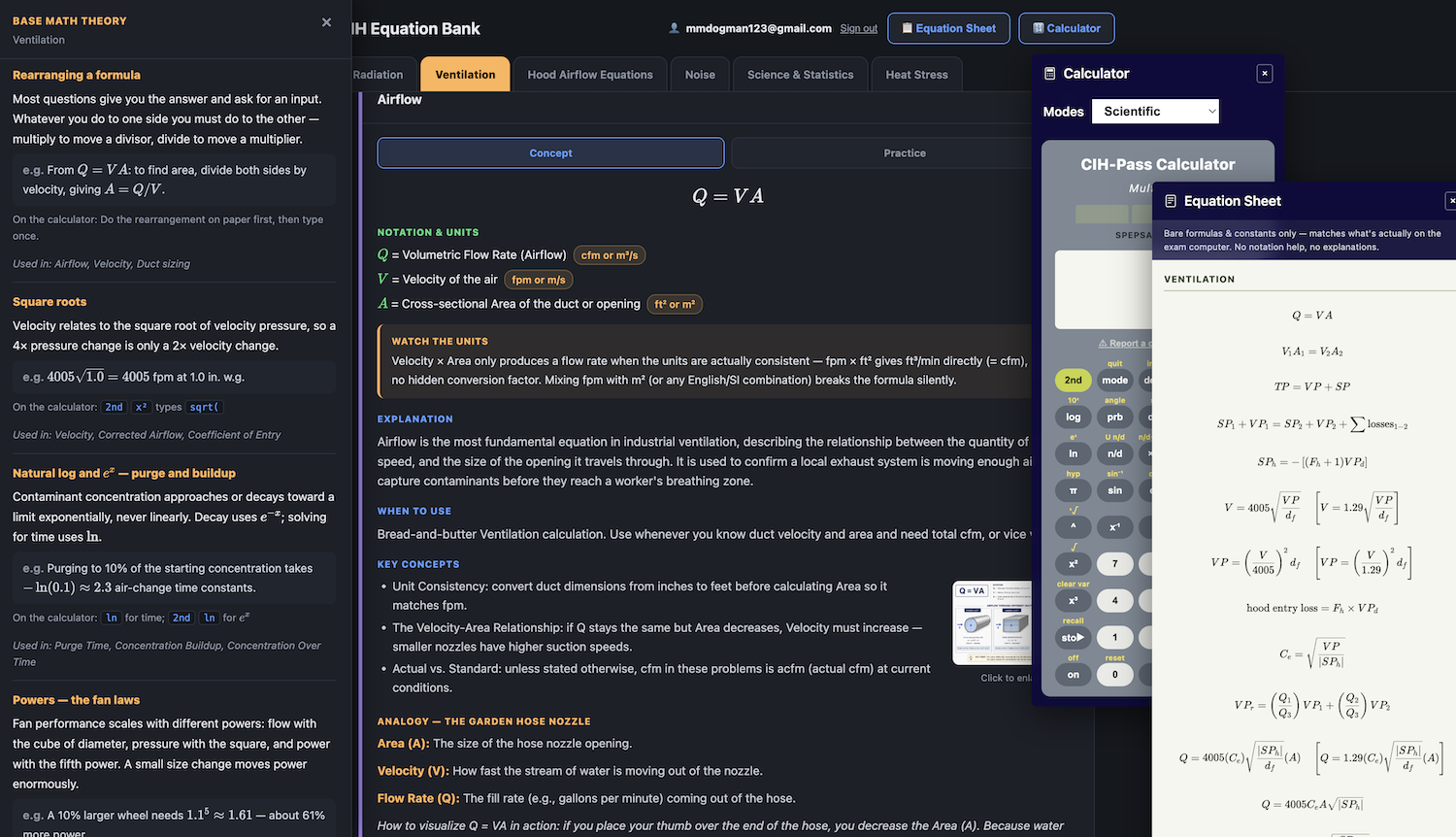
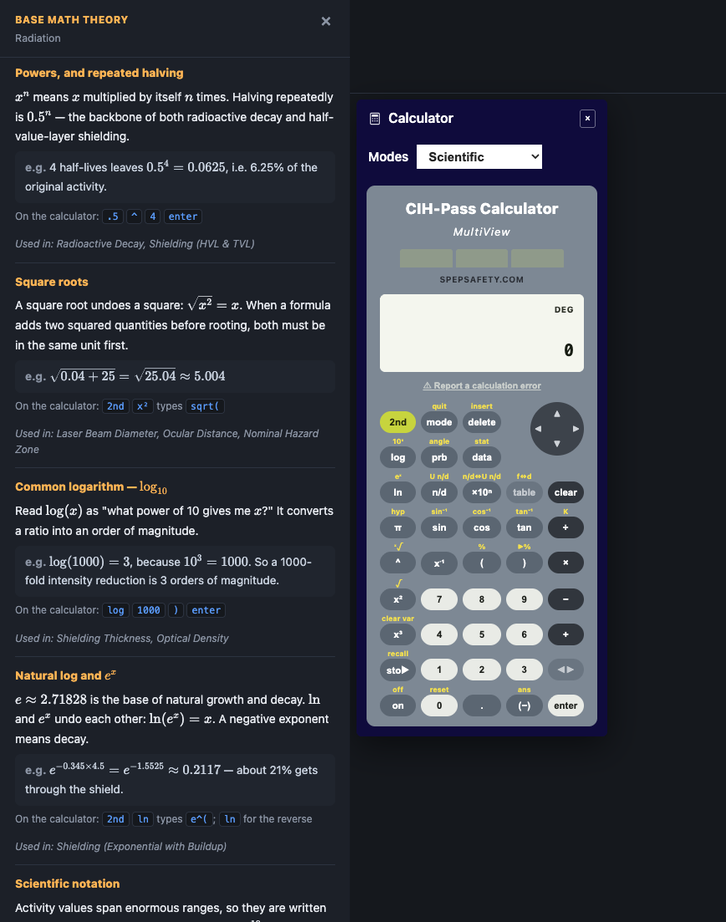
Base Math Theory & Calculator
Before the equations, the calculator itself. A sidebar walks through the underlying math — powers and repeated halving, square roots, logarithms, natural log, scientific notation — each with the exact keystrokes for the CIH-approved scientific calculator, plus a note on which equations actually use that skill.
Paired with a full working scientific calculator (MultiView, trig, logs, memory functions) built directly into the app, so you practice on the same interface you'll use on exam day.
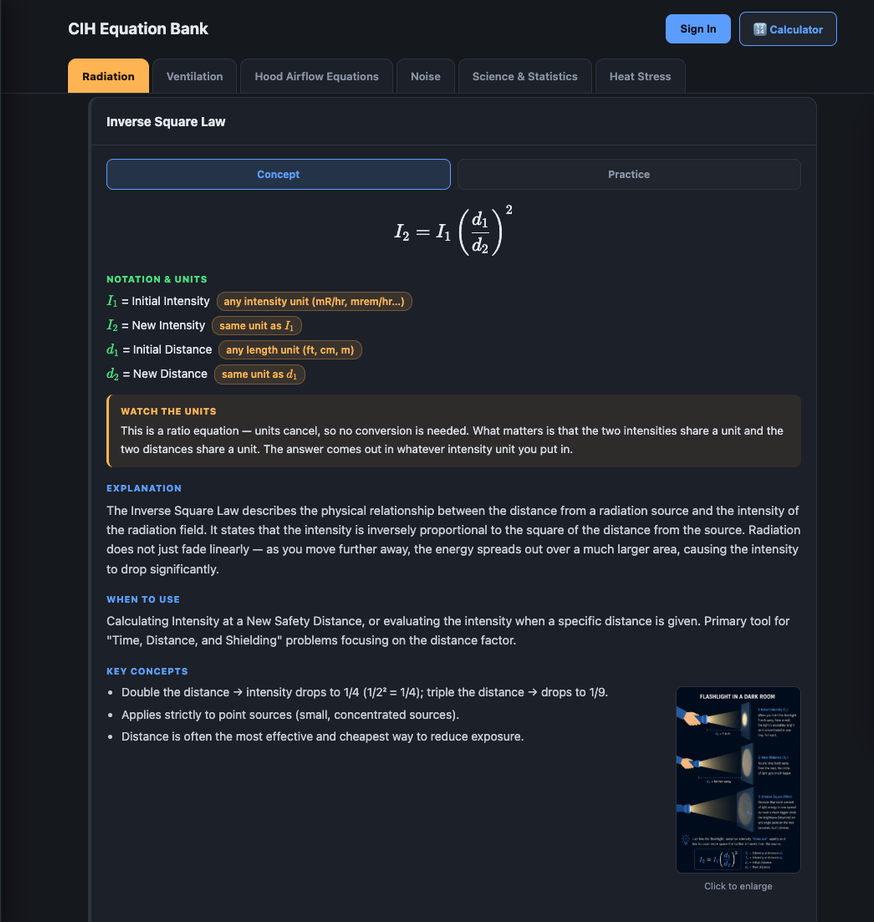
Concept & Practice, Per Equation
Every formula on the exam gets its own Concept and Practice tab. Concept breaks the formula down variable by variable — Notation & Units, a plain-language Explanation, When to Use, and Key Concepts. Practice then drills it, so recognizing the formula and remembering what each letter stands for becomes automatic instead of something you're still working out mid-exam.
All 98 equations are organized into six categories — Radiation, Ventilation, Hood Airflow, Noise, Heat Stress, and Science & Statistics.
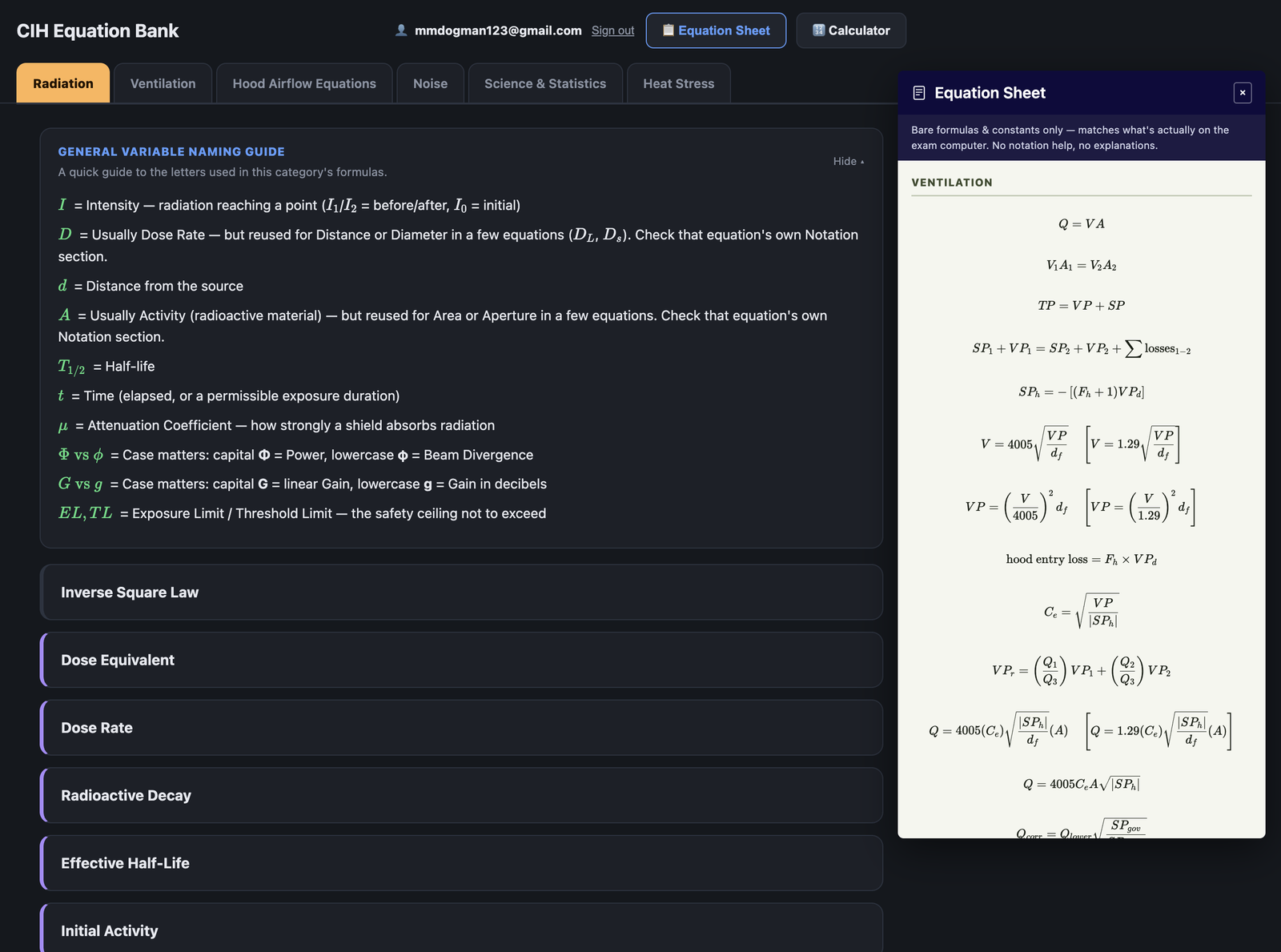
Equation Sheet + Calculator — the Exam, Simulated
The real CIH exam gives you a bare formula sheet with no notation help and no explanations — just the equations and constants. The app's Equation Sheet mode is built to match that exactly, paired with the same calculator. Practicing here isn't just equation review — it's a dry run of the actual exam-day interface, so nothing about the format is unfamiliar when it counts.
Try the CIH Equation Master Free
All 98 equations, worked practice problems, dimensional-analysis breakdowns, and a built-in scientific calculator.
Try Free — Radiation Category →No sign-up required
Already working toward CRSP or CRST instead?
SPEP's full CRSP and CRST question banks are live — 4,000+ blueprint-aligned questions, case-based scenarios, and adaptive weak-area tracking.
CIH Exam Prep — Frequently Asked Questions
Is the CIH practice question bank ready yet?
Not yet. SPEP already has full CRSP and CRST practice question banks built from real observed exam patterns. For CIH, SPEP is documenting a real, first-person exam journal as the founder studies and sits the exam himself — once he completes it, SPEP plans to build a CIH question bank the same way, based on what actually gets tested.
What is the CIH Equation Master, and is it free?
The CIH Equation Master is a standalone calculator and practice tool covering all 98 equations on the CIH exam, organized by category (Radiation, Ventilation, Hood Airflow, Noise, Heat Stress, and Science & Statistics). It includes a built-in scientific calculator, per-equation notation and practice, and an Equation Sheet mode that matches the bare formula sheet provided on the real exam. The Radiation category is free to try with no sign-up required.
How is CIH content different from the CRSP/CRST content on SPEP?
CRSP and CRST have complete, blueprint-aligned practice question banks built after the founder passed both exams. CIH is being built the opposite way, in public: the founder is documenting his own CIH study process as he goes, sharing reference guides and the Equation Master as he builds them, ahead of sitting the exam himself.
Is SPEP affiliated with BGC or ABIH?
No. SPEP (Safety Professional Exam Preparation) is an independent exam preparation resource and is not affiliated with, endorsed by, or connected to BGC (Board for Global EHS Credentialing), formerly ABIH.
Where should I start if I'm new to CIH exam prep?
Start with the CIH Exam Eligibility checklist to confirm you qualify, then the CIH Exam Journal to follow real chapter-by-chapter prep notes. If you're ready for equations, the CIH Equation Master's Radiation category is free to try immediately with no sign-up.
