CIH Radiation Reference: Ionizing and Nonionizing
The radiation chapter of the CIH exam throws four different unit systems at you — Curie, Roentgen, rad, rem — each paired with an SI equivalent. They're confusing on their own, but they stop being confusing once you see them as a chain: each unit describes radiation at a different point in its journey from the source to a person. This page started as that units guide and now covers the whole chapter in order: ionizing radiation (types, units, control, detection, effects, limits), then nonionizing radiation (UV to radio frequency, and lasers).
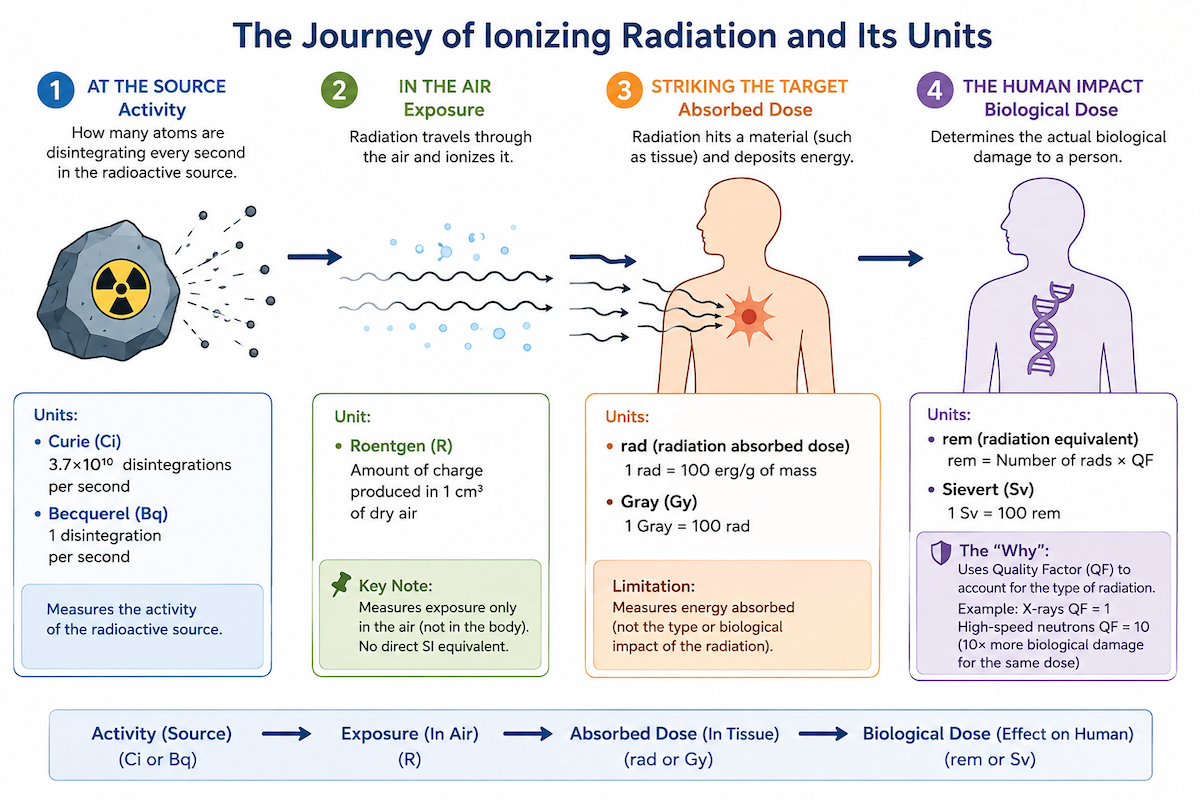
Ionizing radiation units aren't four random terms to memorize — they're four checkpoints along one path: Activity (Curie/Becquerel) at the source → Exposure (Roentgen) in the air → Absorbed Dose (rad/Gray) in a material → Biological Dose (rem/Sievert) in a person. Imperial and SI units exist side by side because SI is the international standard, but imperial units (Curie, rad, rem) are still common in industrial and historical contexts — and the conversions between them are almost always clean factors of 100.
Types of Ionizing Radiation
Ionizing radiation carries enough energy to knock electrons off atoms. What it is decides how far it travels, what stops it, and whether the danger is outside the body or inside it.
| Type | What it is | Stopped by | Main hazard | Protect / shield |
|---|---|---|---|---|
| Alpha (α) | 2 protons + 2 neutrons; heavy, charged | A sheet of paper or the outer layer of skin | Internal only: inhaled, swallowed or through a wound | Shield: none needed outside the body; paper or skin already stops it. The control is containment: fume hood, glove box, ventilation PPE: respirator when the material is airborne as dust, aerosol or gas (the filter or cartridge must match the form), gloves, lab coat or coveralls, eye protection, shoe covers |
| Beta (β) | Fast electron; light, charged | Clothing or a thin layer such as aluminum or plastic | Skin burns and internal; use low-atomic-number shielding to limit bremsstrahlung X-rays | Shield: plastic, acrylic or aluminum first; add lead outside only to stop bremsstrahlung X-rays PPE: gloves and lab coat (skin contamination), safety glasses or face shield for the eyes, respirator if the material is airborne |
| Gamma (γ) and X-rays | Photons: pure energy (gamma from the nucleus, X-rays from outside it) | Several inches of lead or a few feet of concrete | External, whole body: passes right through | Shield: lead or concrete, with time and distance PPE: lead apron, thyroid collar and leaded glasses where the work allows them; personal dosimeter. A respirator is needed only if there is airborne contamination, because it does nothing against the external beam |
| Neutron (n) | Uncharged particle from fission, reactors and some sources | Hydrogen-rich material: water, polyethylene, concrete | External and deep; can make other materials radioactive | Shield: water, polyethylene or concrete to slow them, then a borated layer to capture them, then gamma shielding PPE: clothing does not stop neutrons; use a neutron-sensitive dosimeter. Respirator and gloves only where there is airborne or surface contamination (activated materials) |
A respirator is for intake, not for the beam. Radioactive material usually arrives as dust, aerosol or gas, so the respirator protects against breathing it in. It gives no protection against external radiation, which is what a shield is for. Pick the filter or cartridge for the form of the contaminant. Shield choices are explained in the Shield Material box below.
Source: EPA radiation basics
The Journey of Ionizing Radiation and Its Units
Before memorizing conversion factors, it helps to see the whole path radiation takes — from the radioactive source, through the air, into tissue, and finally to the biological effect on a person. Each of the four unit categories below sits at one stage of that journey.
Ionizing Radiation Units and Relationships
| Category | Imperial Unit | SI Unit | Relationship / Conversion | Description & Purpose | Measurement Type |
|---|---|---|---|---|---|
| Activity | Curie (Ci) | Becquerel (Bq) | 1 Ci = 3.7 × 10¹⁰ Bq | Measures the number of atoms disintegrating per unit of time at the source. | Direct Measurement |
| Exposure | Roentgen (R) | N/A | 1 R = 2.58 × 10⁻⁴ C/kg air | Measures ionization produced in dry air by γ or X-ray radiation. Does not measure dose in the body. | Direct Measurement |
| Absorbed Dose | rad | Gray (Gy) | 1 Gy = 100 rad | Measures the amount of radiation absorbed by a mass (1 rad = 100 erg/g), regardless of radiation type. | Direct Measurement |
| Biological Dose | rem | Sievert (Sv) | 1 Sv = 100 rem | Measures the dose equivalent, or biological impact — factors in radiation type using a Quality Factor (QF). | Calculated |
Explanation of Conversions and "Why"
The units for ionizing radiation follow a logical progression based on the journey radiation takes — starting at its radioactive source, moving through the air, being absorbed by a target, and finally causing a biological effect.
1. Direct Measurements
These units represent physical phenomena that can be directly observed and quantified using specific detection instruments.
At the Source: Activity Direct Measurement
The journey begins at the radioactive material itself. Activity measures how many atoms are disintegrating (decaying) every second within that source.
Imperial Unit: Curie (Ci), defined as 3.7 × 10¹⁰ disintegrations per second.
SI Unit: Becquerel (Bq), which is simply 1 disintegration per second.
How it's measured: instruments like a gas proportional counter or a Geiger-Müller (GM) meter detect these disintegration counts directly.
In the Air: Exposure Direct Measurement
Once radiation is emitted, it travels through the environment. For gamma and X-ray radiation, we measure the amount of ionization it produces in the surrounding dry air.
Unit: Roentgen (R). This represents the amount of charge produced in 1 cm³ of dry air.
How it's measured: typically with an ion chamber, which captures the voltage difference created by the positive and negative ions produced.
Key Note: This measures exposure only in the air and not in the body, and there is no direct SI equivalent to the Roentgen.
Striking the Target: Absorbed Dose Direct Measurement
When radiation hits a physical mass, such as human tissue, it is absorbed. The Dose measures the actual amount of energy deposited into that mass.
Imperial Unit: rad (radiation absorbed dose), where 1 rad equals 100 erg/g of mass.
SI Unit: Gray (Gy), where 1 Gray is equal to 100 rad.
How it's measured: devices like Thermoluminescent Dosimeters (TLDs) or calibrated detectors measure this energy deposition directly — for example, by measuring the light emitted when a TLD crystal is heated.
Limitation: this unit measures pure energy absorption but does not differentiate between the types of radiation or their specific biological impacts.
2. Calculated Units
These units are derived by applying a mathematical factor to a direct measurement, to account for biological variables.
The Human Impact: Biological Dose Calculated
This card covers the last bridge: from absorbed dose to biological dose (every radiation type)
rad (Gy)
energy in tissue, measured directly
$\times\,QF$ (or $w_R$) →
every radiation type
rem (Sv)
calculated
Bridges 1 and 2 (activity to exposure, exposure to absorbed dose) exist only for gamma and X-rays and are in the special-case box below. Alpha, beta and neutron radiation have no exposure stage, so they start at absorbed dose and use only this bridge.
Bridge 3: absorbed dose to biological dose (rem). The quality factor sets the biological weight of that energy:
The final stage of the progression is determining the actual biological damage to a person. This is known as the dose equivalent, and unlike the first three categories, it isn't read directly off an instrument — it's calculated based on the Absorbed Dose, multiplied by the Quality Factor. Because different types of radiation (like alpha vs. gamma) cause different amounts of damage to human tissue even when the absorbed energy is the same, a Quality Factor (QF) must be applied.
Imperial Unit: rem (radiation equivalent). Calculation formula: $\text{rem}=\text{rads}\times QF$, where the rads are the Absorbed Dose.
SI Unit: Sievert (Sv), where 1 Sv equals 100 rem — calculated from Grays using the same biological weighting factors.
The "Why": if you have a direct measurement in rads, you multiply it by the QF (e.g., 1 for X-rays, 10 for high-speed neutrons) to determine the rem, the actual biological impact. X-rays have a QF of 1 while high-speed neutrons have a QF of 10 — meaning neutrons cause ten times the biological damage for the same absorbed dose.
Weighting factors by radiation type. The last step of the chain, absorbed dose to biological dose, works the same way for every type of radiation: only the weighting factor changes. Two systems are in use, and an exam question will name one.
| Radiation | ICRP 103 wR | NRC 10 CFR 20.1004 Q | Teaching point |
|---|---|---|---|
| Gamma rays and X-rays (photons) | 1 | 1 | Same weighting category; energy and exposure geometry still matter |
| Electrons, including beta-minus particles; muons | 1 | 1 (beta) | Same weighting does not mean identical penetration or exposure patterns |
| Protons and charged pions | 2 | 10 (high-energy protons) | Framework-specific protection factor, not “moderate risk”; the two systems differ here |
| Alpha particles, fission fragments, heavy ions | 20 | 20 | High weighting per absorbed dose; actual risk also depends on dose and location |
| Neutrons | Continuous function of energy | 10 if energy unknown; otherwise a table of 2 to 11 by energy | Do not replace this with a universal 5–20 range |
How to use it: equivalent dose (Sv) = absorbed dose (Gy) × wR in the ICRP system; dose equivalent (rem) = absorbed dose (rad) × Q in the NRC system. The rem/Sv units follow the same 1 Sv = 100 rem relationship shown above.
Equation reference: dose equivalent and dose rate.
Know which system the question names. Canada’s Radiation Protection Regulations list the ICRP 103 weighting factors (Schedule 2). The NRC rule in 10 CFR 20.1004 still uses quality factors, which is why protons and neutrons differ between the two columns. Examples from the NRC neutron table: thermal neutrons Q = 2, 1 MeV neutrons Q = 11. Sources: ICRP Publication 103, Radiation Protection Regulations, Schedule 2, 10 CFR 20.1004.
Special Case: Gamma and X-Rays Have the Full Chain, from Activity to Biological Dose Calculated
The table above applies to every radiation type, but it starts from absorbed dose. Only gamma rays and X-rays let you calculate all the way from a source’s activity, because only they have an exposure (roentgen) and a gamma constant. The whole chain, Activity → Exposure → Absorbed Dose → Biological Dose, has four stages and therefore three bridges. Time, distance and the source strength go in; rem comes out.
This box covers all three bridges: from activity to biological dose (gamma and X-rays only)
Ci, mCi (Bq)
source strength, direct measurement
$\times\,\frac{\Gamma\,t}{d^{2}}$ →
gamma and X-ray only
roentgen (R)
dose in air, direct measurement
$\times\,1\ \text{rad/R}$ →
gamma and X-ray only
rad (Gy)
energy in tissue, direct measurement
$\times\,QF$ →
every radiation type; QF = 1 here
rem (Sv)
calculated
Bridge 1: activity to exposure (R). The air exposure from a point source is
Bridge 2: exposure to absorbed dose (rad). Each roentgen of gamma or X-ray exposure deposits about 1 rad in tissue (the usual exam simplification):
Bridge 3: absorbed dose to biological dose (rem). The quality factor sets the biological weight of that energy:
All three bridges together:
| Symbol | What it is | Units |
|---|---|---|
| Γ | Gamma constant (exposure rate constant): exposure rate at 1 cm from a 1 mCi point source of that isotope | R·cm2/(mCi·h) |
| Activity | Source strength | mCi |
| Time | Time exposed | h |
| Distance | Distance from the source | cm (must match the Γ units) |
| QF | Quality factor; 1 for gamma and X-rays | none |
Worked example: a 5 mCi Co-60 source, Γ = 13.07 R·cm2/(mCi·h), a worker 50 cm away for 4 hours.
Bridge 1 (activity to exposure): $\frac{13.07\times 5\times 4}{50^{2}}=\frac{261.4}{2{,}500}=0.105\ \text{R}$.
Bridge 2 (exposure to absorbed dose): $0.105\ \text{R}\times 1\ \text{rad/R}=0.105\ \text{rad}$.
Bridge 3 (absorbed dose to biological dose): $0.105\ \text{rad}\times QF\ 1=\mathbf{0.105\ rem}$ (about 105 mrem).
When it applies: gamma and X-rays from an unshielded point source, ignoring decay during the exposure and attenuation in the air. Adding shielding is a separate step (HVLs, below). If a question gives you Γ, use the value given.
When it does not apply: alpha, beta and neutron radiation have no roentgen and no Γ, so there is no Bridge 1. You cannot go from activity to dose with this formula. Bridges 1 and 2 are not available, so you start at the third stage, the absorbed dose (rad or Gy), and cross only Bridge 3 using the weighting factor in the table above. Source for Γ: NRC gamma constants; tabulated values vary slightly between compilations.
Controlling Exposure: Time, Distance, Shielding
Time
Dose = dose rate × time. Halve the time, halve the dose. Plan the job, rehearse it away from the source, and rotate workers.
Distance: the inverse square law
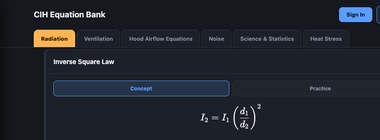
For a point source, intensity falls with the square of distance: $I_1 d_1^{2}=I_2 d_2^{2}$. Doubling the distance cuts the rate to one quarter. Example: 100 mR/h at 2 ft → 25 mR/h at 4 ft. Tongs and remote handling tools use this directly. Equation reference: inverse square law.
Shielding and the half-value layer
A half-value layer (HVL) is the thickness of a material that halves the intensity of a photon beam. Each extra HVL halves it again: after n HVLs, 1/2n remains (3 HVLs → 1/8). Match the shield to the radiation: paper for alpha, plastic or aluminum for beta, lead or concrete for gamma and X-rays, hydrogen-rich material for neutrons.
Shield Material Shielding
Six materials, six different jobs. A shield is good only for the radiation it actually stops, and the wrong material in the first layer can make a new, more penetrating hazard. Look at the marks next to each name first.
Lead ✔ Good: gamma and X-rays✖ Bad: first layer for beta or neutrons
✔ Good for gamma and X-rays — why
Lead is both very dense (about 11 g/cm3) and high in atomic number (Z = 82). A photon is absorbed or scattered by interacting with atoms’ electrons, and a dense, high-Z material packs far more electrons into each centimetre, and the chance of absorbing the photon rises steeply with atomic number. So a thin layer of lead removes a large share of the photons.
✖ Bad as the first layer for beta or neutrons — why
The same property is what makes lead a trap for two other radiations:
| Radiation + lead | What happens | Secondary hazard | Control |
|---|---|---|---|
| Beta + lead | Beta particles are fast electrons. Near a heavy nucleus they are sharply deflected and slowed, and give up energy as photons | Bremsstrahlung (“braking”) X-rays, which penetrate far more than the beta did | Stop the beta with a low-Z material first: plastic, acrylic, plexiglass. Add lead outside only if the bremsstrahlung X-rays need it |
| Fast neutrons + lead | Neutrons carry no charge, so electron clouds do not stop them. A fast neutron striking a heavy nucleus can leave it excited (inelastic scattering) | The nucleus releases gamma rays: a neutron hazard becomes a highly penetrating gamma hazard | Use a hydrogen-rich material first to slow the neutrons. Lead belongs behind it, to attenuate gamma, not in front |
Water (and other hydrogen-rich materials) ✔ Good: neutrons✖ Bad: gamma and X-rays
✔ Good for neutrons — why
Moderate. Water, paraffin and polyethylene are rich in hydrogen, and a hydrogen nucleus has almost the same mass as a neutron. Like a cue ball hitting another billiard ball, a head-on collision can hand over most of the neutron’s energy, so fast neutrons are slowed to thermal speed in few collisions. This slowing is called moderation.
Capture. Once slow, the neutron is absorbed. Boron (boron-10, for example in borated polyethylene or borated water) has a very high capture probability for thermal neutrons and gives off only a low-energy gamma (about 0.48 MeV) in most captures. Capture in hydrogen alone releases a much more penetrating gamma (about 2.2 MeV). So a neutron shield is built in order: moderator, absorber, then a gamma layer if the capture gammas matter.
Layer order and the moderator-plus-absorber approach: UTK NE 406, shielding lesson. Treat the gamma energies as typical values; confirm the isotope data in your reference when a calculation depends on them.
✖ Bad for gamma and X-rays — why
Water is made of light atoms (hydrogen and oxygen) at only 1 g/cm3, so it holds far fewer electrons per centimetre than lead and the photons mostly pass through it. It can attenuate gamma, but only with a very large thickness, so it is not the material to choose for photons.
Concrete ✔ Good: neutrons and gamma/X-rays together
✔ Good for neutrons and gamma/X-rays together — why
Concrete is the usual bulk structural shield because it stops two different radiations in one material:
| Stage | What does the work | What it stops |
|---|---|---|
| 1. Water in the concrete | Cured cement paste keeps a large amount of chemically bound water, so it holds many hydrogen atoms that act like liquid water | Slows fast neutrons by elastic collisions (moderation) |
| 2. Dense aggregate | Heavy-element aggregate such as baryte (barium sulfate), magnetite or steel punchings gives a high density | Attenuates gamma rays and X-rays, including the secondary photons made while neutrons are slowed |
Ordinary concrete already does both jobs; heavyweight aggregate raises the gamma attenuation for a given thickness.
Acrylic plastic (Plexiglas, Lucite) ✔ Good: beta particles✖ Bad: gamma and X-rays
✔ Good for beta particles — why
Acrylic is made of light atoms (carbon, hydrogen, oxygen), so beta particles are stopped with very little bremsstrahlung. In Health Physics data for phosphorus-32, about 0.5% of the beta energy becomes X-rays in Lucite, against about 4.8% in lead. It is also clear, so the worker can see the source. A layer of about 1 cm stops all P-32 betas (the maximum range is about 0.6 cm). If X-rays from stronger sources still matter, add lead on the outside of the acrylic, never in front of it.
✖ Bad for gamma and X-rays — why
Acrylic is low in density and low in atomic number, so photons mostly pass through it. It contains hydrogen, but far less than polyethylene and no boron, so it is not a designed neutron shield either.
Sources: University of Michigan, phosphorus-32 data sheet; Harvard EHS, P-32 shielding. Local guidance quotes thicknesses from about 1/4 inch to 1 cm.
Aluminum ✔ Good: beta particles✖ Bad: gamma and X-rays
✔ Good for beta particles — why
A thin aluminum sheet stops beta particles, and aluminum is light, rigid and does not burn, so it suits holders, covers and guards where a plastic would soften or crack.
✖ Bad for gamma and X-rays, and as the first layer for strong betas — why
Aluminum is only moderately dense (about 2.7 g/cm3) and has a low atomic number (Z = 13), so it is a poor photon shield. Its atomic number is also higher than plastic’s, so it turns more of a strong beta’s energy into bremsstrahlung X-rays than acrylic does. For high-energy betas, put plastic first and aluminum or lead behind it.
Polyethylene and borated polyethylene ✔ Good: neutrons✖ Bad: gamma and X-rays
✔ Good for neutrons — why
Polyethylene is almost all hydrogen and carbon (CH2), so it packs even more hydrogen into each cubic centimetre than water does, and it comes as a solid sheet that is easy to machine. Hydrogen slows fast neutrons by elastic collisions (moderation). Borated polyethylene, commonly sold at about 5% boron, adds the capture step: once the neutrons are slow, boron absorbs them with only a low-energy gamma (about 0.48 MeV in most captures). Plain polyethylene slows neutrons but leaves them to be captured in hydrogen, which releases the more penetrating 2.2 MeV gamma.
✖ Bad for gamma and X-rays — why
Polyethylene has a low density and a low atomic number, so it does little against photons, and neutron capture in it makes gamma rays. A gamma layer (lead or concrete) is usually needed behind it. Polyethylene is also combustible, so check the fire rating where it is installed.
Source for the borated grade and its boron content: borated polyethylene sheet supplier (a manufacturer description, not a standard).
Calculating attenuation with the half-value layer
The half-value layer tells you how much a shield of any thickness lets through, not only whole numbers of HVLs. Two relationships do all the work.
| Step | Equation | Meaning |
|---|---|---|
| 1. Transmission (what gets through) | $\displaystyle \frac{I}{I_0}=\left(\frac{1}{2}\right)^{x/\mathrm{HVL}}$ | I0 is the intensity before the shield, I the intensity after it, x the shield thickness. x and HVL must be in the same unit |
| 2. Attenuation (what the shield removes) | $\displaystyle \text{Attenuation}=100\%-\text{Transmission}$ | Transmission is $\frac{I}{I_0}\times 100\%$. Whatever does not get through is attenuated |
Worked example (a different case). A shield material has an HVL of 20 mm for a gamma source. What is the attenuation of a 50 mm layer?
Number of HVLs: $\frac{50}{20}=2.5$.
Transmission: $\left(\frac{1}{2}\right)^{2.5}=0.177$, or about 17.7%.
Attenuation: $100\%-17.7\%=\mathbf{82.3\%}$.
Working backwards. To cut the intensity to a chosen fraction, solve for thickness: $x=\mathrm{HVL}\times\log_{2}\frac{I_0}{I}$. For 1% transmission, $\frac{I_0}{I}=100$ and $\log_{2}100=6.64$, so $x=6.64\times 20\ \text{mm}\approx 133\ \text{mm}$. Equation reference: half-value layer and attenuation coefficient.
The HVL belongs to one material and one photon energy: the same material has a different HVL for a different source. These relationships assume a narrow beam of a single energy; in practice buildup from scattered radiation means real shields are made somewhat thicker. Use the HVL value given for the material and source.
ALARA and internal exposure
Keep doses As Low As Reasonably Achievable, not just under the limit. For unsealed sources, the main job is preventing intake: contamination control, ventilation, gloves and protective clothing, no eating or drinking in the area, and surveys before leaving.
Detecting and Measuring It
Every detector turns radiation into something you can count or read. There are five classes, and the way each one works decides what it can and cannot see.
The 5 classes of radiation detection instruments
Class 1: Gas-filled detectors
The principle: radiation passes through a gas-filled chamber and strips electrons from the gas atoms, making ion pairs (positive ions and free electrons). A voltage across the chamber pulls the electrons to an anode wire, which creates an electrical pulse you can count.
What it detects: depending on the voltage applied, there are three sub-types:
- Ionization chambers: measure the total exposure rate. Excellent for gamma and X-rays.
- Proportional counters: can tell particle types apart (pulse size is proportional to the energy deposited). Excellent for alpha and beta; also wipe and contamination counting.
- Geiger-Müller (GM) tubes: the high voltage makes a large avalanche of ions from a single interaction. Highly sensitive for detecting the presence of beta and gamma, but with no energy discrimination.
Alpha hook A standard GM tube cannot detect alpha because its metal wall is too thick. To detect alpha, a gas detector needs a paper-thin, fragile mica window that lets the weak alpha particle into the gas.
Limits GM counts events and gives no energy information, and it can saturate in high fields. Ion chambers are less sensitive at low levels. Proportional counters are usually laboratory or bench instruments.
Class 2: Photographic film (passive dosimeters)
The principle: silver halide crystals in the film emulsion react photochemically when radiation hits them. When the film is developed in a lab, the areas struck by radiation turn dark, and the darkness (optical density) shows how much dose was received.
What it detects: highly penetrating gamma and X-rays, and moderately penetrating beta particles.
Alpha hook Cannot detect alpha: the film is wrapped and the alpha particle cannot get through the wrapper.
Limits Read afterwards, not in real time. Affected by heat and light. Largely replaced by TLD and OSL.
Class 3: Luminescent solid-state dosimeters (TLD and OSL)
The principle: specialised crystals (lithium fluoride for TLD, aluminum oxide for OSL). When radiation hits the crystal, electrons are knocked loose and become trapped in flaws in the crystal. The badge stores this energy until it is read:
- TLD (thermoluminescent dosimeter): the lab heats the crystal, which releases the trapped electrons as measurable light.
- OSL (optically stimulated luminescence): the lab shines a green light or laser on the crystal, which releases the electrons as blue light.
What it detects: gamma, X-ray and beta.
Alpha hook Cannot detect alpha unless the badge is made with a specialised, uncovered element, because the standard plastic badge case blocks alpha completely.
Limits Personal dosimetry: gives the worker’s cumulative dose, read afterwards, not in real time.
Class 4: Scintillation detectors
The principle: a material (a phosphor, crystal or liquid) gives off a tiny flash of visible light the moment it absorbs radiation. A photocathode captures the flash and a photomultiplier tube (PMT) multiplies it into a measurable electrical signal.
What it detects:
- Solid crystals (sodium iodide, NaI): exceptional for gamma and X-ray spectroscopy, which means identifying the exact isotope.
- Liquid scintillation: the sample is dissolved directly in the fluid. Suited to low-energy beta (such as tritium) and alpha, because the particle is completely surrounded by the detector fluid.
Limits The crystal is fragile and temperature sensitive.
Class 5: Semiconductor (solid-state) detectors
The principle: works like a digital camera sensor made of very pure silicon or germanium. Radiation excites electrons across a narrow bandgap to make electron-hole pairs, which show up as a precise electrical current.
What it detects: alpha, beta, gamma and X-rays. It is the gold standard for high-resolution laboratory isotope analysis.
Limits The equipment is delicate, and germanium detectors often need liquid-nitrogen cooling.
The five classes side by side
| Class | Detects | Alpha hook |
|---|---|---|
| 1 Gas-filled (ion chamber, proportional, GM) | Gamma and X-rays; alpha and beta; beta and gamma presence | Standard GM wall too thick; needs a thin mica window |
| 2 Photographic film | Gamma, X-rays, beta | Cannot detect alpha |
| 3 TLD and OSL | Gamma, X-ray, beta | Cannot detect alpha; plastic badge case blocks it |
| 4 Scintillation (NaI, liquid) | Gamma spectroscopy; low-energy beta and alpha | (liquid scintillation is the alpha option) |
| 5 Semiconductor | Alpha, beta, gamma, X-rays | (none) |
Radioactive decay and half-life
A radioactive source does not stay at the same strength. Each nucleus decays at random, but a large group follows a fixed pattern: the activity falls by half in every half-life (T½), a constant for each isotope. A reading taken today will be lower next week, so allow for decay when you plan a job, compare readings or store a source. In alpha decay the nucleus loses 2 protons and 2 neutrons, so its mass number falls by 4 and its atomic number by 2 (for example radium-226 becomes radon-222).
| Quantity | Equation | Meaning |
|---|---|---|
| Decay constant | $\displaystyle \lambda=\frac{0.693}{T_{1/2}}$ | 0.693 is ln 2; a short half-life means a large λ |
| Activity after time t | $\displaystyle A=A_0\,e^{-\lambda t}$ | A0 is the starting activity; use the same time unit for t and T½ |
| The same, in half-lives | $\displaystyle A=A_0\left(\frac{1}{2}\right)^{t/T_{1/2}}$ | After n half-lives, 1/2n remains (3 half-lives → 1/8) |
| Effective half-life in the body | $\displaystyle \frac{1}{T_{\mathrm{eff}}}=\frac{1}{T_{\mathrm{phys}}}+\frac{1}{T_{\mathrm{bio}}}$ | Material inside the body is lost by decay and by excretion, so the effective half-life is shorter than either |
Worked examples. (1) A Co-60 source (T½ ≈ 5.27 years) starts at 10 mCi. After about 10.5 years, which is two half-lives, it holds $10\times\left(\frac{1}{2}\right)^{2}=2.5\ \text{mCi}$. (2) An I-131 dose (T½ ≈ 8 days) of 80 mCi has to fall to 10 mCi. $\frac{10}{80}=\frac{1}{8}=\left(\frac{1}{2}\right)^{3}$, so it takes 3 half-lives, about 24 days.
The dose rate from an unshielded source falls in step with its activity, so the Direct Dose formula above uses the activity at the time of the exposure. Half-lives come from nuclide data tables. Equation reference: radioactive decay, initial activity and effective half-life.
Biological Effects
| Effect type | Dose relationship | Examples |
|---|---|---|
| Deterministic (tissue reactions) | A threshold exists; above it, severity rises with dose | Skin erythema and burns, cataracts, acute radiation syndrome, temporary sterility |
| Stochastic | No assumed threshold; the probability rises with dose, not the severity | Cancer (including leukemia) and heritable genetic effects |
Rapidly dividing, less specialized cells are the most sensitive: blood-forming bone marrow, the gut lining, reproductive cells and the developing fetus. That is why a declared pregnant worker has a separate, much lower limit.
Occupational Dose Limits (US NRC)
| Who or what | Annual limit |
|---|---|
| Adult worker, whole body (total effective dose equivalent) | 5 rem (0.05 Sv) |
| Any single organ or tissue (except the lens) | 50 rem (0.5 Sv) |
| Lens of the eye | 15 rem (0.15 Sv) |
| Skin and extremities | 50 rem (0.5 Sv) |
| Embryo/fetus of a declared pregnant worker | 0.5 rem (5 mSv) for the whole pregnancy |
| Member of the public | 0.1 rem (1 mSv) per year; no more than 0.002 rem (0.02 mSv) in any hour in unrestricted areas |
Source: 10 CFR 20.1004, 20.1201, 20.1208, 20.1301. Workers under 18 are held to 10% of the adult limits.
Radon
Radon is a naturally occurring radioactive gas from uranium in soil and rock, and the second leading cause of lung cancer after smoking. EPA recommends fixing a building at 4 pCi/L (150 Bq/m³) or more, and considering it between 2 and 4 pCi/L (EPA). The harm comes mainly from radon’s short-lived decay products, which lodge in the lung and emit alpha particles; the high-LET alpha energy deposited in the airway cells is the damage mechanism.
The Nonionizing Spectrum
Nonionizing radiation lacks the energy to ionize. Its effects come mainly from heating (IR, RF, microwave) or photochemical damage (UV and blue light). The wavelength decides which part of the eye or skin takes the hit.
| Band | Range | Primary eye target | Eye injury | Skin and body | Typical sources |
|---|---|---|---|---|---|
| UV-C | 200–280 nm | Cornea | Photokeratitis (“welder’s flash”) | Erythema (sunburn), skin cancer | Germicidal lamps, welding arcs |
| UV-B | 280–315 nm | Cornea | Photokeratitis | Accelerated skin aging, pigmentation, skin cancer | Sun, arcs |
| UV-A | 315–400 nm | Lens | Photochemical UV cataract | Pigment darkening, skin burn | Sun, black lights, curing lamps |
| Visible | 400–780 nm | Retina | Photochemical (blue light) and thermal retinal injury | Photosensitive reactions, skin burn | Arcs, high-intensity lamps, lasers |
| Infrared A | 780–1,400 nm | Retina and lens | Retinal burns; “glassblower’s” cataract | Skin burn | Furnaces, molten metal and glass |
| Infrared B and C | 1,400 nm and up | Cornea and lens | Thermal corneal burns; cataract | Skin burn | Heaters, hot processes |
| Radio frequency / microwave | 3 kHz–300 MHz / 300 MHz–300 GHz | Tissue heating; RF can heat deep tissue without warming the skin sensors that would warn you | Heat sealers, induction heaters, radar, communications | ||
| Extremely low frequency (ELF) | Power frequency, 50/60 Hz | Induced currents in the body; evidence of long-term effects is limited | Power lines, transformers, welding cables | ||
Sources: OSHA Technical Manual, laser chapter (effects of light by band); OSHA RF health effects.
Photochemical damage vs thermal damage
The same eye can be hurt in two different ways, and the wavelength band tells you which one to expect.
| Photochemical damage | Thermal damage | |
|---|---|---|
| Bands | UV (about 180–400 nm, the range of ACGIH’s UV limit; a source that emits across it is a broadband source) and blue light (about 400–500 nm) | High-power visible light and infrared (IR-A, IR-B, IR-C) |
| What happens | Photons trigger chemical change in the tissue molecules, with little or no rise in temperature | The tissue absorbs the energy and heats, and proteins are damaged: a burn |
| What sets the injury | The total dose that has built up (irradiance × time), so long, low-level exposure counts | Irradiance and time together: a short, intense exposure burns; heat also spreads away, so a weak exposure may not |
| When it shows | Delayed (photokeratitis appears hours later) and cumulative (cataract builds over years) | Immediate, at the time of the exposure |
| Examples | Welder’s flash (photokeratitis), UV cataract, blue-light retinal injury | Retinal burn, corneal burn, “glassblower’s” cataract |
UV safety time: how long before the daily limit is reached Calculated
With a laser you find a safe distance. With ultraviolet light you usually cannot move away, so you find a safe time: how many seconds of exposure use up the day’s allowance. The idea is the same: keep what reaches the tissue below a limit.
| Laser safety distance | UV safety time | |
|---|---|---|
| What you control | Distance, so the area grows | Time, so less builds up |
| What is compared with the limit | Irradiance (W/cm2) against the MPE | Accumulated effective exposure (mJ/cm2) against the daily limit |
| The answer | NOHD in metres | Maximum time in seconds |
1. Why time matters: irradiance is the rate, radiant exposure is the total
Irradiance says how fast energy arrives on each unit of area. Radiant exposure says how much has built up. At a constant irradiance:
$$H_{\mathrm{eff}}=E_{\mathrm{eff}}\times t$$
| Quantity | Meaning | Unit |
|---|---|---|
| $E_{\mathrm{eff}}$ (effective irradiance) | Biologically weighted UV energy arriving per second on each cm2 | µW/cm2 |
| $H_{\mathrm{eff}}$ (effective radiant exposure) | Biologically weighted UV energy accumulated per cm2 | µJ/cm2 (or mJ/cm2) |
| $t$ | Time of exposure | seconds |
Think of filling a container: irradiance is how fast you pour, and radiant exposure is how much is in it. A faster pour reaches the brim sooner.
2. What “effective” means
Different UV wavelengths harm tissue by different amounts. Effective irradiance has already been weighted with the UV hazard action spectrum, so it is not simply the lamp’s total UV output. A question that says “effective irradiance” has done that weighting for you.
3. The daily limit
For the weighted UV exposure of unprotected skin or eye over an 8-hour day, the guideline limit is:
$$H_{\mathrm{limit}}=3\ \text{mJ/cm}^{2}=3{,}000\ \mu\text{J/cm}^{2}\ (=30\ \text{J/m}^{2})$$
This is the ACGIH TLV and the ICNIRP limit, which are the same dose in different units. Because 1 µW = 1 µJ/s, a rate in µW/cm2 is already µJ per second per cm2.
4. The maximum time
Divide the exposure allowance by the exposure rate:
$$t_{\max}=\frac{H_{\mathrm{limit}}}{E_{\mathrm{eff}}}$$
Equation reference: permissible exposure time.
5. The allowance is shared across the day
“During an 8-hour day” means all the exposures of the day add up to the limit. A break does not reset it. At the same effective irradiance, these all use exactly the same allowance:
| How the exposure is split | Total time | Effective radiant exposure |
|---|---|---|
| One exposure of the maximum time | tmax | 3 mJ/cm2 |
| Two exposures of half the time | tmax | 3 mJ/cm2 |
| Four exposures of a quarter of the time | tmax | 3 mJ/cm2 |
6. Worked example
A welding inspection booth exposes a worker only while the arc is struck. The effective irradiance at the worker’s position is 12 µW/cm2. What is the maximum cumulative exposure time in a day?
$$t_{\max}=\frac{3{,}000\ \mu\text{J/cm}^{2}}{12\ \mu\text{J/(s}\cdot\text{cm}^{2}\text{)}}=250\ \text{s}$$
Answer: 250 seconds, which is 4 minutes 10 seconds of cumulative exposure in the whole day.
Does distance help? If the source behaves as a point source and the worker stands twice as far away, the irradiance falls to a quarter (inverse square law): $12/4=3\ \mu\text{W/cm}^{2}$. Then $t_{\max}=3{,}000/3=1{,}000\ \text{s}$, which is 16 minutes 40 seconds. Shorter time lowers the accumulated exposure, and more distance (or a shield) lowers the rate.
7. What this calculation does not cover
- Other limits still apply: a full assessment also checks the UV-A eye limit (315–400 nm), and the allowance assumes no other UV source adds to the day.
- No warning: UV is invisible, so you cannot rely on the blink response or on feeling anything while the exposure builds up.
- Keep the controls: shielding and appropriate eye and skin protection stay in place during the exposure. The time limit is not a reason to drop them.
Limit and method: ACGIH TLV for ultraviolet radiation and ICNIRP, Protection of Workers against Ultraviolet Radiation (2010). The TLVs are recommendations, and OSHA has no UV limit of its own (OSHA letter of interpretation). Confirm the value against the current edition and your jurisdiction.
RF and Microwave: Fields and Measurement
Near field vs far field
Close to an antenna (within a few wavelengths) the electric (E) and magnetic (H) fields vary independently, so each must be measured separately. In the far field they are locked in a fixed ratio, so one measurement gives power density (mW/cm²), and the field falls off with distance like any point source.
Step 1: why do we assess electric and magnetic fields? Both fields can produce electrical effects inside the body and contribute to energy absorption.
| External field | How it interacts with the body | Possible effect at sufficiently high RF exposure |
|---|---|---|
| Electric field E | Acts on electric charges, producing internal electric fields and currents | Tissue heating |
| Changing magnetic field H | Induces electric fields and circulating currents inside the body | Tissue heating |
From about 10 MHz up to 6 GHz, Safety Code 6 builds its reference levels on limiting whole-body heating (SAR). Below 10 MHz, limits that prevent nerve stimulation also apply. E and H are external exposure indicators; neither directly measures absorbed dose. Sources: Health Canada, Technical Guide for Safety Code 6, §4.2.2; Safety Code 6 (2015).
Step 2: compare with where the worker stands. Two distances from the antenna mark the three zones. D is the largest dimension of the antenna and λ is the wavelength, in the same units. Use E in V/m and H in A/m to get power density in W/m2 (1 mW/cm2 = 10 W/m2); keep P and the area (or distance) in matching units.
| Zone | Relationship between E and H | What the hygienist does | Power density (S) | How to determine |
|---|---|---|---|---|
| At the antenna face (the source) | Energy is confined to the antenna’s own area | Calculate from transmitter power and antenna area | Average across the aperture, power spread evenly over the face: $\displaystyle S_{\text{avg}}=\frac{P}{A}=\frac{4P}{\pi D^{2}}$ for a circular antenna of diameter D. Maximum at or directly in front of the surface (approximate, FCC aperture-antenna model, P = power fed to the antenna): $\displaystyle S_{\text{surface,max}}\approx\frac{4P}{A_{\text{aperture}}}=\frac{16P}{\pi D^{2}}$, 4 times the average. Do not mix them up (see the box below) | Calculate from the power and the area; nothing to measure or average |
| Reactive near-field (non-radiating) | Stored energy is important. Do not assume $E/H=377\ \Omega$ | Measure E and H separately. Do not calculate and do not assume the 377 Ω ratio | Do not interpret $E^{2}/377$ as actual power density. Use appropriate measurements or modelling | 1. Measure with an RF survey meter (E probe and H probe) at several heights along the body line, about 0.2 to 1.8 m. 2. Then average each field as an RMS value, E and H kept separate |
| ▼ Inner boundary: $R_{\text{inner}}=0.62\sqrt{D^{3}/\lambda}$ | ||||
| Radiating near-field (Fresnel region) | Field distribution changes with distance. A plane-wave relationship may approximate local conditions, but cannot be assumed from the zone label | Measure E and H separately with a survey meter, unless the applicable method justifies deriving one from the other. Calculating is not reliable here | Simple inverse-square predictions are generally unsuitable; use an appropriate source model or survey | 1. Measure with an RF survey meter (E probe and H probe) at several heights along the body line, about 0.2 to 1.8 m. 2. Then average E and H as RMS values; if you derive a valid S, average it as the arithmetic mean |
| ▼ Outer boundary (Fraunhofer or Rayleigh distance): $R_{\text{far}}=\frac{2D^{2}}{\lambda}$ | ||||
| Far field (Fraunhofer), beyond $R_{\text{far}}$ | Under free-space plane-wave conditions $E/H\approx 377\ \Omega$. This does not guarantee uniform exposure throughout the workplace | Measure one of E, H or S; the others follow if those assumptions hold. If the source is known, calculate with the inverse square law | $\displaystyle S=\frac{E^{2}}{377}=377\,H^{2}$ (W/m2). Idealized prediction: $\displaystyle S=\frac{PG}{4\pi r^{2}}$ | 1. Measure with an RF survey meter (E probe and H probe) at several heights along the body line, about 0.2 to 1.8 m. 2. Then average E or H as an RMS value, and S as the arithmetic mean |
Two near-field formulas that look alike: the average and the maximum Calculated
| Formula | Where | What it estimates |
|---|---|---|
| $\displaystyle S_{\text{avg}}=\frac{P}{A_{\text{aperture}}}=\frac{4P}{\pi D^{2}}$ | Across the antenna aperture | The average power per area, where P is the power crossing the aperture. A uniform spread would make the local value equal to this average. |
| $\displaystyle S_{\text{surface,max}}\approx\frac{4P}{A_{\text{aperture}}}=\frac{16P}{\pi D^{2}}$ | At or directly in front of the antenna surface | An approximate maximum, from the FCC’s aperture-antenna model, where P is the power fed to the antenna. It is 4 times the average. |
Both start with “4P”, which is why they get mixed up. Because A = πD2/4, the average is P/A and the maximum is 4P/A: the same area, four times apart. Far from the antenna, use the far-field formula in the table above.
Memory: P over the area is the average; 4P over the area is the maximum.
Step 3: combine the readings using the appropriate average. The table above assumes a heating-based RF assessment and equally weighted spatial sampling points. n is the number of sampling points and the subscript i is each reading.
| Quantity being averaged | Calculation | Why |
|---|---|---|
| Power density S | arithmetic mean $\displaystyle S_{\text{avg}}=\frac{S_1+S_2+\cdots+S_n}{n}=\frac{\sum S_i}{n}$ | Power density already represents power per unit area, so the samples are simply averaged |
| Electric field E | RMS $\displaystyle E_{\text{avg}}=\sqrt{\frac{\sum E_i^{2}}{n}}$ | The assessment averages the squared field strength, then returns the result to V/m |
| Magnetic field H | RMS $\displaystyle H_{\text{avg}}=\sqrt{\frac{\sum H_i^{2}}{n}}$ | The assessment averages the squared field strength, then returns the result to A/m |
The boundaries are approximate, not sharp edges, and they assume an antenna larger than the wavelength. Sources differ slightly on the inner coefficient (0.62 or 0.5), and for very small antennas the reactive zone is commonly taken as $\lambda/2\pi$. The 377 Ω ratio holds in the far field only. Equation reference: power density. Sources: field regions around an antenna; MVG, antenna measurement fields.
Limits and the body
Exposure limits are built on heating, expressed as the specific absorption rate (SAR, W/kg) and as measurable field strength or power density. Tissues with poor blood flow to carry heat away, such as the lens of the eye and the testes, are the classic sensitive sites. OSHA’s old nonionizing standard sets a guide of 10 mW/cm² for 10 MHz to 100 GHz, averaged over any 0.1 hour (29 CFR 1910.97); current consensus limits from IEEE and ACGIH vary with frequency.
Lasers
| Class (older name) | Power (continuous wave) | Hazard | Controls |
|---|---|---|---|
| 1 | Below hazard levels (or a higher-power laser fully enclosed) | None in normal use | Exempt in operation; service may expose the embedded laser |
| 2 (II) | Visible, up to 1 mW | The blink reflex (about 0.25 s) protects against brief viewing | Do not stare into the beam |
| 3R (IIIA) | 1–5 mW | Hazardous for direct intrabeam viewing | Limited controls; no aiming at eyes |
| 3B (IIIB) | 5–500 mW | Direct and specular (mirror-like) reflections are hazardous | Controlled area, eyewear, interlocks, laser safety officer |
| 4 (IV) | Above 500 mW | Direct, specular and diffuse reflections; skin burns; fire hazard | All class 3B controls, plus beam stops, fire precautions and strict access control |
Source: OSHA Technical Manual, laser chapter. Current ANSI Z136.1 classes also include 1M and 2M, which are safe unless viewed through optics.
Laser hazards: output → wavelength → protection
1. Output mode: how quickly is energy delivered?
| Output mode | What it means | Useful quantities and formulas | Injury mechanism |
|---|---|---|---|
| Continuous wave (CW) | Continuous emission | Power P: W. For constant power, energy delivered: $\displaystyle Q=P\times t$ | Usually thermal injury; photochemical injury is also possible, depending on wavelength and duration |
| Pulsed | Energy delivered in separate bursts | Pulse energy Qp: J. For equal pulses: $P_{\text{avg}}=Q_p\,f$. For approximately rectangular pulses: $\displaystyle P_{\text{peak}}\approx\frac{Q_p}{\tau}$, where f is the repetition rate and τ the pulse duration | Thermal injury; sufficiently short, intense pulses can produce mechanical or acoustic damage or optical breakdown |
| Q-switched | A type of pulsed laser producing short, high-peak-power pulses, commonly nanoseconds | Uses the same pulsed-laser formulas above | High peak power can cause severe injury despite modest average power |
2. Wavelength: which eye structures are at risk?
| Medium / laser example | Common output | Main ocular concern |
|---|---|---|
| Gas: HeNe | 632.8 nm, red | Retina |
| Gas: argon-ion | 488 / 514.5 nm, blue-green | Retina; thermal and, under suitable exposure conditions, photochemical injury |
| Solid-state: Nd:YAG | 1,064 nm, near-IR | Retina; the invisible beam gives no visible-light warning |
| Semiconductor: laser diode | Device-dependent; many emit near-IR | Retina for outputs within 400–1,400 nm |
| Gas: CO2 | 10,600 nm, IR-C | Primarily corneal thermal injury |
| Gas: ArF excimer | 193 nm, UV | Primarily corneal injury |
Memory: 400–1,400 nm is the retinal hazard region. UV and longer-wave IR mainly affect the front of the eye, with the exact target depending on wavelength.
Blink reflex: the 0.25-second assumption. Some visible-laser assessments assume an accidental eye exposure lasts 0.25 seconds before the person blinks or turns away. This is not guaranteed protection and is not the exposure time for every CW laser calculation. Select the exposure duration required by the applicable assessment method.
But:
- Invisible UV or infrared: you cannot assume a visible-light blink response.
- Intentional viewing or another specified duration: use the applicable assessment duration.
- High-power lasers: injury can occur before you blink.
Sources: OSHA Technical Manual, laser chapter; Old Dominion University laser safety manual.
Check the actual output. A laser may emit several wavelengths or frequency-converted light, for example frequency-doubled Nd:YAG at 532 nm. Source: OSHA Technical Manual, laser chapter (wavelength and biological-effects tables).
MPE, NHZ and eyewear
The maximum permissible exposure (MPE) is the level the eye or skin can take without injury. The nominal hazard zone (NHZ) is the space where direct, reflected or scattered light exceeds the MPE; controls apply inside it. Eyewear is chosen for the laser’s wavelength and an optical density of at least:
$OD=\log_{10}\frac{H_0}{MPE}$, where $H_0$ is the worst-case exposure. Example: $H_0=1\ \text{W/cm}^2$, $MPE=0.0025\ \text{W/cm}^2$ → $OD=\log_{10}(400)=2.6$, so choose OD 3 or higher. Equation reference: optical density.
3. MPE and protective eyewear. The MPE depends on wavelength, exposure duration, pulse characteristics and exposure geometry. A repetitive-pulse laser may need a single-pulse check, an average-exposure check and the applicable multiple-pulse checks. Put beam enclosure, interlocks and beam stops first, and use eyewear where hazardous exposure remains. Source: Princeton EHS, Laser Control Measures.
$T=10^{-OD}$ (transmission). Use matching units in the ratio: irradiance over MPE irradiance, or radiant exposure over MPE radiant exposure.
| OD | Attenuation factor | Transmission |
|---|---|---|
| 1 | 10 | 10% |
| 2 | 100 | 1% |
| 3 | 1,000 | 0.1% |
| 4 | 10,000 | 0.01% |
Eyewear must give the required OD at every relevant wavelength, with suitable resistance to the anticipated laser exposure and adequate visibility. A rating at 10,600 nm does not establish protection at 1,064 nm, so check the certified wavelength coverage.
Laser safety distance: irradiance, divergence and the NOHD Calculated
A laser does not lose power as it travels: a 50 W beam still carries 50 W at a far wall. What changes is how tightly that power is squeezed. Distance protects the eye by spreading the same power over a larger area, until the intensity is below the exposure limit.
1. Irradiance: power per area
Injury depends on how concentrated the power is on the tissue, not on the machine’s total output alone. The beam spot is a circle, so its area comes from its diameter D.
$$E=\frac{\Phi}{A}\qquad A=\frac{\pi D^{2}}{4}$$
Here E is irradiance in W/cm2 and Φ is the laser power in W.
2. The limit: MPE (written EL in the equation reference)
The maximum permissible exposure (MPE) is the irradiance the eye can take. Above it the beam is hazardous; at or below it the energy is too spread out to be hazardous. The value comes from the standard for the laser’s wavelength and exposure time, so a question will normally give it to you. Because power is fixed, the only thing you can change to lower the irradiance is the area.
3. Why the area grows: beam divergence
A laser beam spreads much less than a flashlight, but it is not perfectly parallel. Exit aperture (a) is the beam diameter where it leaves the laser. Divergence (φ) is the full angle of the spread, in radians; 1 mrad = 0.001 rad. At a distance r the beam diameter is (see laser beam diameter in the equation reference):
$$D(r)=\sqrt{a^{2}+\phi^{2}r^{2}}$$
Far from the aperture this is close to φr, so each metre of travel adds about φ × 1 m to the diameter:
| Distance travelled | Extra beam diameter at 3 mrad |
|---|---|
| 1 m | 3 mm |
| 5 m | 15 mm |
| 10 m | 30 mm |
Check the angle convention: if a value is defined as a half-angle, the diameter grows about twice as fast (6 mm per metre at 3 mrad). Beam diameter and divergence must be defined consistently. Source: OSHA Technical Manual, laser chapter.
4. The safe boundary: Nominal Ocular Hazard Distance (NOHD)
The NOHD is the distance r from the laser at which the irradiance has fallen to the MPE. Set the irradiance of the spread beam equal to the limit:
$$\frac{4\Phi}{\pi D(r)^{2}}=MPE\quad\text{with}\quad D(r)^{2}=a^{2}+\phi^{2}r^{2}$$
Solving for r gives the NOHD formula:
$$r_{NOHD}=\frac{1}{\phi}\left(\frac{4\Phi}{\pi\,MPE}-a^{2}\right)^{1/2}$$
This is the same form as the Nominal Hazard Zone and Ocular Hazard Distance equations in the CIH equation reference. More power or a smaller divergence (a tighter beam) means a longer NOHD. r is the distance from the laser out to the boundary. It is not the radius of the beam.
| Where you stand | Beam condition | Meaning |
|---|---|---|
| Closer than the NOHD | Narrow and intense: irradiance above the MPE | Hazard zone: controls and eyewear apply |
| At the NOHD (r) | Irradiance equals the MPE | The boundary line |
| Beyond the NOHD | Wide and diluted: irradiance below the MPE | Direct beam viewing is within the limit |
5. What the NOHD is used for
- Setting the controlled laser area: where to put barriers, interlocked doors and laser curtains.
- Deciding who needs eyewear: anyone who may be inside the boundary, in the beam path.
- Sizing the eyewear: the NOHD only locates the boundary. The lens density is then found from the exposure at the point of concern, as in the MPE card above: $OD=\log_{10}\frac{\text{exposure}}{MPE}$.
6. Worked example
A 50 W continuous laser leaves its aperture with a diameter a = 2 cm and a divergence of 2 mrad (0.002 rad). The applicable MPE is 0.1 W/cm2. What is the NOHD?
Check the starting point. The area is $A=\frac{\pi(2)^2}{4}=3.14\ \text{cm}^2$, so the irradiance is $\frac{50}{3.14}\approx 15.9\ \text{W/cm}^2$, far above 0.1 W/cm2.
$$\frac{4\Phi}{\pi\,MPE}=\frac{4\times 50}{\pi\times 0.1}=636.6\ \text{cm}^2$$
$$r_{NOHD}=\frac{1}{0.002}\left(636.6-2^{2}\right)^{1/2}=\frac{25.15}{0.002}\approx 12{,}600\ \text{cm}$$
NOHD ≈ 126 m. At that distance the beam is about 25 cm across and the 50 W is spread thinly enough to be at the limit.
A shortcut sometimes taught adds the divergence growth to the exit diameter in a straight line, $r=\frac{D-a}{\phi}$; here that gives about 116 m, a little short of the standard result. Use the formula above. The NOHD assumes a stated MPE and no focusing optics in the path; use the MPE and divergence values the question or the laser data sheet gives.
7. Second worked example: reflectivity and viewing angle given
Which formula? If the question gives a reflecting surface (reflectivity ρ) and a viewing angle (θ) instead of an aperture and a divergence, the hazard is the diffuse reflection off that surface, so use this form of the Nominal Hazard Zone equation, not the NOHD formula above:
$$r=\sqrt{\frac{\rho\,\Phi\cos\theta}{\pi\,MPE}}$$
ρ is the fraction of the power the surface sends back (70% = 0.70), Φ is the laser power in W, θ is the viewing angle, and the MPE (exposure limit) is in W/cm2, so r comes out in cm.
Question. The radiant power of a laser beam is 1,500 W, with a viewing angle of 25°. The reflecting surface is 70% diffuse and the exposure limit is 0.25 W/cm2. What is the nominal hazard zone?
$$r=\sqrt{\frac{0.70\times 1500\times\cos 25^{\circ}}{\pi\times 0.25}}=\sqrt{\frac{1050\times 0.9063}{0.7854}}=\sqrt{1212}\approx 35\ \text{cm}$$
NHZ ≈ 35 cm. Even a 1,500 W beam is only hazardous within about half a metre of a surface that scatters it this way.
Practice question. A 500 W laser strikes a surface that is 60% diffuse. The viewing angle is 30° and the exposure limit is 0.1 W/cm2. What is the nominal hazard zone?
$$r=\sqrt{\frac{0.60\times 500\times\cos 30^{\circ}}{\pi\times 0.1}}=\sqrt{\frac{300\times 0.866}{0.3142}}=\sqrt{827}\approx 29\ \text{cm}$$
Two traps: convert the percent to a decimal (70% = 0.70), and keep W with W/cm2 so the answer is in cm. This form applies to a diffusing surface, not a mirror-like one. The formula is the reflection form on the equation card.
Nonionizing controls in one line
Enclose or shield the source, interlock the access, use distance (fields and scattered light weaken quickly), limit time, and match the PPE to the wavelength: UV-filtering welding lenses, IR-filtering glass-furnace eyewear, laser eyewear with the right OD. Eyewear rated for one laser wavelength may give no protection at another.
Optical density: how much laser light gets through? Calculated
A laser filter cuts down the light that reaches the eye. Optical density (OD) states that reduction at one wavelength. It is not the thickness of the lens, and it is not how dark the lens looks.
$$OD=\log_{10}\!\left(\frac{E_{incident}}{E_{transmitted}}\right)\qquad E_{transmitted}=E_{incident}\times 10^{-OD}$$
| OD | Reduction factor | Light transmitted |
|---|---|---|
| 1 | 10-fold | 10% |
| 2 | 100-fold | 1% |
| 3 | 1,000-fold | 0.1% |
| 4 | 10,000-fold | 0.01% |
Memory: every extra OD unit lets through one-tenth as much light.
Compare with shielding for ionizing radiation
| Idea | What it describes |
|---|---|
| Half-value layer (HVL) | Thickness of material that cuts the radiation to one-half (see the HVL card) |
| Tenth-value layer (TVL) | Thickness of material that cuts the radiation to one-tenth |
| One OD unit | A 10-fold reduction of the light at the rated wavelength. It is a factor, not a thickness |
One TVL and one OD unit are the same tenfold arithmetic, but they belong to different shielding systems: material thickness for ionizing radiation, a rated filter for laser light.
Practice: what OD is required?
A laser assessment gives an incident irradiance of 2 W/cm2 and an applicable MPE of 0.001 W/cm2 (a value assumed for this example).
$$OD_{min}=\log_{10}\!\left(\frac{2}{0.001}\right)=\log_{10}(2000)=3.30$$
The eyewear must give at least OD 3.30 at the laser wavelength. If the choices are OD 3 and OD 4:
- OD 3: 2 / 1,000 = 0.002 W/cm2, which is above the MPE. Not enough.
- OD 4: 2 / 10,000 = 0.0002 W/cm2, which is below the MPE. Choose this one.
Always round the required OD up to the next available rating, never down.
Selection check: match the wavelength, the required OD and the resistance to the expected exposure, and keep enough visibility to work. Use the same units in the ratio. For pulsed lasers use the radiant-exposure quantities and pulse criteria that apply. Eyewear supports beam enclosure and the other controls; it does not replace them. Same equation as the optical density card. Source: Princeton EHS, Laser Control Measures.
Following along with my real CIH prep?
This page came out of my own Ch.5 Radiation notes — I found the unit system genuinely confusing until I mapped it as a chain instead of four separate facts. Full context, plus the rest of the radiation chapter breakdown, is in the CIH Exam Journal.
Read the CIH Exam JournalWant to practice these radiation equations? The CIH Equation Master has all of them — free, no sign-up.
CIH Radiation Units — Frequently Asked Questions
What are the units of radiation on the CIH exam?
Four categories, each with an imperial and an SI unit: Activity (Curie / Becquerel), Exposure (Roentgen, no direct SI equivalent), Absorbed Dose (rad / Gray), and Biological Dose (rem / Sievert). Each stage describes radiation at a different point in its journey from the source to a person.
How do you convert rad to rem?
rem = rad × Quality Factor (QF). The QF weights the absorbed dose by how biologically damaging that type of radiation is: QF = 1 for X-rays, gamma and beta; QF = 10 for neutrons of unknown energy and high-energy protons; QF = 20 for alpha particles (US NRC, 10 CFR 20.1004).
Why is the Roentgen unit different from the others?
The Roentgen only measures ionization produced in dry air — not dose absorbed by the body — which is why it has no direct SI equivalent. SI measures air exposure directly in coulombs per kilogram (C/kg) instead of defining a parallel unit.
What is 1 Curie in Becquerels?
1 Curie (Ci) = 3.7 × 10¹⁰ Becquerels (Bq). Both measure activity — the number of atoms disintegrating per second at the radioactive source.
What stops alpha, beta, gamma and neutron radiation?
Paper or the outer skin stops alpha; clothing or a thin layer of aluminum or plastic stops beta; lead or concrete attenuates gamma and X-rays; hydrogen-rich material such as water, polyethylene or concrete slows neutrons. Alpha emitters are mainly an internal hazard.
What is the annual occupational dose limit?
Under US NRC rules (10 CFR 20.1201), 5 rem (0.05 Sv) total effective dose equivalent per year for an adult worker, 15 rem to the lens of the eye, and 50 rem to the skin, extremities or any single organ. A declared pregnant worker's embryo/fetus is limited to 0.5 rem for the whole pregnancy.
How is laser eyewear optical density chosen?
OD = log10(H0 / MPE), where H0 is the worst-case exposure and MPE the maximum permissible exposure in the same units. The eyewear must also be rated for the laser's wavelength.