CIH Exam Eligibility: The Complete BGC Requirements Checklist
Every CIH exam eligibility requirement, explained step by step — academic degree, STEM credits, industrial hygiene coursework, ethics training, professional experience, and reference options — sourced from BGC's official eligibility checklist.
To be eligible for the CIH exam, BGC requires a bachelor's degree, 60 STEM semester credits (900 contact hours) with 25% upper-level, 12 IH-specific credits (180 contact hours) with 50% covering the "Big Four" (Fundamentals of IH, Toxicology, Measurements, Controls), 2 documentable ethics hours, 4 years of broad-scope professional IH experience across at least two stressor categories, and two professional references. ABET-accredited graduates can shave 6–12 months off the experience requirement, and candidates without a CIH mentor have three alternative reference paths.
Who administers CIH eligibility
The CIH (Certified Industrial Hygienist) is administered by BGC — the Board for Global EHS Credentialing, previously known as ABIH (American Board of Industrial Hygiene). BGC sets and reviews the eligibility requirements, application process, and exam content. The CIH is widely considered the gold-standard credential for industrial hygiene practice in North America.
Most candidates focus their preparation anxiety on the exam itself. In practice, the eligibility application is where a real share of journeys stall — not because the requirements are unreasonable, but because they are specific and documentable, not just "years in the field." Getting the checklist right the first time avoids months of delay.
The CIH eligibility checklist
BGC publishes an official lettered checklist (A–L). The breakdown below follows that same structure so you can cross-check it directly against your own transcripts and experience record.
- Bachelor's from an ABET-accredited IH program: 6 months of experience credit
- Master's from an ABET-accredited IH program, or a doctorate in an IH field: 1 year of experience credit
- A reference from an existing CIH
- A reference from someone certified at the professional level by an organization recognized by IOHA
- Three distinct work samples demonstrating broad-scope IH activities
- A formal request for a panel review of the professional practice claimed
Where candidates actually get stuck
The individual requirements above read like simple boxes to check. In practice, a handful of them cause most of the delays.
The credit-to-hour conversion. BGC's numbers are stated in both semester credits and contact hours, and they are not interchangeable across every institution's transcript formatting. The official conversion is fixed: 1 U.S. academic semester credit = 15 contact hours. Misapplying this when tallying your own transcript is one of the most common administrative errors in the application.
Treating "STEM" as a formality. 900 contact hours (60 credits) is a floor, not a target, and 25% of it must specifically be upper-level (junior/senior/graduate) coursework — a mix of introductory "101" surveys will not satisfy requirement C even if the total hour count looks sufficient.
Ethics documentation. Two contact hours sounds negligible next to a four-year degree, but it is a frequent point of failure because the training must be documentable — a personal attestation of understanding professional ethics is not sufficient. You need proof of a formal course from a university or CE provider.
Assuming a missing CIH mentor is a dead end. The traditional reference pathway requires a CIH to vouch for your work, which is a real obstacle for candidates in solo practices, small firms, or regions where the CIH is rare. BGC's three alternatives (IOHA-recognized certifier reference, three work samples, or a panel review) exist precisely to keep the credential accessible without lowering the bar — many eligible candidates don't realize these options exist.
Leaving the international Evaluation Report until late. If your degree is from outside the U.S. or Canada, the NACES/AICE Evaluation Report is often the longest lead-time item in the whole application. Starting it early avoids it becoming the bottleneck on an otherwise-ready application.
How to apply — 6 steps
- Review the CIH Candidate Handbook on BGC's website for the current process, eligibility, and exam requirements, and complete the eligibility checklist for your own benefit before applying.
- Complete the online application in CAPS — educational background (degrees, STEM, IH, ethics), work experience, and references — uploading supporting documentation for IH and ethics coursework as needed.
- Pay the non-refundable Application Fee.
- Request official transcripts or e-transcripts. International applicants should order an official Evaluation Report at this stage.
- Request your references complete the online Professional Reference Questionnaire (PRQ).
- Check CAPS regularly for updates, progress, and any items BGC still needs to complete your review.
BGC does not offer detailed preliminary reviews of applications or submissions — the review takes place after the application is complete and the fee is paid, so it pays to get the checklist right before submitting rather than treating the application itself as a first draft.
Follow a real CIH eligibility application in progress
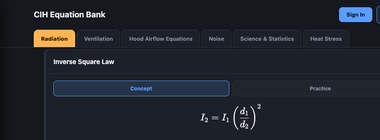
I'm documenting my own CIH prep in real time — the eligibility process, the Authorization to Test, and chapter-by-chapter study notes — in a live journal, alongside the CIH Equation Master practice bank.
Read the CIH Exam JournalNeed to drill the equations? Try the CIH Equation Master — free to start.
CIH Eligibility — Frequently asked questions
What are the CIH eligibility requirements?
BGC requires a bachelor's degree (or equivalent), at least 60 STEM semester credits (900 contact hours) with 25% at the upper level, at least 12 semester credits (180 contact hours) of industrial hygiene coursework with 50% in the four core areas of Fundamentals of IH, Toxicology, Measurements, and Controls, 2 documentable ethics contact hours, 4 years of professional-level broad-scope IH experience across at least two occupational health stressor categories, and at least two professional references.
How many STEM credits are required for the CIH exam?
At least 60 U.S. academic semester credits, equivalent to 900 contact hours, in science, science-based technology, engineering, or math. One semester credit equals 15 contact hours. At least 25% of those STEM credits — 15 semester credits or 225 contact hours — must be upper-level (3rd-year, 4th-year, or graduate level) coursework.
How much industrial hygiene experience is required for CIH?
4 years (48 months) of professional-level, comprehensive industrial hygiene practice, and that experience must be broad-scope — touching at least two of four occupational health stressor categories: Chemical, Physical, Biological, or Ergonomic. Candidates must also be currently practicing IH at the professional level.
Can I get CIH experience credit for my degree?
Yes. Graduates of ABET-accredited industrial hygiene programs can shave time off the 4-year experience requirement: a bachelor's degree from an ABET-accredited IH program earns 6 months of experience credit, and a master's degree from an ABET-accredited IH program or a doctorate in an IH field earns 1 year of experience credit.
What if I don't have a CIH to give me a reference?
BGC offers three alternatives to the traditional CIH-mentor reference: a reference from a professional certified by an organization recognized by the International Occupational Hygiene Association (IOHA), submission of three distinct work samples demonstrating broad-scope IH activities, or a formal request for a panel review of the professional practice claimed.
Is the CIH eligibility checklist the same every year?
BGC periodically reviews and updates the eligibility checklist — this page reflects the June 2023 revision. The overall structure (academic, IH-specific, experience, references, ethics) is stable, but specific hour and credit thresholds can change. Always confirm current requirements on gobgc.org before submitting an application.