Heat and Cold Stress: CIH Reference
Occupational thermal stress, mechanisms, measurements, calculations, prevention, and emergency recognition.
How to use this page
This reference follows a CIH-oriented learning sequence. It explains why each mechanism or measurement matters, corrects misleading statements, and adds original calculation examples. Numerical examples are teaching exercises, not exposure limits or prescribed work schedules. Apply the current assessment method and requirements relevant to the workplace. The ACGIH numbers below are short values quoted with their source for study; the TLV booklet and its Documentation remain the authority, and thermal TLVs are guidance unless a regulation adopts them.
- Sections 1 to 4 build the heat balance and the units; 5 to 7 cover measurement, WBGT and clothing; 8 to 10 the body, illness and controls; 11 to 13 other indices and cold stress; 14 is a memory table and seven practice checks.
- Original wording, not a copy of any course text, BGC material or standard. Numerical examples are teaching exercises, not exposure limits or work schedules, and the current ACGIH tables are not reproduced. Source links are in the text and listed on the CIH References page.
01 Start With the Assessment Question
The question every thermal assessment starts from, and the chain that follows it.
Can the worker release enough heat—or retain enough heat—to keep body temperature within a tolerable range during the actual task?
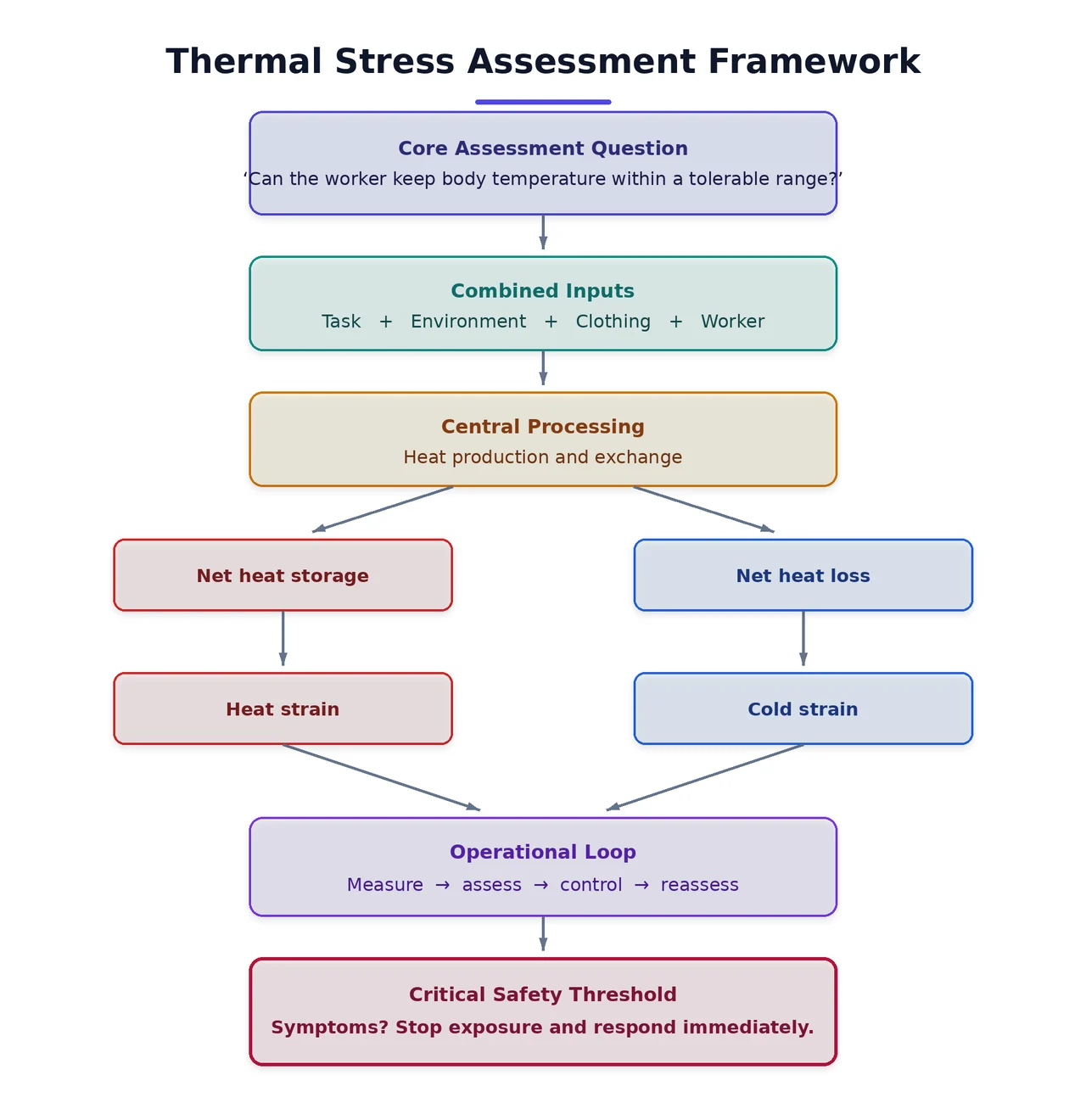
| Concept | Plain-language meaning | CIH implication | Memory aid |
|---|---|---|---|
| Thermal stress | The thermal challenge imposed by the environment, work, and clothing | Assess more than air temperature | Conditions create the load. |
| Thermal strain | The person's physiological response, such as changes in heart rate, sweating, or core temperature | Environmental measurements and physiological monitoring answer different questions | The body shows the response. |
| Homeostasis | Regulation that keeps internal conditions within a functional range | Temperature regulation uses feedback; it is not a perfectly fixed temperature | Regulate, not freeze at one number. |
| Hypothalamus | A major control center for temperature regulation | Coordinates responses including sweating and changes in skin circulation | Controller. |
| Core versus skin temperature | Deep tissues and the body surface can have different temperatures | Skin temperature governs exchange at the surface; it is not a substitute for core temperature | Core is inside; exchange is at the surface. |
| Thermal comfort | How acceptable the thermal environment feels | Comfort alone cannot establish that an exposure is safe | Comfort is not a dose measurement. |
A core temperature of 37°C / 98.6°F is a useful reference, not an exact normal value for every person at every moment. Distinguish environmental heat stress from the resulting heat strain. ACGIH states the goal of its heat TLV as keeping core temperature within about ±1°C of 37°C (roughly 36–38°C), and says this range can be exceeded in selected populations with environmental and physiological monitoring. It is a TLV goal, not a legal requirement to hold every worker at an exact temperature. CCOHS: heat health effects
02 Heat Balance: Follow the Energy
Storage equals metabolic heat plus gains minus losses, with consistent signs and units.
Use a consistent sign convention. Here, exchange terms are positive when they represent heat leaving the body:
| Symbol | Meaning | How to use it |
|---|---|---|
| $\dot S$ | Rate of heat storage | Positive: net warming; negative: net cooling |
| $M$ | Metabolic energy expenditure rate | Physical work usually increases it |
| $W$ | Useful external mechanical work rate | Subtract the energy transferred out as mechanical work |
| $M-W$ | Metabolic heat remaining in the body | Usually positive in ordinary occupational activity |
| $C$ | Convective heat loss | Negative if convection adds heat |
| $R$ | Radiative heat loss | Negative if radiation adds heat |
| $K$ | Conductive heat loss | Negative if contact adds heat |
| $E$ | Evaporative heat loss | Positive for actual evaporation; subtract it once |
All terms must use the same rate units, such as watts. Respiratory exchanges can be included in the appropriate terms or shown separately in a more detailed model; do not count them twice.
For constant rates over a time interval:
Watts are joules per second. Thus, $\dot S$ is a rate, while $\Delta S$ is stored energy. Writing $\Delta S$ beside terms in kcal/hour without defining the time basis mixes energy and power.
Some references instead write $S=(M-W)\pm C\pm R\pm K-E$. This expresses the same physical accounting when gains and losses are assigned consistently. NIOSH heat criteria, Chapter 3
Equation card: Heat balance, with a worked explanation in the CIH equation reference.
Worked example: a worker near a furnace
Assume the following whole-body rates:
- Metabolism: 400 W; external mechanical work: 50 W.
- Convection removes 40 W; radiation adds 80 W.
- Conduction is negligible; evaporation removes 250 W.
Over 30 minutes:
Interpretation: heat is accumulating. The calculation does not, by itself, predict a particular core temperature or time to heat stroke. Real exchange rates and physiological responses change over time.
Memory aid: metabolic heat + environmental gains − heat losses = storage.
03 Why Each Heat-Transfer Mechanism Matters
Convection, radiation, conduction and evaporation, and three corrections to common shortcuts.
| Mechanism | What drives it? | Why it matters at work | Common mistake | Memory aid |
|---|---|---|---|---|
| Convection | Temperature difference between the body surface/clothing and moving air or water | Cooler moving air can remove heat; hotter air can add heat | Assuming a fan must always cool the body | Moving fluid transfers heat. |
| Radiation | Thermal radiation exchanged with surrounding surfaces and the sun | A furnace can heat a worker even when air temperature is moderate | Treating dry-bulb temperature as a radiation measurement | Hot surroundings can heat across a gap. |
| Conduction | Direct contact and the thermal properties of the materials | Hot tools, cold metal, wet contact, or cooling garments can produce substantial local exchange | Assuming contact heat transfer is always negligible | Touch transfers heat. |
| Evaporation | Water changing to vapor, with a vapor-pressure gradient and a path for vapor to escape | Sweating helps only to the extent that sweat evaporates and removes heat | Equating sweat production or dripping sweat with effective cooling | Sweat must leave as vapor. |
These mechanisms operate together. Airflow can change convection and evaporation at the same time. Skin blood flow brings heat toward the surface; whether it leaves the body depends on the surrounding conditions and clothing. CCOHS: heat exchange
Three corrections to remember
1. Relative humidity is not the entire evaporation calculation.
The relevant driving difference is approximately:
Ambient RH describes saturation at the air temperature. Therefore, saturated air cooler than wet skin can still have a lower vapor pressure than the skin surface. The conclusion that “100% RH always means zero skin evaporation” does not follow. This is a physical inference from the vapor-pressure relationship. Clothing resistance and skin wetness also matter. NIOSH heat criteria, Section 3.2.3
2. A fan does not remove the radiant source. It may still help through other exchange mechanisms. Shielding, source insulation, separation, remote operation, and recovery in a cool area address different parts of the overall heat load.
3. Do not use 95°F as a universal fan on/off threshold. It is an assumed skin temperature in some simplified models. Above skin temperature, faster air can increase convective heat gain, while also affecting evaporation. Evaluate the net effect, humidity, clothing, and actual conditions; extremely hot air is not a reliable cooling supply. CCOHS: heat controls
04 Formula and Unit Audit: Expressions That Mislead
A correct-looking equation with mismatched units can give a seriously wrong answer.
Some study notes give $C$, $R$ and $E$ expressions with the units shown below. They should not be used with those units.
| Expression in the notes | Verification finding | What to learn |
|---|---|---|
| $C=6.5V_a^{0.6}(t_a-95)$, labeled kcal/hour with ft/second | This coefficient/unit combination was not verified. NIOSH's corresponding English-unit approximation uses 0.65, airflow in ft/min, and output in Btu/hour | Coefficients depend on units and model assumptions |
| $R=15(t_w-95)$, labeled kcal/hour | NIOSH presents the coefficient 15 in an English-unit approximation with Btu/hour output | Do not relabel Btu/hour as kcal/hour |
| $E=2.4V_a^{0.6}(42-VP_w)$, labeled kcal/hour with ft/second | NIOSH's version uses ft/min, mmHg, and Btu/hour | This concerns evaporative capacity under specified assumptions, not guaranteed actual cooling |
These are simplified relationships for a reference worker and specified clothing, not universal heat-transfer laws. The fixed skin temperature and skin vapor pressure are assumptions. Preserve the complete equation, units, sign convention, and applicability when solving a problem. NIOSH heat criteria, printed pages 14–15
Useful constants and conversions
| Quantity | Value or relationship | Exam reminder |
|---|---|---|
| Celsius to Fahrenheit | $°F=1.8(°C)+32$ | Use the offset for temperatures |
| Fahrenheit to Celsius | $°C=(°F-32)/1.8$ | Subtract before dividing |
| Celsius to kelvin | $K=°C+273.15$ | Use absolute temperature where the equation requires it |
| Temperature differences | $\Delta°F=1.8\Delta°C$ | No +32 for a difference or CAF |
| Core-temperature reference | 37°C = 98.6°F | Not a rigid normal value |
| Common assumed skin temperature | 35°C = 95°F | Not necessarily the worker's measured skin temperature |
| Thermochemical calorie | 1 cal = 4.184 J | Nutritional Calorie = 1 kcal |
| Power | 1 W = 1 J/s | Time must be in seconds when calculating joules |
| Heat-rate conversion | 1 kcal/hour ≈ 1.163 W | 1 W ≈ 0.860 kcal/hour |
| Air velocity | 1 m/s ≈ 196.85 ft/min | ft/min and ft/s differ by 60 |
| Clothing insulation | 1 clo = 0.155 m²·K/W | Insulation resistance, not a WBGT temperature addition |
The clo conversion is documented in NIOSH heat criteria. Conversion examples use ordinary unit arithmetic.
05 Measurement: Choose the Instrument for the Question
Each tool answers a different question, and none of them alone gives heat strain.
| Measurement or tool | What it tells you | Why useful | What it does not tell you alone |
|---|---|---|---|
| Dry-bulb thermometer | Air temperature | Establishes the air-to-surface temperature relationship | Radiation, evaporative potential, or total heat strain |
| Anemometer | Air speed | Helps explain convection and evaporation | Whether the net heat balance is favorable |
| Hygrometer / psychrometer | Humidity-related conditions | Helps assess the moisture environment | Complete occupational heat stress |
| Natural wet-bulb sensor | Temperature of a wetted sensor exposed to natural local conditions | Provides the heavily weighted WBGT component | It is not automatically interchangeable with a forced-ventilation psychrometric wet bulb |
| Black globe thermometer | Globe temperature affected by radiation and convection | Responds to the radiant environment | Raw globe temperature is not automatically mean radiant temperature |
| WBGT instrument | An environmental heat-stress index | Combines environmental influences for occupational screening | Workload, clothing, acclimatization, or core temperature must still be addressed |
| Physiological monitoring | Selected indicators of worker response | Helps assess strain under a defined program | A single heart-rate or skin-temperature reading does not diagnose heat illness |
Place the instrument where the worker actually experiences heat, including sun or process radiation. Follow setup, calibration, stabilization, and maintenance instructions. Weather-station data may not represent a furnace platform, enclosed cab, or sheltered work area. OSHA: heat hazard recognition
Sensor memory aid (original): Wet wick → black globe → dry air. In sun: 7–2–1. Without sun: 7–3. The natural wet-bulb sensor is a wet wick exposed to local natural conditions, not wet clothing and not automatically a psychrometric wet bulb. The globe responds to radiation and convection, so it matters indoors near hot processes as well as outdoors. The dry bulb measures air temperature and appears as a separate term only in the direct-solar-load equation. Do not conclude that air temperature is physically irrelevant indoors: the two equations are index formulations, not percentages of heat flowing through the body.
Quality checks: record time, location, task, clothing, instrument identification, stabilization, and unusual conditions. For wick instruments, check water and wick condition. For instruments estimating wet-bulb values electronically, confirm suitability for the measurement method.
06 WBGT Calculations and Interpretation
Two equations, three worked examples, and the step from a number to a decision.
Use $T_{nwb}$ for natural wet-bulb, $T_g$ for globe, and $T_{db}$ for dry-bulb temperature.
Without direct solar load:
With direct solar load:
An indoor furnace can still produce strong radiant exposure; “without solar load” does not mean “without radiation.” The globe component remains in both equations. Use consistent units and the units required by the assessment criteria. CCOHS: WBGT calculations
Equation cards: WBGT with no solar load (indoors) and WBGT with solar load (outdoors), each with notation and an explanation.
Example A: indoor process heat
Natural wet bulb = 26°C; globe = 38°C:
Example B: work in direct sunlight
Natural wet bulb = 25°C; globe = 40°C; dry bulb = 32°C:
Example C: nighttime maintenance crew
Natural wet bulb = 25°C; globe = 35°C; dry bulb = 30°C. No direct sunlight reaches the work area. Which equation applies, and what is the WBGT?
The solar-load equation would give $0.7(25)+0.2(35)+0.1(30)=27.5°C$, so choosing the wrong equation changes the answer. The elevated globe reading at night can reflect nearby process heat. Daytime air temperature plays no part in this measurement set.
Example D: time weighting
For an illustrative cycle with 45 minutes at WBGT 30°C and 15 minutes at WBGT 24°C:
If the corresponding metabolic rates are assumed to be 415 W and 115 W:
These calculations demonstrate weighted averages. They do not establish that the proposed cycle is safe. Use the averaging period, clothing treatment, and exposure pattern specified by the selected assessment method; do not average away a dangerous short exposure or symptoms.
From measurement to decision
- Identify the task, location, and exposure duration.
- Measure representative WBGT, including changing conditions.
- Estimate metabolic workload from actual activity and pace.
- Apply the appropriate clothing adjustment where the method permits it.
- Identify acclimatization status.
- Compare using the applicable exposure guidance and its assumptions.
- Select controls, monitor workers, and reassess.
ACGIH distinguishes the Action Limit and TLV for different acclimatization assumptions. NIOSH uses Recommended Alert Limit (RAL) and Recommended Exposure Limit (REL) terminology. Consult the actual selected framework; the names and limits are not interchangeable regulatory labels. OSHA Technical Manual: heat stress
The ACGIH heat assessment workflow
ACGIH's own decision chart (Figure 1 of its Heat Stress and Heat Strain TLV) is the workflow to know. Start it when a qualitative assessment suggests possible heat stress, workers report discomfort, or professional judgment points to heat stress. Not every case passes through every step.
| Step | Question | If NO | If YES |
|---|---|---|---|
| 1. Clothing | Does the clothing allow air or water-vapor movement, and is it covered by a clothing ensemble in Table 1 (or other usable data)? | Screening is not a reliable method (for example, fully encapsulating or multi-layer ensembles): go to physiological monitoring | Go to step 2 |
| 2. Screening | Are the Table 2 screening criteria exceeded? | Low risk: continue work and monitor conditions | Go to step 3 |
| 3. Detailed analysis | Are data available for a detailed analysis (task analysis with time-weighted effective WBGT and metabolic rate, or a rational model such as ISO 7933)? | Go to physiological monitoring | Analyze. If the TLV for acclimatized workers is exceeded: physiological monitoring. If above the Action Limit but not the TLV: general controls, keep monitoring |
| 4. Heat strain | Is there excessive heat strain on monitoring (Table 4)? | General controls; keep monitoring periodically | Implement job-specific controls, then reassess |
| 5. Controls | General controls (training, hygiene practices, medical surveillance) and job-specific controls (engineering, administrative, personal protection) | Check effectiveness and adjust |
Note the logic: above the Action Limit but below the TLV means general controls; above the TLV for acclimatized workers means physiological monitoring is the only way to show adequate protection. This is the chart ACGIH publishes, not a four-tier system. Sources: ACGIH Heat Stress and Heat Strain TLV (booklet pages, edition not printed on the pages read) and CCOHS: heat assessment. ACGIH TLV pages
Screening criteria: ACGIH Table 2 (WBGT, °C)
Values are WBGT with the clothing adjustment already added, for an 8-hour day in a 5-day week with conventional breaks. A dash means ACGIH gives no value there; do not fill it in.
| Work in a cycle of work and recovery | TLV Light | TLV Moderate | TLV Heavy | TLV Very Heavy | Action Limit Light | Action Limit Moderate | Action Limit Heavy | Action Limit Very Heavy |
|---|---|---|---|---|---|---|---|---|
| 75 to 100% | 31.0 | 28.0 | — | — | 28.0 | 25.0 | — | — |
| 50 to 75% | 31.0 | 29.0 | 27.5 | — | 28.5 | 26.0 | 24.0 | — |
| 25 to 50% | 32.0 | 30.0 | 29.0 | 28.0 | 29.5 | 27.0 | 25.5 | 24.5 |
| 0 to 25% | 32.5 | 31.5 | 30.5 | 30.0 | 30.0 | 29.0 | 28.0 | 27.0 |
- TLV applies to heat-acclimatized workers; the Action Limit applies to unacclimatized workers.
- Values are given to the nearest 0.5°C. Where work and rest happen in different places, use time-weighted averages.
- The blanks exist because heavy and very heavy work among less fit workers carries strain risk regardless of WBGT: use detailed analysis or physiological monitoring instead.
- The table is a screening tool, more protective than the TLV or Action Limit curves, and is not a prescribed work/rest schedule.
- Acclimatized, for the TLV: a recent history of at least two continuous hours of heat-stress exposure, for example on 5 of the last 7 to 10 of the last 14 days. Loss begins when exposure stops, is noticeable after about four days, and can be complete in three to four weeks.
Metabolic rate categories used with the table (Table 3): rest 115 W, light 180 W, moderate 300 W, heavy 415 W, very heavy 520 W. Sources: ACGIH TLV pages above; CCOHS table, adapted from ACGIH 2026.
Limiting heat strain: ACGIH Table 4
Any one of these may mark excessive heat strain, and exposure is discontinued so the worker can recover:
| Indicator | Limit | Qualifier |
|---|---|---|
| Sustained heart rate (several minutes) | More than 180 − age (bpm) | For individuals with assessed normal cardiac performance. A 30-year-old: above 150 bpm. A 50-year-old: above 130 bpm |
| Body core temperature | More than 38.5°C (101.3°F) | Medically selected, acclimatized personnel |
| Body core temperature | More than 38.0°C (100.4°F) | Unselected, unacclimatized workers |
| Recovery heart rate | More than 120 bpm at one minute after a peak work effort | The figure is 120 bpm, not 110 |
| Symptoms | Sudden and severe fatigue, nausea, dizziness or lightheadedness | Symptoms count even when every number is normal |
A worker may be at greater risk (these are risk indicators, listed separately from the stop criteria) if profuse sweating is sustained over hours, if weight loss over a shift exceeds 1.5% of body weight, or if 24-hour urinary sodium excretion is below 50 mmol.
Emergency response (ACGIH wording in brief): a worker who is disoriented or confused, or has inexplicable irritability, malaise or chills, is removed to rest in a cool place with rapidly circulating air and kept under skilled observation. Absent medical advice to the contrary, treat it as an emergency with immediate transport to a hospital. Never ignore signs or symptoms of heat-related disorders. ACGIH TLV pages
07 Clothing: clo and CAF Answer Different Questions
Insulation is not the same as an adjustment to a WBGT assessment.
| Concept | Meaning | How used | Memory aid |
|---|---|---|---|
| clo | Clothing thermal insulation | Describes resistance to dry heat transfer | clo = insulation |
| Clothing adjustment factor (CAF) | An adjustment to a WBGT-based assessment for a specified ensemble | Add the factor to measured WBGT when authorized by the method | CAF = adjustment |
| Evaporative resistance | Resistance to moisture-vapor transfer | Explains why an impermeable suit may trap heat even when relatively thin | Vapor must escape |
CAF is not a new name for clo. A zero CAF means the ensemble is the assessment baseline; it does not mean the clothing provides zero insulation.
The following public OSHA table is adapted from NIOSH 2016. It is a study reference, not a claim to reproduce the latest ACGIH table. OSHA clothing adjustments
| Specified clothing ensemble | Add to WBGT, °C |
|---|---|
| Baseline work clothing | 0 |
| Cloth coveralls | 0 |
| SMS coveralls | 0.5 |
| Polyolefin coveralls | 1 |
| Double-layer cloth clothing | 3 |
| Limited-use vapor-barrier coveralls | 11 |
Do not add arbitrary garment factors together. Match the complete ensemble to the assessment method. Do not apply the limited-use-coverall factor indiscriminately to a fully encapsulating Level A ensemble; specialized assessment and monitoring are needed.
Worked example: for Example B and the specified double-layer ensemble:
The air has not physically warmed by 3°C. The adjustment changes how the measured environment is evaluated for that clothing. A 3°C difference equals 5.4°F, not 37.4°F.
08 Physiology, Acclimatization and Hydration
Why the body responds as it does, and the NIOSH example progressions.
Why the body responds this way
| Response | What changes | Why it helps—and its limit |
|---|---|---|
| Skin vasodilation | More blood reaches the skin | Transfers internal heat toward the surface; external conditions still govern heat loss |
| Sweating | Water reaches the skin | Evaporation removes heat; dripping sweat also loses body fluid but does not deliver the same cooling |
| Cardiovascular response | Circulation supports working muscles and skin | Heat and physical work can compete for circulatory capacity |
| ADH and aldosterone responses | Water and sodium conservation are regulated | Conservation helps maintain fluid balance but cannot replace lost fluid indefinitely |
| Acclimatization | Repeated exposure improves heat tolerance | Adaptation reduces strain; it does not remove environmental hazards |
Heat adaptation includes expansion of plasma volume, not “increased plasma output.” Plasma is a blood compartment, not an output stream. NIOSH heat criteria, Section 4.1.5
Acclimatization plan
NIOSH describes adaptation over approximately 7–14 days. Benefits include earlier and more effective sweating, reduced electrolyte loss, and lower heart rate and core temperature for comparable work.
| Worker | NIOSH example progression in usual exposure duration |
|---|---|
| New to the hot work | No more than 20% on day 1; increase by no more than 20% on each subsequent day |
| Previously experienced | No more than 50%, 60%, 80%, and 100% on days 1–4 |
These are exposure progressions, not proof of full physiological adaptation by day 4 or 5. Absence for a week or more can reduce adaptation. Air-conditioned recovery breaks do not erase acclimatization. NIOSH: acclimatization
Hydration
For moderate activity in heat lasting less than two hours, NIOSH recommends approximately one 8-US-fluid-ounce cup (about 240 mL) every 15–20 minutes. Several hours of sweating may call for balanced electrolyte replacement. NIOSH advises that intake generally should not exceed six cups per hour; excessive fluid intake is not a prevention strategy. Individual medical restrictions require individualized planning. NIOSH: workplace recommendations
Study calculation: 240 mL every 20 minutes is about 720 mL/hour; every 15 minutes is about 960 mL/hour. These are conversions of the example guidance, not mandatory amounts for every worker.
Consider illness, medications, pregnancy, cardiovascular or kidney conditions, fitness, hydration, and acclimatization when planning work. Body shape alone is not a reliable fitness-for-heat decision. CCOHS: individual susceptibility
09 Recognize Heat Illness and Act
Neurological change in the heat means emergency help and immediate cooling.
Confusion, slurred speech, seizures, or collapse during heat exposure require an emergency response. Do not wait for dry skin, loss of sweating, or a temperature of 106°F.
| Condition | Typical clues | Mechanism / study distinction | Initial response |
|---|---|---|---|
| Heat stroke | Altered mental status, seizures, loss of consciousness; skin may be sweaty or dry | Severe failure to manage heat, with potential organ injury | Call 911 immediately and begin rapid cooling. Stay with the worker |
| Heat exhaustion | Weakness, headache, nausea, dizziness, heavy sweating | Often substantial water and salt loss with heat strain | Stop work, cool, stay with the worker, and obtain medical assessment; give small sips only if alert and safely swallowing |
| Heat cramps | Painful muscle spasms | Often associated with exertion and sweat-related fluid/electrolyte losses | Stop exertion, move to a cool area, replace fluids appropriately; persistent symptoms need medical evaluation |
| Heat syncope | Fainting or lightheadedness, often while standing | Reduced blood flow to the brain can involve pooling and dehydration | Prevent falls, cool, and assess; do not presume every collapse is simple syncope |
| Heat rash | Itchy bumps in sweaty or covered areas | Sweat-duct obstruction and local irritation | Keep the area cool and dry; address clothing and exposure |
| Rhabdomyolysis | Severe muscle pain or weakness, sometimes dark urine | Muscle breakdown can injure the kidneys | Stop activity and seek urgent medical care |
Illness descriptions: NIOSH: heat-related illnesses.
For suspected heat stroke: remove excess outer clothing when feasible, cool immediately with cold-water immersion when it can be done safely, or use other active cooling such as wetting the body and circulating air while emergency help is coming. Maintain supervision and airway safety. Do not give oral fluids to someone confused, unconscious, seizing, vomiting, or unable to swallow safely; drinking must not delay emergency cooling. OSHA: heat first aid, CCOHS: heat first aid
Memory aid: neurological change in the heat → emergency help + immediate cooling.
10 Select Controls by the Mechanism
Match each problem to the part of the heat balance the control changes.
| Main problem | Control examples | Why the control works |
|---|---|---|
| High metabolic heat | Mechanize lifting, reduce force or pace, redesign the task | Reduces heat generated inside the body |
| Strong radiant source | Shield or enclose the source, insulate hot surfaces, increase separation, use remote operation | Reduces radiation reaching the worker |
| Hot air | Cooler supply air, conditioned stations, cooled recovery spaces | Improves the temperature gradient or provides recovery |
| High humidity | Repair steam leaks, control moisture sources, dehumidify where appropriate | Improves the vapor-pressure conditions for evaporation |
| Clothing restricts cooling | Use suitable protective ensembles with lower thermal burden, compatible cooling equipment, and revised work duration | Reduces resistance or provides another route for removing heat |
| Long exposure | Task-specific work/recovery schedules and cooler recovery areas | Limits accumulation and creates an opportunity to lose heat |
| New or returning workers | Gradual exposure and close supervision | Allows adaptation and earlier recognition of difficulty |
| Delayed recognition | Buddy observation, symptom reporting, practiced emergency response | Reduces time between illness onset and action |
Control framework: OSHA Technical Manual, NIOSH workplace recommendations.
Do not remove required chemical, biological, electrical, or impact protection merely to reduce heat. Solve the combined hazards through equipment selection, engineering, work organization, and appropriate recovery.
Match the control to the cause
Hot workpiece or furnace   → radiant exposure            → shield or insulate the source
Confirmed steam leak       → added moisture and heat     → repair the leak
Heavy handling             → metabolic heat              → mechanize or reduce effort
Sweat cannot evaporate     → clothing or humid-air limit → assess compatible controls
Establish the actual source before choosing the control. High humidity alone does not prove a steam leak. A fan does not always reduce net heat load, and a cooling vest is personal cooling equipment, not an engineering control. These are examples to evaluate, not a fixed package. CCOHS: heat controls
Structure of a heat stress management program
ACGIH recommends starting a program when heat stress exceeds the Action Limit, or when clothing limits heat loss. It offers the elements below (its Table 5) as considerations for the industrial hygienist's judgment; they are not part of the TLV itself and not a legal checklist. Monitor heat stress (Table 2) and heat strain (Table 4) to confirm the controls work.
| Part | Elements |
|---|---|
| General controls | Instructions and an annual training program on heat stress and strain; about 1 cup of cool, palatable water (or an acceptable replacement drink) roughly every 20 minutes; encourage workers to report symptoms to a supervisor, to limit their own exposure when no supervisor is present, and to watch co-workers for signs; counsel and monitor those on medications that affect cardiovascular, blood pressure, temperature-regulation or sweat functions, and those misusing alcohol or other intoxicants; healthy lifestyle, ideal body weight and electrolyte balance; adjust expectations for people returning after an absence from hot work; consider pre-placement medical screening; monitor conditions and reports of heat disorders |
| Job-specific controls | Engineering: reduce metabolic rate, provide general air movement, reduce process heat and water-vapor release, shield radiant sources. Administrative: set acceptable exposure times, allow recovery, limit strain. Personal protection: only equipment shown to be effective for the actual work and conditions |
Good practice that a program also covers (not on the ACGIH list): roles and responsibilities, a gradual acclimatization schedule (NIOSH example in section 8), an emergency plan that includes cooling before transport, and records of measurements, training and incidents. Training or review frequencies are legal requirements only where the jurisdiction says so. Check the local regulation. ACGIH TLV pages, NIOSH workplace recommendations
Heat and chemicals. Warm skin can influence dermal absorption, but the effect depends on the substance, the skin condition and the exposure. Keep skin absorption separate from permeation through a glove. Do not turn any single "doubles per 10°C" rule into a prediction for real workers; if a problem stipulates one, treat it as an assumed model. NIOSH: skin exposures
11 Other Indices: What Question Do They Answer?
WBGT, heat index, HSI and older indices are not interchangeable.
| Index or approach | Main idea | Interpretation |
|---|---|---|
| WBGT | Weighted environmental measurements | Occupational screening requires workload, clothing, acclimatization, and duration |
| Heat index / humidex | Combines air temperature and humidity | Useful warning information; not interchangeable with WBGT or a complete task assessment |
| Heat Stress Index (HSI) | Required evaporation relative to maximum evaporative capacity | A heat-balance concept, not a direct core-temperature reading |
| Effective temperature | Historical combined comfort/thermal index | Identify the exact version and assumptions before use |
| Predicted four-hour sweat rate | Historical prediction approach | Useful context for older literature; do not substitute it automatically for the selected occupational method |
| Botsball / wet globe | A wetted globe response | Its reading is not simply the WBGT equation output |
For the traditional HSI concept:
If required evaporative cooling is 300 W and estimated maximum capacity is 250 W, HSI = 120%. This means the modeled evaporation requirement exceeds the modeled capacity. It does not mean 120% body temperature, nor does HSI below 100% prove that every worker is safe. NIOSH heat criteria, Section 9.2.2
Heat index omits important workplace factors such as process radiation, workload, and clothing. OSHA: heat hazard recognition
12 Cold Stress: The Same Balance, Opposite Problem
Losses can exceed heat production; wetness, wind and contact drive the risk.
In cold conditions, losses can exceed metabolic heat production. Vasoconstriction conserves heat in the core but reduces warmth at the extremities; shivering increases metabolic heat production.
| Factor | Why it increases risk | Workplace example |
|---|---|---|
| Low temperature | Increases the temperature difference driving heat loss | Freezer work |
| Wind / drafts | Removes the warm boundary layer and increases convection | Exposed platform or cold-room air jet |
| Wet clothing | Reduces useful insulation and can add evaporative cooling | Rain, sweat-soaked layers, immersion |
| Cold contact | Conducts heat away from local tissue | Bare hand on cold metal |
| Low activity or exhaustion | Reduces ability to maintain heat production | Stationary watch or prolonged outdoor work |
| Tight footwear or gloves | Can impair circulation and compress insulation | Multiple socks squeezed into undersized boots |
The statement “water conducts heat about 23 times faster than air” is not a whole-body cooling multiplier. Actual cooling depends on temperature, motion, contact, insulation, and geometry. Do not calculate immersion survival time from that ratio. CCOHS: cold health effects
Cold illnesses and injuries
| Condition | What is affected? | Recognition | Response priority |
|---|---|---|---|
| Hypothermia | Whole-body core temperature, generally below 35°C / 95°F | Shivering, poor coordination, confusion, slurred speech, drowsiness; shivering may stop as the condition worsens | Emergency assistance; shelter, remove wet clothing, insulate, and warm the trunk |
| Frostbite | Freezing of local tissue | Numbness; pale, gray, waxy, or hard skin | Protect the area and obtain medical care; do not rub or use direct high heat |
| Immersion / trench foot | Nonfreezing injury after prolonged cold, wet exposure | Numbness, swelling, pain, discoloration | End wet/cold exposure, remove wet footwear carefully, protect feet, and seek assessment |
| Chilblains | Local inflammatory response to nonfreezing cold | Itching, redness, swelling, or painful skin lesions | Protect from further cold and obtain care for persistent or severe symptoms |
Cold injury distinctions: NIOSH: cold-related illnesses.
Corrections: shivering can begin before core temperature reaches 35°C. Do not memorize 33°C as a universal definition of “severe hypothermia.” Act on suspected illness without waiting to assign a temperature stage. Hypothermia can occur above freezing, especially when someone is wet. Handle the person gently; warm beverages are appropriate only when alert and able to swallow safely. CDC: hypothermia
Whole-body cooling and local tissue injury are different problems: hypothermia is core heat loss and can occur above freezing, frostbite is local freezing, and trench foot and chilblains arise without freezing. Do not stage a cold victim from symptoms or a temperature band alone. Rarer conditions such as frostnip and cold urticaria are not covered here because this review did not confirm a source for their classification.
For frostbite, avoid unnecessary walking on affected feet, rubbing, massage, and direct heat from a stove or heating pad. Numb skin can burn without warning. Obtain medical care and check for coexisting hypothermia. CDC: frostbite
13 Wind Chill and Cold Controls
A cooling equivalent, not an air temperature, with the NWS equation and controls.
Wind chill describes the cooling effect of wind on exposed skin. It is not the measured air temperature, body temperature, or a complete assessment of clothing, wetness, and workload.
The U.S. National Weather Service equation is:
Here, $T$ is air temperature in °F, and $V$ is wind speed in mph. Its stated range is air temperature at or below 50°F, with wind above 3 mph. Do not insert °C or km/hour into this version. NWS: wind chill questions
Example: at 10°F and 15 mph, calculated wind chill is approximately −7°F. The air is still 10°F. Wind alone makes an object approach air temperature faster; it does not make that object reach the wind-chill temperature.
| Control | Why it works |
|---|---|
| Windbreaks, enclosures, reduced drafts | Reduce convective heat loss |
| Heated recovery areas and planned breaks | Provide a place to regain warmth |
| Dry, adjustable layers | Maintain insulation while allowing sweat management |
| Wind- and water-resistant outer protection | Limit wind penetration and wetting |
| Suitable gloves, boots, and insulated handles | Protect extremities and reduce cold contact |
| Spare dry clothing | Prevent continued work in wet insulation |
| Buddy checks and reliable communication | Help detect impaired judgment and summon assistance |
Cold-work guidance with its limits. CCOHS says that where fine manual dexterity is not required, gloves should be used below 4°C for light work and below −7°C for moderate work. It cites ACGIH (2024) for a work-warming regimen when work is continuous at wind chill of −7°C or below, and for added measures (such as constant observation by a supervisor or buddy) at −12°C or below. CCOHS's separate work/warm-up schedule applies to any four-hour period of moderate or heavy activity with normal breaks every two hours; it is not a statement about every shift. These are guidance values with stated conditions, not universal legal triggers. Check the requirement in the workplace's own jurisdiction. CCOHS: cold control measures, CCOHS: cold overview
Cold stress numbers in one place
These come from the IHSA construction manual (2024 edition, adapted from ACGIH) and CCOHS (citing ACGIH 2024). They are written as "should" guidance. The IHSA states that Ontario has no legislated exposure limits for working in cold, so a number here is not automatically a legal trigger.
| Temperature | What the guidance says | Source |
|---|---|---|
| Below 16°C | Fine work with bare hands for more than 10–20 minutes needs measures to keep hands warm (warm-air jets, radiant heaters, contact warm plates). Gloves where fine dexterity is not needed and work is sedentary | IHSA |
| Below 4°C | Gloves for light work where fine dexterity is not needed | IHSA, CCOHS |
| Below −1°C | Cover metal handles of tools and control bars with thermal insulation. Unprotected skin freezes only below −1°C, regardless of wind speed | IHSA |
| −7°C or below (air for gloves, wind chill for work-warming) | Gloves for moderate work; insulated gloves where reachable surfaces (especially metal) are colder than −7°C; a work-warming regimen for continuous work at wind chill of −7°C or below, with heated shelters nearby | IHSA, CCOHS (ACGIH 2024) |
| −12°C or below | Work should include constant observation (supervisor or buddy), pacing to limit heavy sweating, and time for new workers to adjust | CCOHS |
| Below −17°C | Use mittens | CCOHS |
| Equivalent chill temperature of −32°C | Continuous exposure of skin should not be permitted | IHSA (ACGIH) |
The ACGIH work/warm-up schedule (IHSA Table 7-1) applies to moderate or heavy work in any four-hour period, with warm-up breaks of 10 minutes in a warm place and a normal break after two hours; it assumes dry clothing and is stepped one level more protective when physical activity is limited. It starts at air temperatures of about −26 to −28°C on a sunny day with no noticeable wind and shortens the allowed work period as wind rises, ending in "non-emergency work should stop" at the coldest, windiest combinations. Read the table itself before using it. IHSA cold stress chapter
Choose clothing for both the work period and the recovery period. Heavy activity can wet clothing with sweat, then stopping work reduces metabolic heat while the worker remains damp. NIOSH: preventing cold-related illness and injury
14 Final Memory Table and Practice Checks
One line per topic, then seven questions to apply it.
| Topic | Full memory aid |
|---|---|
| Heat balance | Production plus gains minus losses determines storage. |
| Units | Rate × time = energy; never mix watts with joules. |
| Convection | Airflow strengthens exchange; the temperature gradient determines its direction. |
| Radiation | A hot source can heat you without touching you. |
| Evaporation | Water loss is not necessarily heat loss: sweat must evaporate. |
| Humidity | Compare vapor pressures, not RH alone. |
| WBGT | Measure the environment, then account for the job, clothing, and worker. |
| Clothing | clo measures insulation; CAF adjusts WBGT. |
| Acclimatization | Repeated, gradual exposure improves response; it does not eliminate risk. |
| Heat stroke | Sweating does not rule it out; neurological change demands emergency action. |
| Cold | Wind strips warmth; wetness defeats insulation; contact cools locally. |
| Wind chill | Cooling equivalent, not actual air temperature. |
| Hypothermia versus frostbite | Core cooling versus local freezing. |
| Trench foot | Cold and wet can injure without freezing. |
Master thermal numerical targets
Learn these as a set, with their qualifiers. "Exam use" below means they are the figures worth knowing; the qualifier is part of the answer.
Heat
| Parameter | Value | Qualifier |
|---|---|---|
| Core temperature goal | within about ±1°C of 37°C (36–38°C) | TLV goal; can be exceeded in selected, monitored populations |
| Core temperature, stop criterion | above 38.5°C | Medically selected, acclimatized |
| Core temperature, stop criterion | above 38.0°C | Unselected, unacclimatized |
| Sustained heart rate | above 180 − age bpm, several minutes | Assessed normal cardiac performance |
| Recovery heart rate | above 120 bpm at 1 minute | After a peak work effort |
| Shift weight loss | above 1.5% of body weight | Greater-risk indicator |
| 24-hour urinary sodium | below 50 mmol | Greater-risk indicator |
| WBGT, no solar load | 0.7 Tnwb + 0.3 Tg | |
| WBGT, direct sun | 0.7 Tnwb + 0.2 Tg + 0.1 Tdb | |
| Clothing adjustment (add to WBGT) | 0 baseline and cloth coveralls; 0.5 SMS; 1 polyolefin; 3 double-layer woven; 11 limited-use vapor-barrier | Not for fully encapsulating suits; do not add for multiple layers |
| Metabolic rates | rest 115, light 180, moderate 300, heavy 415, very heavy 520 W | ACGIH Table 3 |
| Acclimatized (TLV) | 2 or more continuous hours of heat exposure on 5 of last 7 to 10 of last 14 days | Loss noticeable after about 4 days |
| Acclimatization exposure plan (NIOSH) | new workers 20% day 1, +20% daily; experienced 50/60/80/100% | Exposure plan, not proof of adaptation |
| Water | about 1 cup (ACGIH, every 20 min); NIOSH 1 cup every 15–20 min, under 2 hours moderate work | Not above 6 cups per hour |
Cold
| Parameter | Value | Qualifier |
|---|---|---|
| Hypothermia | core temperature below 35°C | Can occur above freezing, especially when wet |
| Barehanded fine work | below 16°C for more than 10–20 minutes | Hand-warming measures |
| Gloves | below 4°C light work; below −7°C moderate work | Fine dexterity not required |
| Metal handles insulated | below −1°C | Contact frostbite prevention |
| Work-warming regimen | wind chill −7°C or below | Continuous cold work |
| Constant observation, buddy | −12°C or below | |
| Mittens | below −17°C | |
| Skin exposure | equivalent chill −32°C: continuous exposure should not be permitted | |
| Work/warm-up schedule | four-hour period, moderate or heavy work, 10-minute warm breaks | Dry clothing; Saskatchewan table via ACGIH |
Edition notes: the heat TLV values come from ACGIH's Heat Stress and Heat Strain pages (edition not printed on the pages read; the Table 2 values match the CCOHS table adapted from ACGIH 2026). Cold values come from IHSA (2024) and CCOHS. Confirm against the current TLV booklet before relying on any figure for an exam or a workplace decision.
Apply the knowledge
- A worker is sweating heavily but becomes confused. Is heat stroke excluded?
No. Activate emergency response and start cooling. - A hot furnace is indoors. Which WBGT equation applies?
Without direct solar load: $0.7T_{nwb}+0.3T_g$. Indoor radiation still affects the globe. - Measured WBGT is 27°C and the applicable CAF is 3°C. What is effective WBGT?
30°C. This is an assessment adjustment, not a measured air-temperature change. - A fan is added in air hotter than skin. Has heat stress necessarily decreased?
No. Consider increased convective gain alongside any change in evaporation. - A worker rests in the same hot area. Is that equivalent to recovery in a cool room?
No. Rest reduces metabolic heat, while the recovery environment determines external exchange. - A wet worker becomes confused at an air temperature above freezing. Can this be hypothermia?
Yes. Wetness and prolonged cooling can create risk above freezing. - Why should the C, R and E formulas in Section 4 not be used with their original units?
Their coefficients, airflow units, and heat-rate units were inconsistent. A correct-looking equation with mismatched units can produce a seriously wrong answer. - A night crew has natural wet bulb 25°C, globe 35°C and dry bulb 30°C, with no direct sun. What is the WBGT, and why not use the dry bulb?
$0.7(25)+0.3(35)=28.0°C$. Without direct solar load the dry bulb is not in the equation; the globe still captures process radiation. - A work area is humid and hot. A colleague orders a steam-leak repair before anyone has looked. What is wrong?
Humidity alone does not show a steam leak. Identify the actual source (radiant surface, moisture source, workload, clothing) first, then match the control to it. - A 50-year-old worker has a sustained heart rate of 135 bpm for several minutes and a normal core temperature. What does Table 4 say?
The limit is 180 − 50 = 130 bpm, so 135 bpm sustained marks excessive strain (for a person with assessed normal cardiac performance): discontinue exposure and let the worker recover. - At one minute after a peak effort a worker's heart rate is 115 bpm. Stop criterion met?
No. The ACGIH recovery criterion is above 120 bpm, not 110. - Screening Table 2 has no value for heavy work at 75–100% work. May we use the nearest cell?
No. The blank is intentional: use detailed analysis or physiological monitoring for that case.
Verification scope
On October 9, 2026 the ACGIH heat stress and strain values (Tables 1 to 5 and Figure 1) were read from the booklet pages, the Table 2 values were compared with the CCOHS table adapted from ACGIH 2026, and the cold values were checked on the IHSA 2024 manual and CCOHS. The key figures (the NIOSH heat-exchange equations and clothing adjustment table, the NIOSH acclimatization and hydration guidance, and the NWS wind-chill equation) were checked against the primary documents on October 4, 2026; the other concepts follow the linked OSHA, NIOSH, CDC, CCOHS, and NWS materials. Original worked examples were calculated separately. Historical indices are retained for recognition; they are not presented as preferred modern field methods. Current proprietary ACGIH limits and jurisdiction-specific legal requirements were not reproduced or independently certified in this study reference.