How I Passed the CRST Exam on My First Try
How I passed the Canadian Registered Safety Technician exam on my first attempt: how long I studied, what exam day was like, the six question styles that kept appearing (with example questions), and what I would warn you about.
I passed the CRST on my first attempt after 2 to 3 months of study at 5 to 10 hours a week, with about 10 years of experience as a safety advisor at management level. The CRST is an applied-knowledge exam: technical, clearly worded and light on reading, but the questions go deep, specific numbers and terms matter, and many questions ask you to choose the best decision. I finished with plenty of time left to re-check my doubtful answers.
My background and timeline
- About 10 years as a safety advisor, at management level, when I took the CRST.
- I passed the CRST first, then the CRSP about a year later. I prepared for each separately, but the method was the same.
- Study time: 5 to 10 hours a week for 2 to 3 months.
- The full CRSP story and plan: How I Passed the CRSP on My First Try.
How I studied
- Start from the blueprint, not the textbook. I took the BCRSP blueprint (5 CRST domains, 64 competencies) and turned it into a domain chart, like a game’s skill radar.
- Practice first. I took practice exams before reading, to find the weak domains. Then I went back to read only the knowledge behind the questions I missed. I call this reverse learning. Reading the reference book alone was not enough.
- Drill the numbers. The CRST tested more statistics and standard values than I expected: frequency rate, severity rate and exposure limits. Learn the numbers and the formulas.
The five CRST domains and their weights (see the CRST exam blueprint): Hazard Identification, Risk Assessment and Control 29%; Technical Safety Fundamentals 25%; Health and Safety Systems 17%; Legal, Ethics and Professional Practice 17%; Social and Human Sciences 12%.
Exam day
- The format: 190 to 210 multiple-choice questions in 3.5 hours, on a computer at a Pearson VUE test centre. The CRSP is 4 hours.
- My day: it was mid-winter, with heavy snow, and I was just over the flu and still coughing, so the centre put me in a separate room. I was the only one there.
- The screen: the exam software looked dated, a plain blue screen with old-style buttons. After a few set-up steps the exam starts and the timer runs.
- Pace: my first 10 questions took 4 to 5 minutes, which gave me confidence. I finished all questions in about 2 hours and had time left. I was unsure about 10 to 20 questions and used the extra time to re-check them.
- A tip: after the last question you can review before you submit. If you still have time, keep reviewing until the clock runs out.
What the CRST felt like
- More technical and knowledge-based than the CRSP.
- Questions are usually clear and direct, and the reading load is light.
- They often test a specific term, definition or number. Some options are clearly wrong, so elimination works well.
- Wording such as most, best, highest is common, so knowing common safety statistics helps.
- Very little calculation. Do not worry if maths is not your strength.
- Scenario questions are short and easy to follow, but many still come down to a decision: what to do first, or what works best.
I would call it an applied-knowledge exam, closer to a tough unit test than to the judgment style of the CRSP. See CRSP vs CRST for the full comparison.
Two question formats: independent and case-based
The CRST has two kinds of questions, and the examples below are labelled with which is which.
- Independent questions (about 65 to 75%). A question that stands alone: a stem and four options, choose the best one. Many test recall of a technical value, a term or a rule.
- Case-based questions (about 25 to 35%). A short workplace scenario followed by 3 to 5 questions about that same situation. On the CRST they lean toward applying standards and procedures to the scenario, less toward organizational judgment.
Both formats use four options. The CRST blueprint gives the full format table, and its tip for cases is to read the questions first, then skim the scenario for the facts that matter.
The six question styles, with example questions
These are the six styles I recognized. The examples below come from SPEP’s free question set; they are not real exam questions. For the full pattern guide and AI prompt templates see CRST question style patterns.
At Ridgecrest Forestry Products, a pulp and paper mill in New Brunswick, safety technician Marcus Chen is conducting the morning toolbox talk with the chip handling crew. During the briefing, veteran operator Denise Leblanc raises her hand and mentions that three workers on her shift have been complaining of lower back pain and shoulder stiffness over the past two weeks. She explains that since the automated chip conveyor broke down, workers have been manually shoveling wood chips from the accumulation bin into wheelbarrows, then pushing the loaded wheelbarrows approximately 40 metres to the secondary hopper. Each wheelbarrow load weighs roughly 35 kilograms, and workers complete this cycle about 25 times per 8-hour shift. Denise demonstrates the shoveling motion, showing how workers twist their torsos while lifting and tossing chips at shoulder height to clear the bin walls, which stand 1.2 metres high. Marcus observes that workers are bending forward at the waist with straight legs to reach chips at the bottom of the bin, and the concrete floor near the hopper has a noticeable downward slope that makes pushing the loaded wheelbarrow more difficult. One worker, Tyler, mentions he has been taking over-the-counter pain medication before each shift to manage his discomfort. The supervisor, Frank Morrison, is present and asks Marcus what steps need to be taken immediately and what documentation is required. Marcus reviews the task mentally, noting the combination of repetitive lifting, awkward postures, and the physical demands of pushing weighted loads on uneven surfaces.
A real case has 3 to 5 questions about the same scenario. This one has four; two are shown below.
Supervisor Frank Morrison asks Marcus about his legal responsibilities regarding the ergonomic hazards affecting the chip handling crew. Under Bill C-45 amendments to the Criminal Code, what duty does Frank have as someone directing the work of others?
- A. He should document the complaints and forward them to the joint health and safety committee for resolution
- B. He is required to report the situation to WorkSafeNB within 24 hours of receiving the complaints
- C. He has a legal duty to take reasonable steps to ensure worker safety given the known hazards ✓ (correct)
- D. He should consult with human resources before implementing any changes to work procedures
Why: Bill C-45 created a legal duty, with possible criminal liability, for people who direct the work of others to take reasonable steps to protect workers.
You are reviewing a workplace inspection report from last month and notice that several identified hazards remain unaddressed. What is the MOST critical step that was likely missed in the inspection process?
- A. Follow-up to ensure corrective actions were implemented and effective ✓ (correct)
- B. Preparation of a comprehensive checklist before conducting the inspection
- C. Planning the inspection route to understand the workplace layout and process flow
- D. Determination of risk severity and probability ratings for each hazard using quantitative methods
Why: Preparing (B), planning (C) and rating (D) all happen before hazards are identified. Hazards that stay unaddressed after being reported point to a missed follow-up.
When Marcus recommends controls to address the ergonomic hazards in this chip handling operation, which approach represents the highest level in the hierarchy of controls?
- A. Providing workers with back support belts and requiring their use during shoveling tasks
- B. Rotating workers between chip handling and other duties to limit individual exposure time
- C. Expediting repair of the automated conveyor system to eliminate manual shoveling ✓ (correct)
- D. Training workers on proper lifting techniques and body mechanics for shoveling
Why: Removing the hazard at its source beats administrative controls (rotation, training) and personal protective equipment (belts).
Your organization is establishing its first workplace violence prevention policy. Which element is MOST critical to include to ensure employees feel safe reporting incidents?
- A. A detailed description of all potential consequences for perpetrators of violence, including termination and criminal charges.
- B. Clear examples of unacceptable behaviour with precise definitions of violence, harassment and bullying.
- C. A comprehensive list of all known workplace hazards and risk factors identified in prior safety assessments.
- D. Assurance that no reprisals will occur against reporters, and a confidential reporting process. ✓ (correct)
Why: The barrier to reporting is fear of reprisal. Consequences, definitions and hazard lists matter, but they do not address it.
5. Distinguishing concepts. “What is the difference between X and Y?” Learn the pairs that get confused, such as TLV and OEL.
6. Ethical dilemmas and risk-based questions. For example, “your supervisor tells you to skip an inspection”, or “which industry has the highest fatality rate?” With ethics, prioritizing worker safety is usually the right direction. With risk questions, know the common statistics.
Try these styles yourself
This is what you will see when you start the free practice exam: the case on the left, the question and four options on the right, and a progress bar across the top.
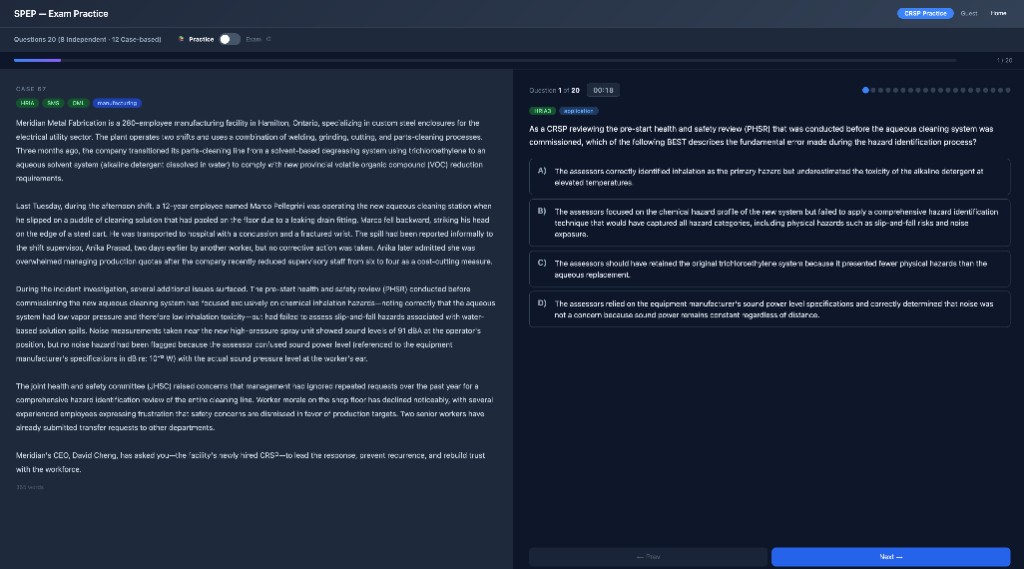
A preview of the practice screen (a CRSP case is shown; the CRST questions use the same layout).
Try the free CRST mini exam
See question styles like the ones above, with case-based and independent questions. No sign-up needed to start.
Try the free CRST mini exam →Want the style guide first? Read the CRST question style patterns.
Mistakes to avoid
- Do not treat the CRST as the easy one. The wording is clear, but the questions go deep technically and specific numbers matter.
- Do not rely on reading alone. Practice exams first, then targeted reading, found my gaps faster.
- Do not rush the end. Use the review option until the clock runs out.
- Do not memorize without the numbers. Frequency and severity rates and exposure limits are worth the hours.
CRST exam — Frequently asked questions
How long should I study for the CRST?
I studied 5 to 10 hours a week for 2 to 3 months, with about 10 years of safety experience. Plan more time if you are newer to the field.
How many questions are on the CRST?
The CRST has 190 to 210 multiple-choice questions, written in 3.5 hours at a Pearson VUE test centre.
Is the CRST hard?
It is more technical and knowledge-based than the CRSP. The wording is clear and the reading load is light, but the questions go deep technically and specific numbers and terms matter.
What is the CRST passing score?
BCRSP does not publish a fixed passing percentage. You receive a pass or fail result.
What do CRST questions look like?
Six styles kept appearing: straight term recall, first-step questions, most effective control, distinguishing concepts, ethical dilemmas and risk-based questions.
What is the difference between independent and case-based questions?
Independent questions stand alone with four options, and make up about 65 to 75% of the exam. Case-based questions give a short workplace scenario followed by 3 to 5 questions about it, and make up about 25 to 35%.
How much does the CRST cost, and when is the exam?
See the exam cost page and the exam dates page.
Should I take the CRST or the CRSP?
It depends on your role, education and experience. The CRSP vs CRST comparison walks through it.
Published by SPEP, not by BCRSP. The example questions come from SPEP’s free question set and are not real exam questions. Confirm requirements on the BCRSP website before you apply.