Ear Anatomy & Industrial Hygiene: A Field Reference
Every occupational hearing-loss concept — ototoxicants, the acoustic reflex, acoustic trauma, audiometric testing frequencies — traces back to which specific part of the ear is actually involved. This page walks the anatomy region by region, then connects each one directly to the industrial hygiene concept it drives.
The ear has three regions, and which one is affected determines everything: outer/middle ear damage causes conductive hearing loss (loudness lost, clarity preserved), while inner ear damage causes sensorineural hearing loss (usually permanent). Noise, ototoxicants, and acoustic trauma don't all attack the same region — knowing which one each targets is the key to understanding how they're diagnosed, measured, and prevented.
The Three Regions of the Ear
Sound travels through the ear in one direction — outer, then middle, then inner — and each region does a completely different job. That division is also exactly how hearing loss gets classified.
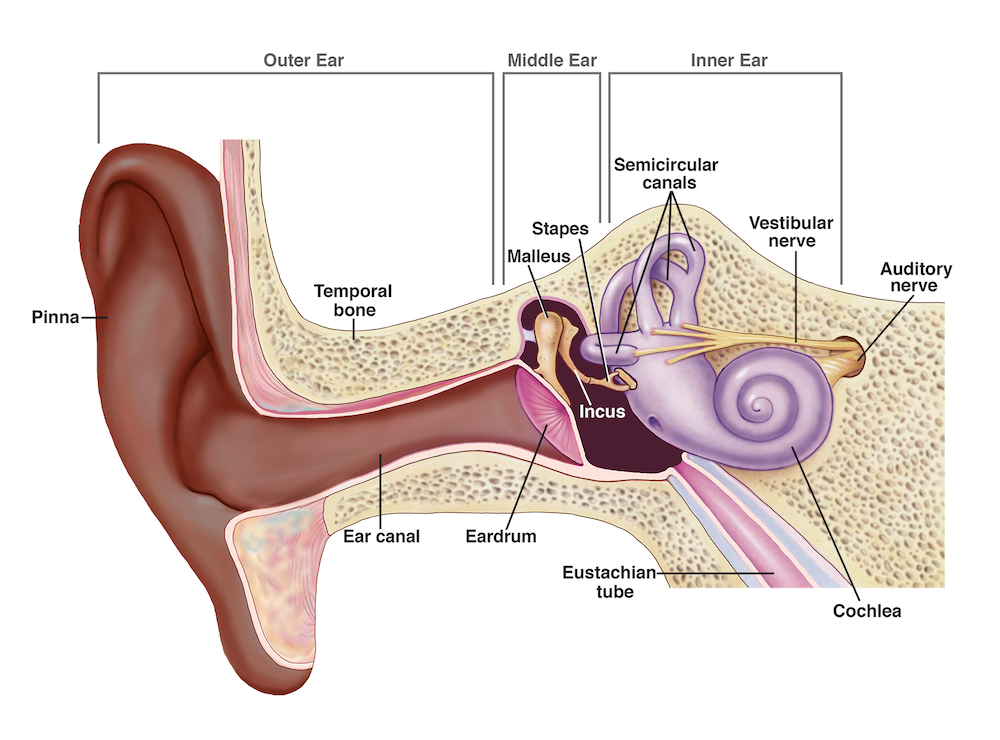
Illustration source: NIDCD — Medical Illustration: Parts of the Ear.
| Ear Region | Key Structures | Primary Function | Associated Hearing Loss |
|---|---|---|---|
| Outer Ear | Pinna, external auditory canal, tympanic membrane (eardrum) | Collects sound vibrations | Conductive (loses loudness only) |
| Middle Ear | Ossicles (malleus, incus, stapes), Eustachian tube, oval window, round window | Transmits mechanical vibrations — amplifies pressure ~25× via impedance matching | Conductive (loses loudness only) |
| Inner Ear | Cochlea (snail-shell-shaped), Organ of Corti (sensory hair cells) | Transduction — converts fluid waves into the chemical nerve impulses the brain reads as sound | Sensorineural (permanent damage to hair cells/nerves) |
Anatomy + Industrial Hygiene, Point by Point
1. Ototoxicants & Sensorineural Hearing Loss
Sensorineural hearing loss occurs strictly in the inner ear (cochlea/Organ of Corti), and involves damage to or loss of the sensory hair cells or the auditory nerve itself.
Ototoxicants are chemical agents — certain solvents, nitriles, metals, and pharmaceuticals among them — that damage these sensitive inner-ear structures. ACGIH assigns an "OTO" designation to chemicals that cause hearing impairment on their own or synergistically when combined with noise.
Because ototoxicants like toluene or lead enter the bloodstream and act directly on the hair cells of the cochlea, the resulting hearing loss is always sensorineural — never conductive. A worker exposed to both an ototoxic solvent and noise is at compounded risk of permanent damage, which is exactly why the OTO designation exists.
2. The Acoustic Reflex (Middle Ear Muscles)
The middle ear contains tiny muscles that automatically tighten the ossicles (malleus, incus, stapes) in response to loud sound.
When exposed to loud sound, these middle-ear muscles contract to tighten the ossicles momentarily, reducing the sound energy transmitted to the inner ear — a natural, involuntary protective mechanism.
The acoustic reflex can't be relied on for occupational hearing protection, for two reasons: the muscles only tighten momentarily and fatigue rapidly under continuous noise, and there's a reaction latency between the sound occurring and the muscle contracting — meaning zero protection against sudden impact or impulse noise, which reaches the inner ear before the reflex can trigger.
3. Audiometric Testing vs. Human Sensitivity vs. Speech Range
Human hearing is most sensitive overall around 4,000 Hz. Occupational noise-induced hearing loss (NIHL) is most prominent in the 3,000–6,000 Hz range.
To monitor early hearing damage, OSHA defines an STS as an average change in hearing threshold of 10 dB or more at 2,000, 3,000, and 4,000 Hz in either ear.
Human speech and hearing sensitivity is best around 500–3,000 Hz. For telephone-quality communication, the Speech Interference Level (SIL) measures the mean decibel level at 500, 1,000, and 2,000 Hz.
These three frequency ranges get mixed up easily because they overlap — but they measure different things. The frequencies monitored for an OSHA STS (2,000–4,000 Hz) are not the same as the broader speech/communication range (500–3,000 Hz); STS tracks where hearing damage shows up earliest, not where speech intelligibility lives.
4. Acoustic Trauma vs. Occupational NIHL
A sudden, acute event — such as an explosion or blast — that can physically rupture the tympanic membrane (eardrum) or dislocate the ossicles in the middle ear, resulting in conductive or mixed hearing loss.
A gradual, chronic condition from prolonged exposure to high noise levels, which fatigues and eventually destroys the sensory hair cells in the Organ of Corti, resulting in permanent sensorineural hearing loss.
The onset speed is the tell. A worker with immediate ear pain and hearing loss right after a high-pressure blast has acoustic trauma — an immediate mechanical injury that can involve the eardrum, middle ear, and in severe cases the cochlea itself — not routine occupational NIHL, which develops gradually over months or years of exposure.
5. Occupational NIHL vs. Presbycusis, Sociacusis & Nosoacusis
Hearing loss from aging alone. It is sensorineural, usually bilateral and symmetrical, and shows up in the high frequencies first. Because it accumulates in the same frequency region as noise damage, OSHA permits an optional age correction (29 CFR 1910.95, Appendix F) when deciding whether a threshold shift is work-related.
Hearing loss from non-occupational noise — firearms, concerts, power tools, motorcycles, personal audio players. The mechanism is identical to occupational NIHL (hair-cell destruction in the Organ of Corti); only the source is off the job. It is identified through the case-history questionnaire, not the audiogram.
Hearing loss from non-noise, non-age causes — ear disease and infection, ototoxic medication, head trauma, and genetic or congenital factors.
A worker's measured hearing loss is the sum of four parts: occupational NIHL + presbycusis + sociacusis + nosoacusis. The industrial hygienist's job is to account for the last three — through age correction and a thorough exposure and medical history — so that only the portion actually caused by workplace noise is attributed to the job.
6. Conductive Hearing Loss
Conductive hearing loss is limited to the outer and middle ear — it physically blocks sound waves from reaching the inner ear.
Because it only blocks physical vibrations rather than damaging any sensory structure, the symptom is a loss of loudness only — speech clarity is completely unaffected.
Conditions like excessive cerumen (earwax) buildup, a middle-ear infection (otitis media), or a ruptured eardrum all cause conductive hearing loss. The distinguishing symptom is loss of loudness with speech clarity preserved — which is what separates an outer/middle-ear issue from real sensorineural damage.
Ear Anatomy & IH — Frequently asked questions
What's the difference between conductive and sensorineural hearing loss?
Conductive hearing loss happens in the outer or middle ear, physically blocking sound from reaching the inner ear — it reduces loudness only, and speech clarity is preserved. Sensorineural hearing loss happens in the inner ear (cochlea/Organ of Corti), involving actual damage to hair cells or the auditory nerve, and is generally permanent.
Why do ototoxicants always cause sensorineural hearing loss, not conductive?
Ototoxicants — certain solvents, nitriles, metals, and pharmaceuticals — travel through the bloodstream and act directly on the sensory hair cells of the cochlea in the inner ear. Since they never physically obstruct the outer or middle ear, the resulting hearing loss is sensorineural, not conductive.
Why can't the acoustic reflex protect hearing from occupational noise?
The acoustic reflex has two limitations: the middle ear muscles that tighten in response to loud sound fatigue rapidly under continuous noise, and there is a reaction latency between the sound occurring and the muscles contracting — meaning it offers no protection against sudden impact or impulse noise, which reaches the inner ear before the reflex can trigger.
What's the difference between acoustic trauma and occupational NIHL?
Acoustic trauma is a sudden, acute event — such as an explosion or blast — that can rupture the eardrum or dislocate the middle ear bones (conductive or mixed hearing loss), and a sufficiently intense blast can also damage the cochlea directly, adding a sensorineural component. Occupational noise-induced hearing loss (NIHL) is a gradual, chronic condition from prolonged high noise exposure that destroys inner-ear hair cells over time, producing permanent sensorineural hearing loss.
How do you tell occupational hearing loss from age-related hearing loss?
A worker's measured hearing loss combines four sources: occupational NIHL, presbycusis (aging), sociacusis (non-occupational noise like firearms or concerts), and nosoacusis (disease, ototoxic drugs, trauma). Presbycusis and occupational NIHL both hit the high frequencies, so they're separated statistically — OSHA allows an optional age correction under 29 CFR 1910.95, Appendix F — while the exposure and medical history account for sociacusis and nosoacusis, leaving the portion attributable to workplace noise.