Noise Dosimeter Setup: OSHA HC, OSHA PEL & ACGIH TLV
As an IH, you'll actually use a dosimeter — this isn't just exam theory. The 3M/Quest Edge 5 is the one I use, and the first time I opened its setup software, seeing three separate meter configurations at once genuinely confused me. This page probably won't show up on the CIH exam directly, but it's exactly the kind of practical application knowledge you need before you ever clip a dosimeter onto a worker.
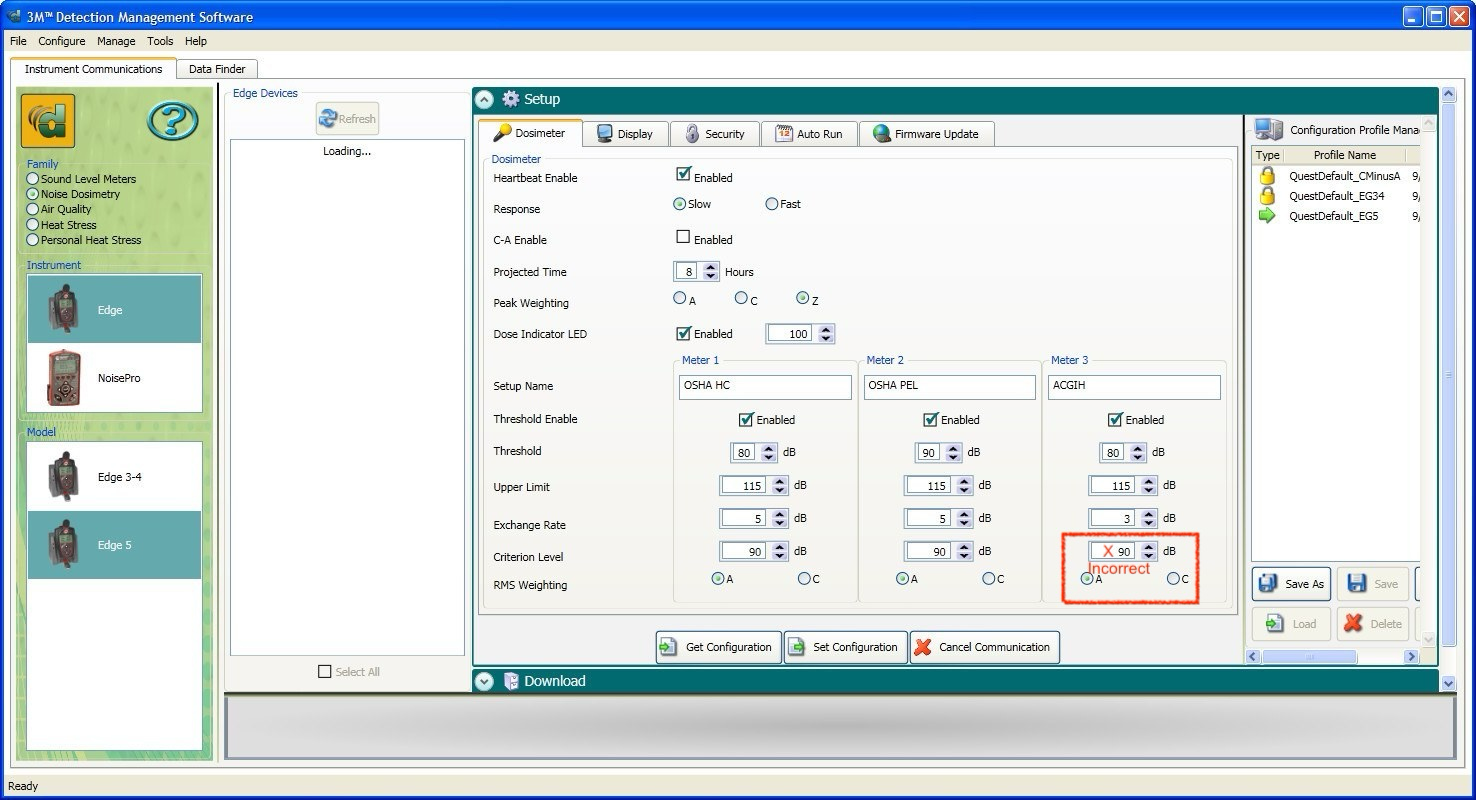
A dosimeter takes one physical noise measurement but can apply three different calculation rulesets to it at once — OSHA Hearing Conservation, OSHA PEL, and ACGIH TLV — because OSHA and ACGIH don't define occupational noise exposure the same way. Below is the standard correct configuration for each, a real 3M DMS setup screenshot, and a real configuration mistake sitting inside it: the ACGIH meter's Criterion Level was left at OSHA's 90 dBA instead of ACGIH's own 85 dBA.
Why Does the Software Have Three Meters?
The important thing to understand first: these are not three different physical microphones. They're three different sets of calculation rules applied to the same noise data the dosimeter collects.
One noise measurement → three different calculation rules → three different exposure results. This matters because OSHA and ACGIH genuinely disagree on the criteria — OSHA uses a 5 dB exchange rate, ACGIH uses 3 dB — and a 3M/Quest Edge 5 can calculate all three profiles simultaneously instead of requiring three separate dosimetry runs.
The Standard Configuration
| Parameter | OSHA HC | OSHA PEL | ACGIH TLV |
|---|---|---|---|
| Threshold | 80 dBA | 90 dBA | 80 dBA* |
| Exchange Rate | 5 dB | 5 dB | 3 dB |
| Criterion Level | 90 dBA | 90 dBA | 85 dBA |
| Criterion Duration | 8 hours | 8 hours | 8 hours |
| Upper Limit | 115 dBA | 115 dBA | 115 dBA |
| Frequency Weighting | A | A | A |
| Response | Slow | Slow | Slow |
*The ACGIH threshold shown in dosimeter software is an instrument measurement setting used to capture exposure data — it should not be confused with the ACGIH TLV itself. The actual ACGIH values to remember are 85 dBA over 8 hours with a 3 dB exchange rate.
What Each Setting Actually Means
Before anything else, here's what every row in that table is actually asking for — the basics every one of these settings assumes you already know:
| Threshold | The sound level below which the dosimeter ignores noise entirely for that meter's dose calculation. Anything quieter than this doesn't count toward the dose at all. |
| Exchange Rate | How much the allowable exposure time is cut in half for a given rise in sound level — 5 dB for OSHA, 3 dB for ACGIH. This is the setting that actually drives the different dose results between the two bodies. |
| Criterion Level | The continuous sound level that would produce exactly 100% dose over the criterion duration. This is the setting that was misconfigured on the ACGIH meter below. |
| Criterion Duration | The reference time period the criterion level is defined over — 8 hours in every configuration here, matching a standard shift. |
| Upper Limit | A separate safety-tracking setting that logs how much time sound spends at or above this level. It is not a threshold and has no effect on the dose calculation itself. |
| Frequency Weighting | Which frequency filter is applied to the raw sound signal before calculating dose. A-weighting (used by all three meters here) attenuates frequencies the human ear is less sensitive to, so the reading tracks perceived loudness rather than raw sound pressure. |
| Response | How quickly the meter's displayed reading reacts to changing sound levels. Slow response smooths out rapid fluctuations into a more stable reading — which is the setting OSHA's own noise tables assume you're using. |
A Real Setup — and a Real Mistake in It
Here's a real 3M Detection Management Software (DMS) setup screen for an Edge 5, configured with all three meters running at once. The one thing wrong with it is already circled in red.
⚠ The Error
Look at Meter 3 (ACGIH): Threshold 80 dBA and Exchange Rate 3 dB are both correct. But Criterion Level reads 90 dBA — that's OSHA's value, not ACGIH's. The correct ACGIH Criterion Level is 85 dBA. Left as-is, this setup would calculate ACGIH exposure using OSHA's criterion level while still applying ACGIH's 3 dB exchange rate — an inconsistent hybrid that doesn't match either standard, and would understate real ACGIH dose. This is an easy mistake to make: OSHA HC and OSHA PEL both use 90, so it's the value your hand defaults to unless you deliberately change it for the third meter.
Threshold vs. Criterion Level — the Recurring Confusion
Threshold
The sound level below which the dosimeter ignores noise entirely for that meter's dose calculation. OSHA PEL's 90 dBA threshold means a continuous 89 dBA exposure contributes nothing to that meter's dose. OSHA HC's 80 dBA threshold means that same 89 dBA exposure does count — which is exactly why the same worker gets different dose results from the HC and PEL meters on the same instrument, same shift.
Criterion Level
The continuous A-weighted sound level that would produce exactly 100% dose over the criterion duration (8 hours, in every configuration here). OSHA's criterion is 90 dBA; ACGIH's is 85 dBA. Threshold decides what gets counted; criterion level decides what counts as full exposure. They're answering two different questions, which is exactly how the ACGIH meter above ended up with a valid-looking number in the wrong field.
Exchange Rate: Why 5 dB vs. 3 dB Matters
The exchange rate defines how much allowable exposure time is cut for a given rise in sound level.
| OSHA (5 dB exchange) | Allowed Time | ACGIH (3 dB exchange) | Allowed Time |
|---|---|---|---|
| 90 dBA | 8 h | 85 dBA | 8 h |
| 95 dBA | 4 h | 88 dBA | 4 h |
| 100 dBA | 2 h | 91 dBA | 2 h |
| 105 dBA | 1 h | 94 dBA | 1 h |
| 110 dBA | 30 min | 97 dBA | 30 min |
| 115 dBA | 15 min | 100 dBA | 15 min |
ACGIH's 3 dB rate follows the equal-energy principle: roughly every 3 dB increase doubles actual sound energy, so allowable time is halved to match. OSHA's 5 dB rate is more lenient — it allows more exposure time at a given sound level than the equal-energy principle would predict, which is the whole reason OSHA and ACGIH produce different dose results from identical noise data.
See this play out on a real case: a full worked example runs the same multi-machine noise data through both OSHA and ACGIH side by side — it'll help make concrete why the two produce meaningfully different dose numbers.
Equation cards for this section: TWA at a 5 dB exchange rate › · TWA at a 3 dB exchange rate › · permissible time › · dose percentage ›.
Two Settings That Look Related but Aren't
Upper Limit (115 dBA)
This is a separate tracking setting that records how much time sound spends at or above 115 dBA — it is not a threshold and shouldn't be confused with one. It's set the same across all three meters here because it lines up with OSHA's exposure table, which reaches 115 dBA at its shortest listed duration (15 minutes).
Peak Weighting: Z
The general dosimeter settings show Peak Weighting set to Z — don't mistake this for the dose calculation using Z-weighting. Peak measurements are handled entirely separately from the normal A-weighted, Slow-response dose calculation that all three meters actually use.
OSHA = 90 / 5 · ACGIH = 85 / 3
OSHA HC threshold = 80 · OSHA PEL threshold = 90
This ties directly into the CIH Exam Journal
The Ch.7 Noise & Vibration entry covers Criterion Level, Exchange Rate, and the OSHA-vs-ACGIH pattern conceptually. This page is the field-application version — the same numbers, but on a real instrument I actually use.
Read the CIH Exam JournalWant the noise equations too? See CIH Exam Equations — Noise.
Noise Dosimeter Setup — Frequently asked questions
Why does a noise dosimeter have three separate meter configurations?
A dosimeter like the 3M/Quest Edge 5 takes one physical noise measurement but can apply multiple calculation rulesets to it at once, because OSHA and ACGIH define occupational noise exposure differently. Running OSHA HC, OSHA PEL, and ACGIH TLV as three separate meters lets you get all three exposure results from a single dosimetry study instead of running it three times.
What is the difference between Threshold and Criterion Level on a dosimeter?
Threshold is the sound level below which the dosimeter ignores noise entirely for that meter's dose calculation. Criterion Level is the continuous sound level that would produce exactly 100% dose over the criterion duration (typically 8 hours). They answer different questions: threshold decides what counts, criterion level decides what counts as full exposure.
What is the correct Criterion Level for ACGIH TLV noise dosimetry?
85 dBA for an 8-hour criterion duration. This is different from both OSHA configurations, which use 90 dBA. A common real-world configuration mistake is leaving the ACGIH meter's Criterion Level at OSHA's 90 dBA instead of changing it to ACGIH's 85 dBA — exactly the error visible in the screenshot above.
What is the difference between OSHA HC and OSHA PEL thresholds?
OSHA Hearing Conservation (HC) uses an 80 dBA threshold, while OSHA Permissible Exposure Limit (PEL) uses a 90 dBA threshold. Both share the same 90 dBA criterion level and 5 dB exchange rate — the only difference is which sound levels get counted toward the dose at all.
Why does OSHA use a 5 dB exchange rate while ACGIH uses 3 dB?
The exchange rate defines how much the allowable exposure time is cut for a given increase in sound level. ACGIH's 3 dB exchange rate follows the equal-energy principle — every 3 dB increase doubles the actual sound energy, so allowable time is halved. OSHA's 5 dB exchange rate is more lenient, allowing more exposure time at higher sound levels than the equal-energy principle would predict.