Free CRSP Practice Test: Sample Questions With Answers
Free CRSP practice questions with answers and explanations, plus what to expect from the exam’s question styles. Take a free practice test without an account, see the five CRSP scenario archetypes with an example question for each, and find more ways to practice for free.
A quick practice test to see the CRSP question style, and a timed mock exam rehearsal to feel exam-day pacing. Both show answers and explanations, and neither needs an account. The nine example questions on this page are SPEP practice questions, not real exam questions: three come from the free timed rehearsal and six are public samples from SPEP’s full practice bank. The full bank of 2,211 CRSP questions and the 20-question mini exams need a subscription.
Curious about the real thing? Read a real experience of CRSP exam day.
What CRSP questions look like
The CRSP is a judgment exam. Most questions put you in a workplace situation, often at management level, and ask what the safety professional should do. Usually two or three options sound reasonable, and you pick the best one for the role and the moment. That is very different from the CRST, where questions are short and technical.
The gap is easy to measure in SPEP’s own practice questions:
| In SPEP’s practice questions | CRSP (2,211) | CRST (1,844) |
|---|---|---|
| Typical question length | 75 words | 30 words |
| Asks for the BEST or MOST option | 53% | 12% |
| Mentions management, executives, a board or a budget | 49% | 8% |
Measured on SPEP’s own practice questions, not on real exam questions. Length is the median number of words in the question stem; the BEST/MOST count looks for those words in capitals.
For the format, see the CRSP exam blueprint: 190 to 210 multiple-choice questions in 4 hours, with 65 to 75% independent questions and 25 to 35% case-based questions. For the recurring scenario themes, see the CRSP scenario archetypes.
Two question formats: independent and case-based
- Independent questions (about 65 to 75%). A question that stands alone: a stem and four options, choose the best one.
- Case-based questions (about 25 to 35%). One workplace scenario followed by 3 to 5 questions about that same situation. Everything you need is in the case, so read the questions first, then read the scenario for the facts that matter.
The examples below are labelled with which is which.
The five CRSP scenario archetypes, with an example question for each
Judgment questions are not random. The same five scenario shapes keep coming back, and recognizing the shape quickly narrows the options. Here they are in 30 seconds, then an example question for each.
The five archetypes in 30 seconds
Name the archetype in the first ten seconds of the scenario, then look for the option that fits its pattern.
| Archetype | You recognize it when | The answer pattern |
|---|---|---|
| 1. Production-vs-Safety Conflict | A senior person asks you to relax a safety control for cost or schedule. | Stop, document, escalate, protect. |
| 2. Building from Low Maturity | There is no policy, no procedures and no committee, and the question asks what comes first. | Leadership commitment, baseline, legal compliance, build the system, improve. |
| 3. Beyond Compliance | A mature, certified program, and management asks what is next. | Lead, engage, integrate, transform. Not more audits, training or paperwork. |
| 4. Imminent-Danger Stop-Work | A life-threatening hazard exists right now, and the question asks for your first action. | Stop, remove, secure, notify, investigate. |
| 5. Plausibility Filter | All four options sound right. | Match domain, hierarchy, stakeholder, time and wording. The answer is in the stem. |
Read the full guide, with the wrong-answer traps for each: CRSP scenario archetypes.
Each example below is tagged with its archetype. Pick an answer first, then read two ways to see the same question: only from the options, and from the CRSP’s chair. Three examples come from the free timed rehearsal and six are public samples from SPEP’s practice bank. They are not real exam questions. Some cards also carry a “Learn the idea” fold-out with study notes, a flashcard and a similar question.
Polaris Cold Chain Logistics operates a 185,000 square-foot frozen food cold storage facility in Laval, Quebec, employing 142 workers across three shifts. The facility handles receiving, storage, and distribution of frozen goods for major grocery chains. Three weeks ago, the maintenance department began an accelerated infrastructure upgrade project to replace aging ammonia refrigeration lines and repair concrete flooring damaged by freeze-thaw cycles throughout the facility.
During the project, maintenance technicians have been using pneumatic chipping hammers to remove damaged concrete sections and angle grinders to cut and prepare metal supports. The work schedule has intensified due to pressure from operations management to complete repairs before the peak holiday distribution season begins in six weeks. Maintenance Supervisor Jean-Pierre Tremblay has authorized extended shifts, with some technicians working 10-hour days using vibrating tools.
Yesterday, two experienced technicians—Marc Dubois and Sylvie Gagnon—reported to the occupational health nurse with complaints of numbness and tingling in their fingers, particularly noticeable when working in the -18°C freezer environment. Marc mentioned his symptoms started approximately two weeks ago but worsened significantly this week. Initial vibration exposure assessments from the equipment manufacturer indicate the pneumatic chipping hammer produces 12 m/s² and the angle grinder produces 4.5 m/s². Technicians typically use the chipping hammer for 2.5 hours and the angle grinder for 3 hours during a standard 8-hour shift.
The facility's Joint Health and Safety Committee (JHSC) has raised concerns about the situation, but Operations Director Nathalie Bergeron is pushing back, citing contractual obligations and potential financial penalties if the refrigeration upgrades aren't completed on schedule. The company's existing hazard assessment documentation does not specifically address hand-arm vibration, though general PPE requirements for maintenance work are outlined. Quebec's RSST (Regulation respecting occupational health and safety) applies, and the facility operates under an ISO 45001-aligned safety management system implemented eighteen months ago.
As the newly hired Corporate Health and Safety Manager reporting to the VP of Operations, you have been asked to investigate the situation, determine appropriate controls, and recommend a path forward that addresses both worker safety and operational requirements.
A real case has 3 to 5 questions about the same scenario. This one has four; two are shown on this page, and all four are in the timed rehearsal.
Pattern: stop, document, escalate, protect.
As you develop a corrective action plan, Operations Director Nathalie Bergeron insists that project delays will result in significant financial penalties and threatens to escalate the issue to the VP of Operations. Which approach demonstrates appropriate leadership and problem-solving while maintaining your professional obligations?
Pick the best answer.
Why: Safety does not win by refusing, and it does not win by giving in. The best answer brings the JHSC, maintenance and operations together to change the schedule and rotation so exposure falls while the work continues. Stopping the project (D) fits an imminent-danger situation, not this one.
Two ways to read this question
Only looking at the options: A, B and C all sound professional: defer and document, quantify the cost, collaborate. D sounds brave.
From the CRSP’s chair: A senior person is pressing on cost and deadlines, which is Archetype 1: you are not a yes-person, and you are not the project owner either. The template is stop, document, escalate and protect. Here the hazard is real but it is not an immediate emergency, so the last two steps carry the answer: protect workers in the meantime and escalate with workable alternatives. C does that. B turns a legal and ethical duty into a cost-benefit argument.
Pattern: leadership commitment, baseline, legal compliance, build the system, improve.
Your organization recently acquired a manufacturing facility in another province that has no formal safety management system in place. The facility has acceptable injury rates but lacks documentation, procedures, and systematic hazard controls. Senior leadership wants production to continue uninterrupted while you develop an OSH management system. What is the MOST appropriate first step in planning the new system?
Pick the best answer.
Why: A gap analysis gives you the baseline every later step depends on, and it can run while production continues. Writing a full system before you know what exists (B), copying another site's system (C) and stopping at minimum legal compliance until injuries rise (D) each skip or shortcut that step.
Two ways to read this question
Only looking at the options: Assessing, writing procedures and adopting a proven system are all things a safety program does eventually.
From the CRSP’s chair: The site has no system, and the question asks what comes first. Archetype 2 says foundations come before tools: leadership is already on board, so the next step is a baseline. A gap analysis is that baseline. B writes procedures before you know what exists, C copies another site's system without checking local law and hazards, and D is reactive, waiting for injuries.
Learn the idea behind this question
The idea
Initial OSH Management System Review
A baseline assessment of the organization's existing OSH management system and relevant arrangements conducted when no system exists, when the organization is newly established, or as appropriate, to establish the foundation for system development.
Going deeper
When an organization has no formal OSH management system — a newly acquired site, a start-up, or an operation running on informal practice — the recognized first step in every major framework (ISO 45001, CSA Z1000, ILO-OSH 2001) is the initial review, or baseline gap analysis. You compare what the facility actually does against two yardsticks: the applicable legal requirements of that jurisdiction and the elements of the recognized system model you intend to adopt. That diagnostic gives you the evidence base to set priorities, objectives and realistic timelines, and it prevents two classic errors — writing shelf-ware procedures disconnected from operational reality, and lifting a parent-company system into a province with different regulations, hazards and culture. Remember also that acceptable injury rates are a lagging indicator and never substitute for a baseline evaluation of controls and compliance obligations.
Try a similar question
A construction contractor with 60 employees has operated for eight years with no documented safety program beyond a one-page policy statement. The owner has committed to implementing CSA Z1000 and asks the newly hired OHS advisor where to begin. Which action best reflects the intent of the standard's requirements for an organization with no existing system?
Why: An initial (baseline) review is the required starting point when no management system exists. It documents existing informal arrangements, identifies applicable legal requirements and hazards, and measures current practice against the standard's elements so that objectives and priorities can be set on evidence. Option A imposes generic documentation with no link to actual operations or jurisdiction. Option C delays the planning foundation and relies on a single narrow data source. Option D sets a lagging-indicator target without knowing the current state or what controls are missing.
Flashcard
Why this is here. SPEP is built on reverse learning: practice first, then study only what you missed. We are bringing the same idea into the mini exam, so when your answers show that an idea is unfamiliar, you will see extra questions and flashcards on it, like the ones in this fold-out.
Pattern: lead, engage, integrate, transform. Not more of the same.
Your organization has recently certified to ISO 45001 and after six months of implementation, front-line supervisors are expressing frustration that the system creates excessive paperwork without meaningful safety improvements. Workers report that hazard reports submitted through the new system receive slow responses, and participation in safety committees has declined. Senior leadership remains committed to the certification but is concerned about the disconnect between the management system and operational reality. As the CRSP leading the OH&S management system, what should be your PRIMARY focus to address this situation?
Pick the best answer.
Why: The system exists and is certified, so the problem is that it is not producing results for workers. Streamlining hazard reporting so reports lead to fast, visible action fixes that. More training (A), more audits (B) and more documents (D) add to a system people already find heavy.
Two ways to read this question
Only looking at the options: More training, more audits and better documents all look like what a certified system should do.
From the CRSP’s chair: This matches the trap list in Archetype 3, which is doing more of the same: training is Do, audits are Check, and polishing documents has little effect. The system is only six months old, so it is not yet a mature program, but the lesson is the same. What is missing is worker engagement, so you make participation produce action.
Pattern: stop, remove, secure, notify, investigate.
While conducting a compliance audit at a manufacturing facility, you observe workers entering a confined space where atmospheric testing indicates oxygen levels at 17.2%. The entry permit has been signed, and the site supervisor tells you the work is urgent to meet a production deadline. The workers are wearing air-purifying respirators and have been briefed on the hazards. As the external auditor, what is your MOST appropriate immediate action?
Pick the best answer.
Why: Oxygen below 19.5% is an oxygen-deficient atmosphere and counts as IDLH, and air-purifying respirators do not supply oxygen. Life is at immediate risk, so the work stops now. Documenting it (B), changing respirators while people stay inside (C) or asking senior management first (D) all come after the danger is controlled.
Two ways to read this question
Only looking at the options: Documenting the finding, upgrading the respirators and informing senior management are all things you would do in some form.
From the CRSP’s chair: The air is oxygen-deficient and workers are in it right now. A time-pressure word plus a life-safety hazard is Archetype 4, and the answer always starts with STOP. Remove, secure, notify and investigate come afterwards. Documentation, a respirator change and a call to management are all later steps.
Pattern: match domain, hierarchy, stakeholder, time and wording.
While conducting quarterly performance reviews, your executive leadership expresses frustration that monthly management safety reports contain extensive hazard data but provide little guidance on what actions are needed. The CEO specifically notes that she cannot distinguish between routine concerns and issues requiring immediate board-level attention. As the senior safety advisor, you recognize this reflects a gap in your risk reporting framework. What is the MOST critical enhancement needed to address this leadership concern?
Pick the best answer.
Why: The CEO's problem is that every concern looks alike. Risk-tolerance thresholds with escalation triggers separate the strategic risks that need executive action from routine operational ones. A bigger risk register (A), better charts (B) and more frequent, more detailed reports (C) give executives more to read, not a clearer signal.
Two ways to read this question
Only looking at the options: A fuller risk register, better charts, more frequent reports and clear thresholds all sound like improvements to reporting.
From the CRSP’s chair: You are the senior safety advisor and the reader is the CEO, so the stakeholder match is a report built for decisions at that level. The CEO named the gap herself: she cannot tell what needs board-level attention. Only D answers that. A, B and C all add information, but none adds a rule for what to escalate.
Learn the idea behind this question
The idea
Risk Monitoring and Reporting
Risk Monitoring and Reporting: The essential process of continuously tracking risks and opportunities with frequency adjusted according to criticality, establishing monitoring structures and forums for appropriate escalation and response implementation.
Try a similar question
A confined-space entry program at a wastewater treatment plant has produced two near-misses involving hydrogen sulphide exceedances in the past month. As the HSE manager, which ongoing monitoring and reporting arrangement best reflects sound risk monitoring principles?
Why: Option B matches monitoring frequency to criticality (continuous during entry), sets defined trigger thresholds with an immediate escalation path to decision-makers, and provides a regular forum for trend-level oversight; the other options rely on delayed review or passive reporting.
Flashcard
Why this is here. SPEP is built on reverse learning: practice first, then study only what you missed. We are bringing the same idea into the mini exam, so when your answers show that an idea is unfamiliar, you will see extra questions and flashcards on it, like the ones in this fold-out.
Pattern: match domain, hierarchy, stakeholder, time and wording.
Your organization's board of directors has asked you to review their governance practices related to occupational health and safety oversight. During your assessment, you discover that three board members sit on the audit committee that reviews safety performance, but two of these members are also owners of contracting firms that provide maintenance services to your facilities. One board member has been absent from the last four quarterly safety reviews due to other business commitments. The board chair asks for your recommendation on how to address these governance concerns in a way that strengthens safety oversight while maintaining operational continuity.
Pick the best answer.
Why: The accepted governance remedy for a conflict of interest is to declare it, step back from the decision and give the duty enough time, with the whole board sharing responsibility for oversight. Restructuring the board (B) and forced divestment (D) are out of proportion, and A comes close but skips formal declaration and shared responsibility.
Two ways to read this question
Only looking at the options: Recusal, restructuring, divestment and declaration all sound like fixes for a conflict of interest.
From the CRSP’s chair: The audience is a board, and your role is advisor, not owner. The stakeholder match says to recommend what fits your standing. A safety professional can advise declaration, recusal and shared accountability. Removing directors or forcing divestment is not your call.
Learn the idea behind this question
The idea
Management Committee (Board) Governance and Principles
Management Committee (Board): A body of people given powers and responsibilities by organizational members to manage organizational affairs. Members are individually committed to upholding organizational values and objectives, giving adequate time and energy to trustee duties, and acting with integrity while avoiding or declaring personal conflicts of interest. Members make decisions collectively, hold joint responsibility for committee actions, and must demonstrate the Nolan Principles: selflessness, integrity, objectivity, accountability, openness, honesty, and leadership.
Going deeper
Governance frameworks for management committees and boards do not require you to eliminate every potential conflict; they require that conflicts be openly declared, that the conflicted member step back from the affected decision, and that every member devote adequate time and energy to their duties. That is the Nolan Principles in action — openness and integrity through declaration, objectivity through recusal, accountability through attendance and collective responsibility for the board's decisions. On the exam, be suspicious of options that escalate to forced divestment, removal of directors, or wholesale restructuring; those are disproportionate remedies that a safety professional has no standing to impose and that ignore the accepted governance remedy. Also note the collective-responsibility point: the whole board owns OHS oversight, so you cannot simply delegate the problem to a subcommittee or external advisor.
Try a similar question
A not-for-profit's management committee is deciding which vendor will supply fall-protection equipment for its facilities. One committee member's spouse is a senior sales manager for one of the three bidding vendors. Applying accepted governance principles, what is the most appropriate course of action?
Why: Governance principles require members to declare actual or perceived conflicts and recuse themselves from the affected decision; resignation, ignoring indirect interests, or outsourcing the decision are disproportionate or improper responses.
Why this is here. SPEP is built on reverse learning: practice first, then study only what you missed. We are bringing the same idea into the mini exam, so when your answers show that an idea is unfamiliar, you will see extra questions and flashcards on it, like the ones in this fold-out.
Pattern: match domain, hierarchy, stakeholder, time and wording.
Show the case for this question
Polaris Cold Chain Logistics operates a 185,000 square-foot frozen food cold storage facility in Laval, Quebec, employing 142 workers across three shifts. The facility handles receiving, storage, and distribution of frozen goods for major grocery chains. Three weeks ago, the maintenance department began an accelerated infrastructure upgrade project to replace aging ammonia refrigeration lines and repair concrete flooring damaged by freeze-thaw cycles throughout the facility.
During the project, maintenance technicians have been using pneumatic chipping hammers to remove damaged concrete sections and angle grinders to cut and prepare metal supports. The work schedule has intensified due to pressure from operations management to complete repairs before the peak holiday distribution season begins in six weeks. Maintenance Supervisor Jean-Pierre Tremblay has authorized extended shifts, with some technicians working 10-hour days using vibrating tools.
Yesterday, two experienced technicians—Marc Dubois and Sylvie Gagnon—reported to the occupational health nurse with complaints of numbness and tingling in their fingers, particularly noticeable when working in the -18°C freezer environment. Marc mentioned his symptoms started approximately two weeks ago but worsened significantly this week. Initial vibration exposure assessments from the equipment manufacturer indicate the pneumatic chipping hammer produces 12 m/s² and the angle grinder produces 4.5 m/s². Technicians typically use the chipping hammer for 2.5 hours and the angle grinder for 3 hours during a standard 8-hour shift.
The facility's Joint Health and Safety Committee (JHSC) has raised concerns about the situation, but Operations Director Nathalie Bergeron is pushing back, citing contractual obligations and potential financial penalties if the refrigeration upgrades aren't completed on schedule. The company's existing hazard assessment documentation does not specifically address hand-arm vibration, though general PPE requirements for maintenance work are outlined. Quebec's RSST (Regulation respecting occupational health and safety) applies, and the facility operates under an ISO 45001-aligned safety management system implemented eighteen months ago.
As the newly hired Corporate Health and Safety Manager reporting to the VP of Operations, you have been asked to investigate the situation, determine appropriate controls, and recommend a path forward that addresses both worker safety and operational requirements.
Given the vibration exposure data provided (chipping hammer 12 m/s² for 2.5 hours; angle grinder 4.5 m/s² for 3 hours), which immediate control measure would MOST effectively reduce Marc and Sylvie's daily hand-arm vibration exposure while the broader corrective action plan is developed?
Pick the best answer.
Why: The hierarchy of controls shows up inside cases. Substituting the pneumatic hammer removes exposure at the source, so it beats job rotation (administrative) and anti-vibration gloves (PPE).
Two ways to read this question
Only looking at the options: Gloves, rotation, a lower-vibration tool and suspending all vibrating work all sound like sensible controls.
From the CRSP’s chair: The wording is MOST effective and immediate, which points to the highest level of the hierarchy that is feasible now. Substitution beats rotation and gloves. Suspending all vibrating tools is out of proportion to the problem.
Pattern: match domain, hierarchy, stakeholder, time and wording.
Your organization recently experienced a series of incidents involving improper lockout/tagout procedures despite workers completing annual LOTO training. Incident investigations reveal that workers can correctly describe the six-step LOTO process and identify energy sources on written tests, but fail to apply proper sequencing during actual equipment shutdown. Senior leadership is questioning the value of continuing the current training program and has asked you to propose modifications that will reduce these application failures. What should be your PRIMARY recommendation to improve training effectiveness?
Pick the best answer.
Why: Workers who pass the written test but fail on the floor show training that stopped at remembering and understanding. The fix is hands-on practice with demonstrated competence before certification. More sessions (A), harder written tests (B) and better handouts (D) keep the training at the same level.
Two ways to read this question
Only looking at the options: More frequent training, harder tests, better materials and hands-on practice all sound like ways to improve training.
From the CRSP’s chair: Read the clue in the stem: workers describe the steps on paper but fail in practice. That points to how the training was designed, not how often it runs, how it is tested or how it is illustrated. The question asks for the PRIMARY recommendation, so fix the cause, not the symptoms.
Learn the idea behind this question
The idea
Training Effectiveness Through Progressive Learning Complexity
Goal: Ensure training imparts necessary knowledge and enhances learners' ability to apply, analyze, evaluate, and create based on learned material. Requires progression from lower-level (remember, understand) to higher-level (apply, analyze, evaluate, create) cognitive objectives.
Going deeper
When learners score high on written recall tests but fail to perform correctly on the floor, the training design stopped at Bloom's lower cognitive levels — remember and understand — and never built the apply, analyze, and evaluate capability that drives behaviour. Effective training objectives must be written at the cognitive level the job actually demands: if the worker must isolate energy, verify zero energy state, and judge when a procedure doesn't fit the equipment, the training must include hands-on application and scenario analysis, not just content delivery. On the exam, watch for scenarios contrasting strong knowledge scores with weak field performance — the root cause is almost always a design-level failure in cognitive progression, not assessment tools, timing, or reinforcement aids. Those other factors (job aids, performance-based testing) are downstream fixes that treat symptoms rather than the flawed objective hierarchy.
Try a similar question
A confined space entry training program consists of a four-hour lecture followed by a 40-question multiple-choice exam with an 80% pass mark. Six months later, an audit finds entrants correctly describe atmospheric hazards during interviews but routinely fail to sequence pre-entry gas testing properly and cannot adapt the permit process to an unusual vessel configuration. What is the most fundamental deficiency in the program?
Why: Workers can recall facts but cannot perform the sequence or adapt to novel conditions, which signals objectives that never advanced beyond remember/understand into apply and analyze.
Flashcard
Why this is here. SPEP is built on reverse learning: practice first, then study only what you missed. We are bringing the same idea into the mini exam, so when your answers show that an idea is unfamiliar, you will see extra questions and flashcards on it, like the ones in this fold-out.
Numbers questions
Some questions do not test a scenario shape at all. They test whether you pick the right formula and baseline. The timed rehearsal includes two of them.
A distribution center recorded a total of 36 lost workdays due to occupational injuries over the past year. Employees worked a combined total of 720,000 hours during that period. Using the standard 200,000-hour baseline, what is the facility's Severity Rate?
Pick the best answer.
Why: Severity rate = lost days × 200,000 ÷ hours worked = 36 × 200,000 ÷ 720,000 = 10.0. Option D is the lost-day count with no formula, and A is what you get from a 100,000-hour baseline.
Two ways to read this question
Only looking at the options: Four numbers, and nothing in the options tells you which one is right.
From the CRSP’s chair: Number questions test whether you pick the right formula and the right baseline. The severity rate uses 200,000 hours. A wrong baseline or no formula at all gives the other options.
And more. Legal-position questions, for example whether the Canadian Charter applies to a private employer, test what a rule covers and what it does not. Process questions, for example a supervisor who suspects impairment, test who you involve first and who you leave out. Both reward knowing your role and the proper channel.
What the exam screen looks like
On exam day you answer at a computer, one question at a time, on a split screen:
- The scenario on the left. For a case-based question, the case stays in view while you answer its 3 to 5 questions.
- The question and four options on the right. You pick the best one. For an independent question the left side is empty and only the right side has the question. Do not panic: that is how the exam software is designed, not a fault on your side.
- A question grid across the top and a running timer. The timer starts when you start the exam, not when you check in.
- Prev, Skip, Flag and Next controls. Flag a question to come back to it. Before you submit, a review page lists every question as answered, not answered or flagged.
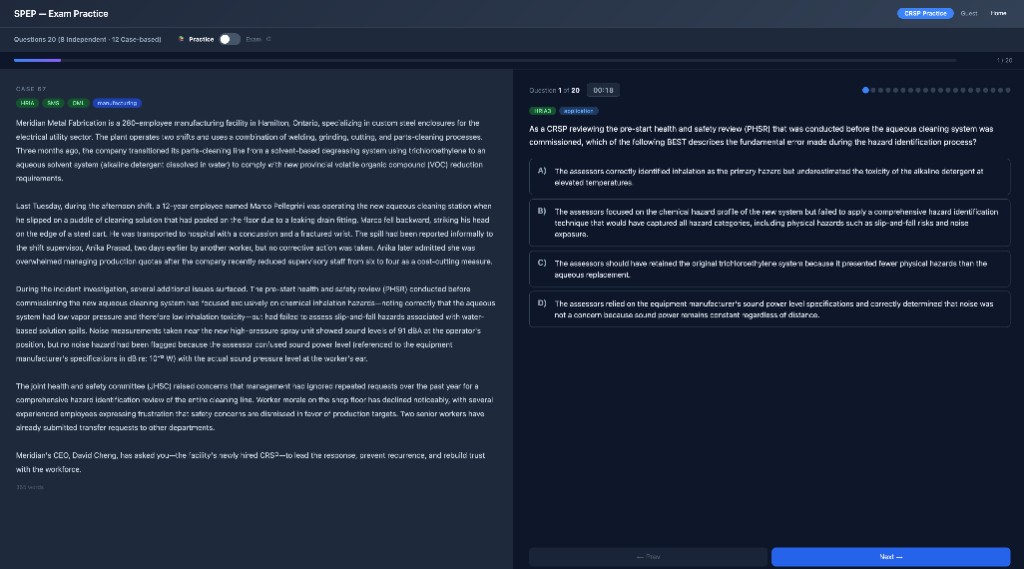
SPEP’s practice screen is built to mirror this layout, so it feels familiar before exam day. A CRSP case is shown. For the full walk-through, read a real experience of CRSP exam day: the test center, the software and the review-and-submit flow.
Now try it yourself: take the quick practice test, or feel the clock with the timed rehearsal.
More ways to prepare for free
- CRSP exam blueprint: the six domains, weights and format.
- CRSP scenario archetypes: the five recurring situations and how to answer them.
- Exam-day strategy and what exam day is like.
- 4-week study plan and the first-try guide with a 6-month plan.
- CRSP glossary and the numeric threshold patterns.
When the free questions run out
The full bank has 2,211 CRSP questions. A subscription gives you 20-question mini exams made from questions you have not seen yet, and timed mock exams. The free practice test and rehearsal are a fair way to see whether the style suits you before you decide. See the CRSP practice options.
CRSP practice questions — Frequently asked questions
Is there a free CRSP practice test?
Yes. Without signing in you can take a short free practice test (about 7 questions, a case plus single questions) and a timed mock exam rehearsal (14 questions, paced like exam day). Both show answers and explanations. The full question bank and the 20-question mini exams need a subscription.
Are these real CRSP exam questions?
No. They are practice questions written by SPEP. BCRSP does not publish real exam questions, so no practice test can show you the real ones. The practice questions are written in the same style so you can learn the patterns.
How many questions are on the CRSP exam?
The CRSP has 190 to 210 multiple-choice questions, written in 4 hours on a computer at a Pearson VUE test centre. See the CRSP exam blueprint for the full format table.
What do CRSP questions look like?
Most are scenarios. You are usually asked to decide what the safety professional should do, and several options sound reasonable. In SPEP's practice questions the typical CRSP question is about 75 words long, compared with about 30 words for the CRST.
What is the difference between independent and case-based questions?
Independent questions stand alone with four options, and make up about 65 to 75% of the exam. Case-based questions give one workplace scenario followed by 3 to 5 questions about it, and make up about 25 to 35%.
How should I use a free practice test?
Answer each question before you read the explanation, then read why the wrong options are wrong. Wrong options on the CRSP are often reasonable actions at the wrong time or from the wrong role, so the explanations teach the pattern.
What does the CRSP exam screen look like?
A split screen: the case scenario on the left and its questions on the right, with a question grid and a running timer at the top and Prev, Skip, Flag and Next controls. For an independent question the left side is empty and only the right side has the question, which is how the exam software is designed. Flagged questions appear on a review page before you submit.
Is the CRSP harder than the CRST?
They test different things. The CRSP leans on judgment in management-level scenarios, the CRST on technical knowledge and specific numbers. The CRSP vs CRST comparison (spepsafety.com/crsp-vs-crst) covers eligibility and format.
How much does the CRSP cost, and when is the exam?
See the exam cost page and the exam dates page.
Ready to try it? Start the free practice test · Take the timed mock exam rehearsal
Published by SPEP, not by BCRSP. The example questions are SPEP practice questions, from its free sets and as public samples from its practice bank, and are not real exam questions. Confirm requirements on the BCRSP website before you apply.